MENU


Code automation AI agents represent one of the fastest-growing segments in the agentic economy, yet turning these autonomous systems into revenue streams remains a significant challenge. Many card processors price online card acceptance as a percentage plus a fixed fee ($0.20 to $0.30), making sub-dollar requests for code generation, document processing, or API calls economically unattractive because fixed fees consume a large share of revenue. Companies seeking to monetize their code automation agents need purpose-built payment infrastructure that handles real-time metering, autonomous transactions, and micropayment economics without eroding margins. This shift demands new approaches to billing, pricing, and settlement that legacy systems simply cannot provide.
The agentic economy is expanding rapidly, with the AI agent market projected to reach $52.62 billion by 2030 according to MarketsandMarkets. Code automation agents are at the forefront of this growth, handling tasks ranging from code generation and bug fixing to documentation and API integrations. However, the fundamental economics of traditional payment systems create a significant barrier to profitability.
Consider a code generation agent that charges $0.50 per request. With a standard online card processing fee structure of 2.9% plus $0.30, each transaction costs approximately $0.31 in fees alone. Fees consume roughly 63% of revenue on a $0.50 charge, which can easily push margins negative once inference and operating costs are included. This problem compounds exponentially when agents process thousands of micro-requests daily.
Card processors and gateways were optimized around consumer commerce flows, where fixed fees are acceptable at typical basket sizes; fixed fees become punitive at micropayment levels. The gap between "I built an AI agent" and "I'm making money from my AI agent" is payment infrastructure.
Code automation agents deliver value in ways that defy traditional billing structures. A single agent might generate code snippets, complete entire functions, or automate complex refactoring tasks. Each action type delivers different value to the user, demanding flexible monetization approaches.
Three distinct pricing models enable AI agent monetization:
Most traditional billing platforms support only usage-based models. This limitation forces developers to shoehorn outcome-based value into inadequate billing structures, leaving significant revenue on the table.
Dynamic pricing engines enable cost-plus-margin automation where platforms define exact margin percentages. When underlying LLM costs fluctuate, pricing automatically adjusts to maintain profitability. This approach prevents the margin erosion that occurs when model providers change pricing without corresponding adjustments on the agent side.
The dynamic pricing capabilities in modern agent payment platforms allow developers to configure pricing rules that respond to real-time cost data, ensuring consistent profitability regardless of upstream changes.
Trust remains a fundamental barrier to AI agent adoption. In a SumUp survey of 1,500 UK consumers, only 29% said they would trust AI to make small, automated payments on their behalf, and enterprise procurement teams demand auditable proof that billed amounts match actual usage.
Tamper-proof metering addresses this challenge by cryptographically signing every usage record at creation and pushing it to an append-only log. The exact pricing rule stamps onto each agent's usage credit, allowing developers, users, auditors, or agents to verify that usage totals match billed amounts per line-item.
This zero-trust reconciliation model provides:
Without tamper-proof metering, AI agent billing becomes a trust exercise that many enterprises refuse to accept.
Multi-agent systems represent the next frontier of code automation. A development workflow might involve a research agent identifying code patterns, an implementation agent writing functions, and a review agent checking for bugs. Each agent in the chain may come from different providers and require payment.
Traditional payment systems require human approval for each inter-agent transaction, creating bottlenecks that destroy the efficiency gains agents promise. Some browser-wallet based demos may prompt per-payment approvals, but x402-style flows can be implemented with embedded wallets, session keys, or policy engines to avoid per-request popups.
ERC-4337 smart accounts can be combined with session-key permissioning to reduce per-transaction user approvals. Users authorize payment policies once, specifying spending limits, time windows, and authorized recipients. Agents then interact freely within those boundaries without requiring human intervention.
The agent-to-agent monetization pattern enables:
Integration speed directly impacts time-to-revenue. Commonly cited timelines for billing system implementations are on the order of 6 to 12+ weeks depending on complexity, integrations, and data, requiring extensive configuration, testing, and custom development.
Purpose-built agent payment infrastructure dramatically compresses this timeline. Nevermined gets you from zero to a working payment integration in 5 minutes, with SDKs for both TypeScript and Python.
The implementation process follows three straightforward steps:
Valory cut deployment time of their payments and billing infrastructure for the Olas AI agent marketplace from 6 weeks to 6 hours using Nevermined, clawing back $1000s in engineering costs. This 98% reduction in deployment time represents the difference between capturing market opportunity and losing it to faster competitors.
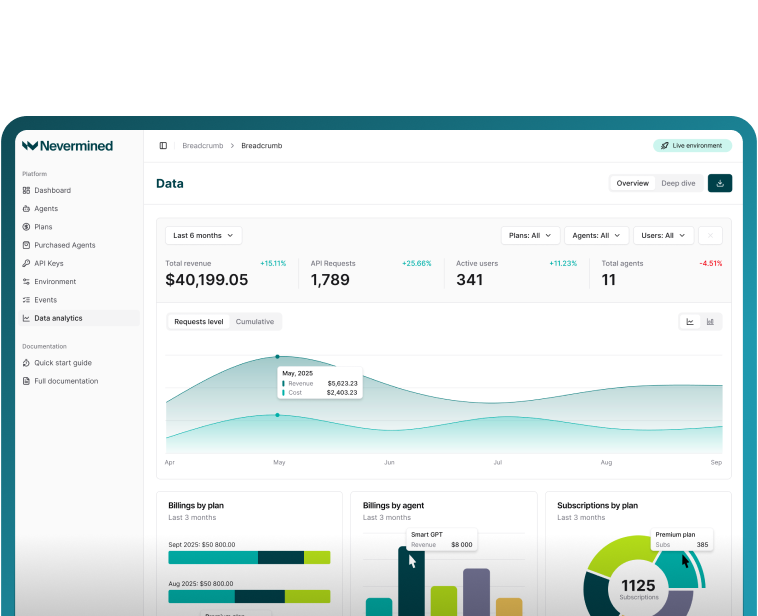
Visibility into agent economics determines long-term sustainability. Without real-time insights into cost per transaction, revenue per user, and margin trends, developers operate blind.
Effective observability dashboards provide:
The observability capabilities in modern agent platforms deliver this visibility through dashboards that show burn rate, margin analysis, and customer-level usage patterns. Finance teams receive trackable recurring billing instead of complex sub-cent charge reconciliation.
The AI agent ecosystem is standardizing rapidly around emerging protocols. Protocol-agnostic architecture ensures compatibility as these standards evolve, avoiding the vendor lock-in that plagues proprietary systems.
Four protocols define the current landscape:
Platforms supporting multiple protocols provide insurance against ecosystem shifts. When a new standard emerges or an existing one gains dominance, protocol-first infrastructure adapts without requiring migration or re-implementation.
Code automation agents operating across multiple environments need persistent, verifiable identities. The ERC-8004 standard proposes an on-chain identity, reputation, and validation registry for trustless agents, using ERC-721-based identities and optional references to endpoints such as DIDs. Originally created as a Draft EIP in August 2025, ERC-8004 has since gained significant ecosystem traction and mainnet deployment, creating portable identities that work across environments, swarms, and marketplaces without re-wiring.
This identity layer enables:
Auto-discovery via Google's A2A protocol enables instant agent connection, reducing the friction of establishing new agent relationships.
Credits operate as prepaid consumption-based units redeemed directly against usage. This model solves multiple problems simultaneously, aligning price to value while providing predictability for both providers and consumers.
The credits approach delivers:
The payment models available through modern agent platforms support credits alongside subscriptions and pay-per-use options, providing flexibility to match pricing strategy to market demands.
Enterprise AI platforms require bank-grade metering and compliance. Regulatory requirements, procurement policies, and audit demands create barriers that poorly documented agent systems cannot clear.
On-chain verification and settlement through smart contracts provide the compliance foundation enterprises demand:
GDPR compliance, SOC 2 certification, and audit-ready traceability are built into platforms designed for enterprise deployment, eliminating the compliance risk that accompanies custom-built billing systems.
Nevermined delivers the complete infrastructure required to monetize code automation agents profitably. Nevermined Pay provides bank-grade enterprise-ready metering, compliance, and settlement so every model call turns into auditable revenue. The platform features ledger-grade metering, a dynamic pricing engine, credits-based settlement, 5x faster book closing, and margin recovery capabilities that traditional billing systems cannot match.
The platform supports native integration with x402, Google's A2A protocol, Model Context Protocol, and Agent Payments Protocol, ensuring compatibility regardless of which standards gain dominance. With a 5-minute setup using TypeScript or Python SDKs, developers can transition from development to monetization without the weeks of integration work that alternative platforms require.
Real-world validation comes from partners like Valory, Naptha AI, and Mother who have deployed Nevermined to power their agent marketplaces and payment infrastructure. As Naptha AI Co-Founder Richard Blythman noted: "Whenever I need to understand AI agent monetization, I turn to the Nevermined team. They're world class and leading the agentic payments space."
For developers building code automation agents, Nevermined eliminates the billing infrastructure gap that stands between functional agents and profitable businesses.
Any transaction averaging below roughly $1 faces severe margin pressure from card processing fees that include a fixed per-transaction component, and sub-dollar transactions are especially vulnerable. With fees of 2.9% plus $0.30 per transaction, fees consume approximately 63% of revenue on a $0.50 charge, which can easily push margins negative once inference and operating costs are included. Below roughly $10, fixed fees can still be meaningful depending on gross margin and cost-to-serve. Purpose-built agent payment infrastructure eliminates minimum transaction fees, making micropayments viable through credit-based systems or blockchain settlement.
Tamper-proof metering creates cryptographically signed records that serve as irrefutable evidence in disputes. When disagreements arise, both parties can independently verify usage against the append-only log. Smart contracts can also automate dispute resolution by holding funds in escrow until predefined outcome criteria are met, releasing payment only when conditions are satisfied.
Modern agent payment platforms support configurable policies for credit exhaustion scenarios. Options include automatic pause with notification, graceful degradation to reduced functionality, auto-recharge from linked payment methods, or queuing requests until credits are replenished. Session keys can include spending limits and expiration windows that prevent runaway costs while maintaining service continuity.
Yes, sophisticated platforms support hybrid pricing strategies. An agent might charge a base subscription for access, usage fees for compute-intensive operations, and outcome bonuses for successfully completed tasks. This flexibility allows developers to capture value at multiple points in the customer journey while providing pricing options that appeal to different user segments.
Agent payment platforms support both fiat and cryptocurrency settlement across multiple currencies. Users can pay in their preferred currency while agents receive settlement in their chosen denomination. On-chain stablecoin transfer and settlement can be fast, but real-world end-to-end speed depends on compliance checks, liquidity, and off-ramping to local rails. Settlement via protocols such as x402 enables cross-border payments without traditional banking delays or correspondent bank fees.
See Nevermined
in Action
Real-time payments, flexible pricing, and outcome-based monetization—all in one platform.