MENU


Data analysis revealing why prepaid credit systems are becoming a fast-growing monetization model for AI services, agentic systems, and autonomous commerce
The shift from traditional software billing to credit-based pricing is changing how AI services capture value. Credit-based AI pricing grew 126% year-over-year in 2025, reflecting a move away from rigid per-seat licensing toward flexible consumption units tied to real usage.
AI agents intensify this shift. They trigger API calls, consume tokens, complete tasks, initiate workflows, and transact with other agents at machine speed. Nevermined's Credits system addresses this directly, giving AI builders a prepaid unit for metering micro-actions while supporting cost-based, usage-based, and outcome-based billing with automated settlement.
Kyle Poyar's analysis found that credit-based pricing grew 126% year-over-year in 2025. That growth reflects the mismatch between traditional per-seat pricing and the high-frequency, usage-sensitive economics of AI services.
Grand View Research estimates the global AI agents market at $7.63 billion in 2025. This creates a growing need for billing infrastructure that can meter autonomous agent interactions.
The same report projects the market will reach $182.97 billion by 2033 at a 49.6% CAGR. This growth requires billing systems that can support high-volume usage, dynamic pricing, and automated settlement.
Menlo Ventures reports that companies spent $37 billion on generative AI in 2025, up from $11.5 billion in 2024. As spending grows, AI builders need clearer ways to connect model usage with revenue.
CloudZero projected average monthly AI spend would rise to $85,521 in 2025, up 36% from $62,964 in 2024. Nevermined Pay supports this environment with bank-grade enterprise-ready metering, compliance, and settlement, so every model call can become auditable revenue.
CloudZero also reported that the share of organizations planning to invest over $100,000 per month in AI tools was set to rise from 20% in 2024 to 45% in 2025. This spending profile makes real-time metering and cost attribution essential.
Stanford HAI's AI Index found that 78% of organizations reported using AI in 2024, up from 55% in 2023. Broader adoption means more teams need pricing models that fit usage patterns rather than static access rights.
Capgemini reports that 82% of surveyed organizations intend to integrate AI agents within one to three years. Credit-based billing gives providers a practical way to charge for agent actions, completed tasks, and recurring access.
Stanford HAI reports that inference costs for a system performing at the GPT-3.5 level fell by more than 280-fold between November 2022 and October 2024. Lower inference costs make granular billing more practical because individual actions can be priced economically.
Stanford HAI also reports 30% annual declines in AI hardware costs. As cost bases change, AI providers need pricing systems that can adjust without rebuilding billing logic.
The same report found 40% annual improvements in energy efficiency. Better efficiency expands the margin opportunity for AI services when billing infrastructure can capture value at the request level.
Valory cut deployment time for the payments and billing infrastructure behind the Olas AI agent marketplace from 6 weeks to 6 hours using Nevermined, clawing back $1000s in engineering costs.
Zylo reported that 66.5% of IT leaders experienced unexpected SaaS charges due to consumption-based or AI pricing models. Credit systems reduce this risk by giving buyers prepaid limits, usage visibility, and clearer burn-rate controls.
As AI vendors move toward consumption-based and hybrid pricing, buyers need transparent usage records. Nevermined's observability dashboard helps teams track usage, performance, and costs across AI services.
Infosys reports that only 16% of U.S. consumers trust and use AI to make payments. This trust gap highlights the need for auditable payment flows, permission controls, and verifiable transaction records.
Infosys also found that 29% of U.K. consumers would trust AI to make small automated payments on their behalf. Regional differences make protocol-agnostic infrastructure valuable for global AI services.
AI services increasingly combine subscriptions, usage-based charges, and credits. Nevermined's payment models support credits, subscriptions, and time-based access in unified billing flows.
Usage-based pricing lets AI providers charge for measurable activity, such as API calls, token consumption, agent requests, or workflow execution. Nevermined's credit charging patterns are designed for this type of granular monetization.
Outcome-based pricing allows providers to charge when an AI system completes a task or delivers a defined result. This is especially relevant for agents who research, negotiate, book, summarize, classify, or complete workflows.
Value-based pricing can connect price to the business value generated by an AI service. Nevermined supports usage-based, outcome-based, and value-based pricing models, allowing builders to choose the monetization approach that fits their service.
AI costs can move quickly as models, infrastructure, and workloads change. Nevermined's dynamic pricing helps providers adapt pricing rules as cost structures and usage patterns evolve.
McKinsey projects global agentic commerce could reach $3 trillion to $5 trillion by 2030. Agent-to-agent payments need infrastructure that can authorize, meter, and settle transactions without stopping workflows for manual checkout.
McKinsey also estimates the U.S. B2C retail market could see up to $1 trillion in orchestrated revenue from agentic commerce by 2030. This creates a large opportunity for billing systems built for autonomous transactions.
Menlo Ventures reports that 76% of enterprise AI solutions are purchased rather than built in-house. Ready-to-integrate payment infrastructure helps AI providers monetize faster while reducing custom billing work.
Tropic's analysis found more than 1,800 pricing changes among the top 500 SaaS and AI companies in 2025. Flexible credit systems make it easier to adjust pricing without disrupting customer access.
The same analysis found an average of 3.6 pricing changes per company. This level of experimentation favors a billing infrastructure that can evolve with packaging and pricing strategy.
Prepaid credits let users define how much an agent can spend before it acts. This helps AI services support autonomous workflows while keeping buyers in control of budgets and permissions.
Nevermined's agent-to-agent capabilities support transactions between AI agents through payment plans, access control, and automated settlement. Its Google A2A integration shows how agents can discover services, validate access, and transact across compatible ecosystems.
Nevermined's x402 facilitator supports HTTP-native payment flows where access and payment can be coordinated at the request level. This is useful for agents that need to pay for tools, APIs, data, or services during execution.
AI services often involve model providers, tool providers, data providers, orchestration layers, and agent developers. Credit-based settlement can help allocate revenue across participants when value is created by multiple components.
MIT NANDA's GenAI Divide research found that only about 5% of integrated AI pilots extract millions in value, while the majority show no measurable P&L impact. Auditable billing data helps teams understand which AI services generate usage, revenue, and ROI.
BCG reports that 60% of companies are seeing minimal revenue and cost gains from AI despite substantial investment. Better metering can help organizations connect AI activity to business outcomes.
BCG also reports that AI future-built companies achieve 5x the revenue increases and 3x the cost reductions of other companies. Pricing and metering discipline are part of turning AI usage into measurable value.
Federal Reserve Bank of San Francisco researchers found that the share of AI pricing jobs among all pricing jobs increased more than tenfold from 2010 to 2024. This reflects the growing complexity of pricing software, data, and AI-enabled services.
Grand View Research reports that North America held 39.63% of the AI agents market revenue in 2025. Regional leadership increases demand for enterprise-grade billing, audit, and settlement infrastructure.
The AI agent ecosystem is evolving across multiple standards, including MCP, Google's A2A, x402, and AP2. Nevermined supports multiple protocols so AI builders can monetize services regardless of which standards dominate.
As AI usage scales, billing systems need verifiable records. Nevermined Pay provides ledger-grade metering, a dynamic pricing engine, credits-based settlement, 5x faster book closing, and margin recovery.
AI services may need to serve crypto-native developers, enterprise finance teams, and global marketplaces. Nevermined supports automated settlement through cryptocurrency or fiat-compatible flows, helping builders serve different customer types.
Billing is not just about collecting payment. AI providers also need to decide who can access a service, how much they can consume, and which agents are allowed to act. Nevermined's request validation helps enforce these rules.
Nevermined gets users from zero to a working payment integration in 5 minutes, with SDKs for both TypeScript and Python. This gives AI builders a faster path to monetizing agents, APIs, and services.
Organizations deploying credit-based billing for AI services should prioritize infrastructure that supports autonomous usage, transparent pricing, and reliable settlement:
Nevermined brings these capabilities together for AI builders that need to monetize agents, APIs, tools, and autonomous services. Its credits system supports granular usage metering, while its payment infrastructure enables access control, dynamic pricing, observability, and automated settlement.
Credits are prepaid units that customers redeem against AI service usage. They can represent API calls, token consumption, requests, time-based access, completed tasks, or other billable actions. For AI builders, credits create a flexible way to charge for usage without relying only on seats or flat subscriptions.
AI agents can trigger many small actions across tools, models, APIs, and services. Credits make those actions easier to meter and monetize because each interaction can draw from a prepaid balance. This helps providers charge for real usage while giving buyers clearer budget controls.
Nevermined provides payment infrastructure for AI agents and services. It supports credits, access control, metering, dynamic pricing, observability, and automated settlement. Builders can use Nevermined to charge for usage-based, outcome-based, and value-based models across agent workflows.
Yes. Credit-based billing can support agent-to-agent payments by giving agents permissioned spending limits and access rights. Nevermined supports agent-to-agent commerce through protocol-compatible infrastructure, including integrations for x402, Google's A2A protocol, MCP, and AP2.
Nevermined provides a 5-minute setup path with TypeScript and Python SDK support. Teams can use the documentation to register services, create payment plans, validate requests, and track usage through observability tools.
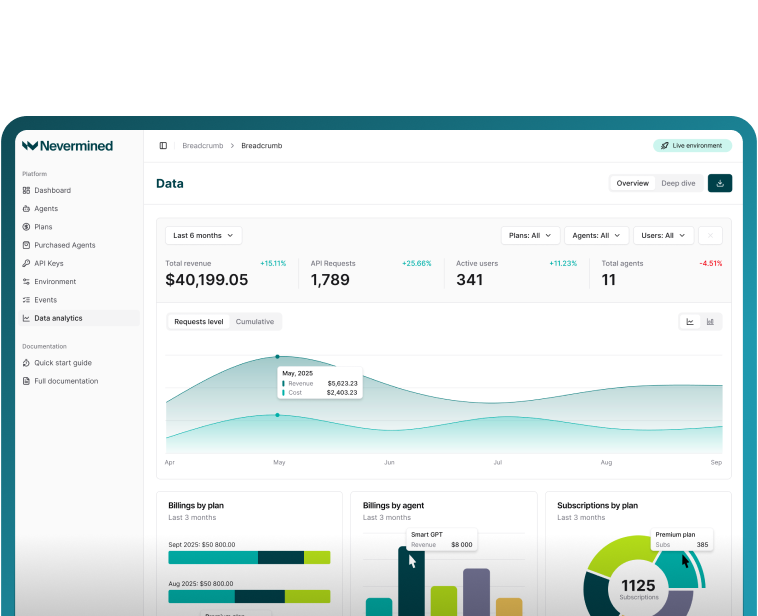
See Nevermined
in Action
Real-time payments, flexible pricing, and outcome-based monetization—all in one platform.