MENU


Data-driven analysis of market growth, transaction volumes, and infrastructure trends shaping how AI agents transact autonomously
The agentic economy demands payment infrastructure that traditional processors were never designed to handle. With 17,000+ AI agents already operating on Web3 platforms and handling 4.5 million daily active wallets, the shift toward decentralized AI payments is accelerating faster than most industry forecasts predicted. Nevermined Pay addresses this transformation by providing real-time metering, flexible pricing models, and instant settlement for every agent interaction, whether settled in fiat or cryptocurrency.
The agentic AI market represents one of the fastest-growing technology segments globally. This nearly 40x growth projection reflects the massive enterprise investment flowing into autonomous agent capabilities across every industry vertical. Payment infrastructure must scale accordingly to capture this value creation.
MarketsandMarkets projects the AI agents sector will expand at a 46.3% CAGR through 2030. This growth creates unprecedented demand for payment systems that can handle micro-transactions, outcome-based billing, and multi-agent coordination. Traditional seat-based pricing models simply cannot capture value from agents completing thousands of sub-cent tasks.
North American adoption leads global markets, with the US agentic AI sector representing nearly half of worldwide activity. This concentration reflects both enterprise readiness and regulatory clarity that encourages experimentation with autonomous agent deployments. The payment infrastructure supporting these agents must meet US compliance standards while enabling global settlement.
The scale of AI agent deployment has reached critical mass. These agents execute trades, manage portfolios, coordinate supply chains, and interact with customers across industries. Each wallet interaction represents a potential billable event that requires metering, pricing, and settlement infrastructure designed for machine-speed operations.
Nearly one-fifth of blockchain-based transactions now involve autonomous agents rather than human users. This percentage will only increase as agents become more capable and enterprises deploy them at scale. Payment systems must accommodate agent-to-agent transactions that happen without any human in the loop.
The blockchain market will expand more than 50x from its 2024 valuation. This growth reflects enterprise confidence in distributed ledger technology for mission-critical applications including supply chain management, financial services, and autonomous agent coordination. Payment infrastructure built on blockchain primitives inherits these security and auditability properties.
Current market revenue demonstrates blockchain has moved beyond experimentation into production deployments. The compound annual growth rate exceeds nearly every other enterprise technology category, signaling sustained investment and adoption momentum through 2034 and beyond.
Public blockchain deployments slightly outpace private and consortium chains, indicating enterprise comfort with transparent, permissionless infrastructure. This balance suggests hybrid approaches will dominate, where public chains provide settlement finality while private systems handle sensitive operational data.
Banking, financial services, and insurance organizations represent the largest blockchain adopters. Their adoption validates blockchain-based payment infrastructure for regulated industries with strict compliance requirements. AI payment systems serving enterprise customers must meet these same standards.
Native cryptocurrency use cases still dominate blockchain activity, providing the transaction volume that sustains network security and development. This foundation enables emerging applications like AI agent payments to leverage existing infrastructure rather than building from scratch.
Network capacity has increased 100x in five years, matching Nasdaq-level throughput. This processing speed enables AI agents to settle micro-transactions in real-time without batching delays that plague traditional payment systems. High throughput is essential when thousands of agents execute millions of sub-cent transactions daily.
Stablecoin transaction activity demonstrates massive real-world adoption for value transfer. This volume rivals established payment networks while offering programmability that enables automated agent payments, smart contract escrow, and instant cross-border settlement.
The stablecoin market has reached sufficient depth to support enterprise-scale AI payment operations. Adequate liquidity ensures agents can execute transactions without slippage or settlement delays, critical for time-sensitive operations like trading, bidding, or service provisioning.
McKinsey analysis citing Artemis and WEF data confirms annual stablecoin volume has reached levels demanding serious consideration from enterprise finance teams. This scale provides the network effects and liquidity pools necessary for AI agent payment systems to operate efficiently.
Valory cut deployment time of their payments and billing infrastructure for the Olas AI agent marketplace from 6 weeks to 6 hours using Nevermined, clawing back $1000s in engineering costs. This case demonstrates how purpose-built infrastructure eliminates the integration burden that slows AI product launches when teams attempt to adapt traditional payment systems.
Combining AI capabilities with blockchain infrastructure delivers measurable productivity gains for decentralized applications. This synergy extends to payment systems where AI optimizes transaction routing, fraud detection, and pricing while blockchain provides settlement finality and auditability.
Approximately 6.8% of the global population already holds cryptocurrency, creating a substantial addressable market for AI services accepting crypto payments. Small businesses can tap this audience without the friction of traditional payment onboarding.
Active Web3 users represent a highly engaged audience comfortable with new payment paradigms. These users expect the AI agents they interact with to accept cryptocurrency, creating market pressure for decentralized payment adoption.
User growth projections suggest cryptocurrency will transition from niche to mainstream within five years. Small businesses building AI agents today should architect payment systems capable of serving this expanding market.
The developer ecosystem supporting decentralized applications continues expanding rapidly. This growth creates the tools, libraries, and infrastructure components that reduce integration complexity for small teams building AI payment capabilities.
A thriving creator community ensures continuous innovation in payment infrastructure, user experience, and integration patterns. Small businesses benefit from shared learnings and open-source components developed by this community. Nevermined's documentation provides integration guides specifically designed for small teams deploying their first AI agents.
India's developer contribution highlights the global distribution of Web3 talent. Small businesses can access this talent pool for integration work, while also targeting Indian users as a growing cryptocurrency market.
McKinsey's Global Payments Map reveals the massive scale of payment infrastructure. Capturing even a small fraction of AI-driven transactions represents enormous opportunity for purpose-built payment systems.
Strong payment industry returns, with some players earning over 100%, demonstrate the economic value of payment infrastructure. AI-native payment systems can capture similar margins by serving an underserved market segment.
Despite massive growth, stablecoins still represent a small fraction of total payment volume. This headroom indicates substantial growth potential as AI agent payments shift from traditional rails to crypto-native infrastructure.
AI-focused dealmaking has nearly doubled from 5% in 2024, indicating accelerating investor interest in AI payment infrastructure. This capital inflow funds innovation across the competitive landscape.
The acquisition rate for AI payment companies exceeds typical fintech patterns, suggesting larger players are buying rather than building capabilities. This consolidation validates the strategic importance of AI-native payment infrastructure.
AI investment concentration within Web3 demonstrates capital markets recognize the synergy between autonomous agents and decentralized infrastructure. This funding supports continued innovation in payment systems designed for agent-to-agent transactions.
First-half fundraising shows sustained investor appetite for Web3 infrastructure companies. Payment systems represent a significant portion of this investment as essential infrastructure for the broader ecosystem.
Investment growth projections indicate accelerating capital deployment into AI-Web3 intersection companies. Payment infrastructure providers are well-positioned to capture this investment momentum.
Direct AI agent funding growth demonstrates sustained confidence in autonomous systems. Each funded agent company represents a potential customer for AI-native payment infrastructure.
Compliance concerns dominate enterprise AI discussions, extending to payment infrastructure that must meet regulatory standards. Nevermined Pay delivers bank-grade, enterprise-ready metering, compliance, and settlement so every model call turns into auditable revenue, featuring ledger-grade metering, a dynamic pricing engine, credits-based settlement, 5x faster book closing, and margin recovery.
Cloud deployment patterns indicate most AI agents operate in cloud environments requiring payment infrastructure that integrates with cloud-native architectures. API-first payment systems align with these deployment models.
The project composition shift demonstrates AI integration becoming standard rather than exceptional in Web3 development. Payment systems serving this market must natively support both AI and blockchain requirements.
Nearly half of financial applications incorporate Web3 components, validating decentralized infrastructure for regulated financial use cases. This adoption supports enterprise confidence in blockchain-based AI payment systems.
Consumer comfort with AI-assisted commerce is growing rapidly. As consumers authorize AI agents to transact on their behalf, payment infrastructure must support these delegated transactions with appropriate controls and auditability.
Gartner's projection via Galaxy Research represents the total addressable market for AI agent infrastructure including payments. Even capturing a small fraction of this value represents enormous opportunity for payment infrastructure providers.
McKinsey's commerce projection specifically addresses consumer-facing AI agent transactions. This estimate provides a concrete market size for AI payment infrastructure serving business-to-consumer use cases.
Stablecoin supply growth will provide the liquidity necessary for enterprise-scale AI payment operations. This expansion ensures adequate settlement capacity for millions of agents executing billions of daily transactions.
The Blockchain AI market will grow nearly 5.5x over eight years, indicating sustained demand for infrastructure combining these technologies. Payment systems operating at this intersection are positioned for proportional growth.
Regional concentration in North America reflects enterprise adoption patterns and regulatory clarity. Payment infrastructure providers should prioritize US market requirements while building global settlement capabilities.
India's projected contribution highlights emerging market opportunity for decentralized AI payments. Infrastructure supporting cross-border settlement and local currency conversion will capture this growth.
Organizations deploying decentralized AI payment infrastructure should prioritize:
Contact Nevermined to discuss implementation requirements for your specific use case.
The agentic economy describes an emerging economic system where autonomous AI agents transact with each other and with humans without continuous human oversight. Nevermined supports this economy through Nevermined Pay, which provides real-time metering, flexible pricing models, and instant settlement in both fiat and cryptocurrency. The platform enables agent-to-agent payments, supports emerging protocols like Google's A2A, and functions as a neutral third-party billing authority between AI vendors and buyers.
Flex Credits operate as prepaid consumption-based units that users redeem directly against agent usage. They solve critical problems by aligning price to value through charging for micro-actions, enabling flexible scaling where credits can be reallocated across users or departments without renegotiating licenses, and providing predictable spend where users prepay, monitor burn rate in real-time, and avoid surprise overruns. This model addresses enterprise reluctance toward minimum commitments that stall adoption.
Yes, Nevermined specifically targets solo developers and solopreneurs with plug-and-play API libraries and composable payment flows that work with any agent. The low-code SDK available in TypeScript and Python enables basic implementation in under 20 minutes. Small businesses can access detailed integration guides designed for teams deploying their first AI agents without dedicated payment engineering resources.
Decentralized AI payment systems employ cryptographic integrity through immutable agent IDs that cannot be spoofed or duplicated, unique signatures for end-to-end authenticity, and tamper-proof event logs mapping to security operations and audit trails. Nevermined's approach ensures every usage record is signed and pushed to an append-only log at creation, allowing any developer, user, auditor, or agent to verify that usage totals match billed amounts per line-item.
See Nevermined
in Action
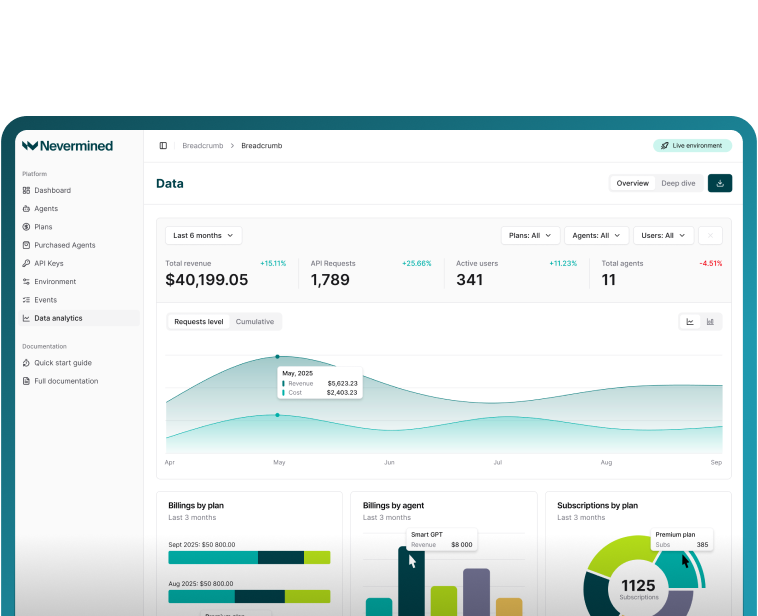
Real-time payments, flexible pricing, and outcome-based monetization—all in one platform.