MENU


As AI agents evolve from simple assistants to autonomous economic actors, they require payment infrastructure that matches their speed and scale. Traditional payment systems built for human checkout flows are economically inefficient for the high-frequency, sub-cent transactions that agents generate when accessing APIs, purchasing data, or hiring other agents for specialized tasks. Companies building in this space can accelerate their go-to-market by leveraging agent-to-agent monetization infrastructure that handles billing, metering, and settlement without requiring custom engineering builds.
AI agents generate transaction patterns that fundamentally differ from human-driven commerce. When an agent queries an API, accesses gated content, or delegates a task to another agent, it may need to pay fractions of a cent hundreds or thousands of times per minute. Traditional payment rails designed for human checkout flows are economically inefficient for this velocity.
The core problem lies in economics. Mainstream payment processors commonly impose fixed per-transaction fees that make micropayments unprofitable. A $0.30 authorization fee destroys the business model for API calls priced at fractions of a cent each. Beyond cost, today's payment systems generally assume a human is directly clicking "buy", creating friction that defeats the purpose of autonomous agents.
Key limitations include:
The x402 protocol has seen rapidly growing adoption, with transaction counts across all integrated projects exceeding tens of millions, demonstrating real and accelerating demand for agent-native payment infrastructure. This represents a fundamental shift where AI agents become economic participants capable of earning, spending, and managing resources autonomously.
For agents to transact without human bottlenecks, they need programmable payment capabilities that operate within predefined boundaries. This is where smart accounts with delegated permissions become essential.
ERC-4337 smart accounts provide programmable validation, batching, and paymasters that enable agents to make payments autonomously. Unlike traditional wallets requiring manual signature for each transaction, smart accounts support session-key permissions such as expiry windows and spend constraints, though these are implementation-specific rather than natively standardized by ERC-4337 itself.
This architecture allows:
The user authorizes payment policies once, then agents interact freely within those boundaries. This contrasts sharply with standard implementations requiring wallet pop-ups for each request. For enterprise deployments, dynamic pricing configurations let platforms define exact margin percentages that lock onto usage credits automatically.
Three notable protocol efforts have emerged to address different segments of the agent payment market. Understanding their design philosophies helps teams select the right approach for their use case.
The x402 protocol embeds payment into HTTP itself. When an agent requests a paid resource, the server responds with a 402 Payment Required status code containing pricing details. The agent signs a payment, includes it in the retry request, and after the payment is confirmed, the server returns the requested resource. This stateless, HTTP-native flow integrates naturally into existing API architectures.
The Agent Payments Protocol (AP2) is a Google-led open protocol effort, developed with more than 60 organizations, that uses mandates and verifiable credentials to support secure, compliant agent-led payments. AP2 establishes a payment-agnostic framework for users, merchants, and payments providers to transact with confidence across all types of payment methods.
The Agentic Commerce Protocol (ACP) is an open standard documented by OpenAI that enables buyers, their AI agents, and businesses to complete purchases. Delegated payment tokens, such as Shared Payment Tokens, scope agent authorization to specific merchants and transaction types with configurable amount limits and expiration windows.
Platforms supporting multiple protocols protect against the risk that any single standard dominates. Native support for Google's A2A protocol, Model Context Protocol (MCP), x402, and AP2 ensures compatibility regardless of which standards gain traction. This protocol-first architecture avoids vendor lock-in that plagues proprietary systems.
When agents make autonomous financial decisions, every stakeholder needs confidence that billing matches actual usage. This requires metering infrastructure designed for verification, not just recording.
As an architectural best practice, every usage record should be cryptographically signed and pushed to an append-only log at creation, making it immutable. The exact pricing rule stamps onto each agent's usage credit, allowing developers, users, auditors, or agents to verify that usage totals match billed amounts per line-item.
This zero-trust reconciliation approach addresses a fundamental concern: can we trust AI agents to manage tasks autonomously without reliable audit trails? The answer requires infrastructure that makes manipulation mathematically impossible, not just institutionally difficult.
For enterprises with compliance requirements, audit-ready traceability becomes non-negotiable. Platforms providing observability alongside billing enable real-time visibility into agent performance, user behavior, revenue analytics, and cost structures. Export capabilities via API and CSV allow independent verification by internal audit teams or external auditors.
Traditional SaaS pricing models assume human usage patterns with monthly subscriptions and seat-based licensing. Agent interactions demand more granular approaches that align price with actual value delivered.
Most payment infrastructure supports only usage-based pricing, charging per token, per API call, or per minute of compute. While necessary, this model misses opportunities to capture value when agents deliver specific outcomes.
Three pricing models address different scenarios:
The ability to implement credit-based settlement that supports all three models provides flexibility as business requirements evolve.
Dynamic pricing engines enable cost-plus-margin automation where platforms define exact margin percentages locked onto usage credits. When underlying costs change, whether from LLM API price adjustments or infrastructure scaling, margins preserve automatically without manual repricing.
Agents need persistent identities that travel across environments, accumulate reputation, and control access to resources. This goes beyond API keys to cryptographic proof of identity and capabilities.
ERC-8004 is currently a Draft ERC that specifies ERC-721-based registries for identity, reputation, and validation. Each agent is uniquely identified by an agentRegistry and agentId, while DIDs and wallet addresses may be advertised as optional endpoints in the agent's registration file.
This identity layer enables:
A2A supports agent discovery via Agent Cards, including standardized well-known endpoints. When agents can verify each other's identities cryptographically, they can establish payment relationships without centralized intermediaries. This peer-to-peer model scales better than hub-and-spoke architectures requiring every agent to integrate with every payment provider.
Coordinating authorization, metering, and settlement across fiat, crypto, credits, and smart accounts requires infrastructure that abstracts complexity from developers.
A payment facilitator provides a unified interface regardless of underlying payment rail. Whether settling in stablecoins via x402 or processing card payments through fiat rails, the developer experience remains consistent. This abstraction layer handles:
For onchain transaction patterns specifically, smart contracts can execute verification and settlement with atomic guarantees. The "pay plus execute" pattern ensures payment and service delivery happen together or not at all within a single blockchain transaction. Escrow with conditional release protects both parties in high-value transactions, while revenue splits distribute payments across multiple stakeholders automatically.
Prepaid credit systems provide predictable costs and simplified reconciliation compared to pay-per-transaction models that generate thousands of individual charges.
Credits operate as consumption-based units redeemed directly against usage. Users prepay credits, monitor burn rate in real-time, and avoid surprise overruns. Finance teams receive trackable recurring billing instead of complex sub-cent charge reconciliation.
Benefits of credit-based systems include:
Technical capabilities supporting credit systems include multi-chain deployment on Polygon, Gnosis Chain, and Ethereum. Gasless transactions via paymaster sponsorship eliminate friction for agents without native token balances. Batching enables atomic operations where multiple credit redemptions settle in a single transaction.
For teams building AI agents that need to transact autonomously, Nevermined offers purpose-built infrastructure that addresses the unique challenges of agent-to-agent payments.
Nevermined delivers bank-grade, enterprise-ready metering, compliance, and settlement so every model call turns into auditable revenue. The platform provides ledger-grade metering, a dynamic pricing engine, credits-based settlement, 5x faster book closing, and margin recovery capabilities that traditional billing systems cannot match.
The practical impact shows in deployment timelines. Valory cut deployment time of their payments and billing infrastructure for the Olas AI agent marketplace from 6 weeks to 6 hours using Nevermined, clawing back $1000s in engineering costs. Nevermined gets you from zero to a working payment integration in 5 minutes, with SDKs for both TypeScript and Python.
Protocol-first architecture supporting x402, Google's A2A, MCP, and AP2 ensures compatibility as standards evolve. Combined with tamper-proof metering through append-only logs and flexible pricing models supporting usage-based, outcome-based, and value-based billing, Nevermined provides the foundation for monetizing agent interactions at any scale.
The primary challenges include transaction economics, authorization latency, and identity verification. Mainstream payment processors commonly impose fixed per-transaction fees (for example, $0.30 authorization fees), making sub-cent micropayments economically unattractive for high-frequency agent interactions. Today's payment systems generally assume a human is directly clicking "buy", adding unacceptable delays, and standard KYC processes assume human account holders rather than software agents. Purpose-built infrastructure addresses these challenges through Layer 2 settlement, smart account delegation, and cryptographic identity systems.
The x402 protocol embeds payment directly into HTTP using the 402 Payment Required status code. When an agent requests a paid resource, the server responds with pricing details in headers rather than requiring a separate checkout flow. The agent includes a signed payment in its retry request and, after the payment is confirmed, the server returns the requested resource. This stateless approach integrates naturally into existing API architectures without requiring agents to navigate multi-step payment flows designed for human users.
Smart accounts with session keys provide scoped, time-bounded permissions that limit exposure from compromised credentials, though these permissions are implementation-specific rather than natively standardized by ERC-4337. Users authorize spending policies once, defining maximum amounts, approved merchants, and expiration windows. Agents operate freely within these boundaries but cannot exceed their authorized scope. On-chain settlement provides immutable transaction records, while cryptographic signatures ensure only authorized agents can initiate payments from their accounts.
Yes, through protocol interoperability. Agents supporting x402 can transact with any x402-compatible service regardless of which framework built them. Google's A2A protocol enables capability discovery using Agent Cards and standardized well-known endpoints, where agents find and connect to each other based on capabilities rather than predetermined integrations. ERC-8004, currently a Draft ERC, provides an ERC-721-based identity registry with optional service endpoints for DIDs and wallet addresses, enabling cross-environment agent identification as the standard matures.
Outcome-based pricing charges for results rather than resource consumption. Instead of billing per API call or per token, the agent pays when it achieves a defined outcome like a booked meeting, qualified lead, or successful task completion. This aligns incentives between service providers and consumers while enabling premium pricing for high-value results. Implementation requires metering infrastructure capable of tracking outcome events and conditional settlement logic that releases payment only when success criteria are verified.
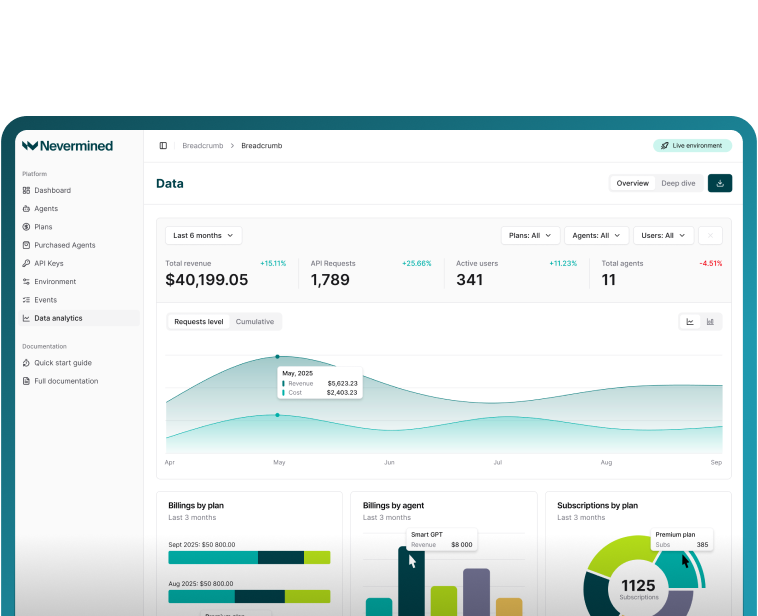
See Nevermined
in Action
Real-time payments, flexible pricing, and outcome-based monetization—all in one platform.