MENU

A single AI agent conversation can trigger hundreds of API calls, each costing fractions of a cent. Traditional billing systems built for seat-based subscriptions struggle to handle these micro-transactions at scale. As Forrester pricing research confirms, the shift away from pure seat-based models toward usage, hybrid, and outcome-based pricing is accelerating as AI agents automate work and decouple value from user count. Multi-agent systems compound this complexity with autonomous agent-to-agent payments, variable compute costs that differ materially by provider, model, modality, and context length, and the need for multiple concurrent pricing models. Purpose-built payment infrastructure designed for AI agents solves these challenges through real-time metering, flexible pricing engines, and instant settlement in both fiat and cryptocurrency.
Multi-agent systems present billing complexities that traditional payment infrastructure was never designed to handle. When autonomous agents interact with each other, call external APIs, and execute tasks without human intervention, every action becomes a potential billing event requiring real-time tracking and attribution.
Standard payment processors excel at human-initiated transactions but struggle with the fundamental characteristics of agentic commerce, as Forrester's pricing research highlights:
The agentic economy demands billing infrastructure with high-throughput, real-time event ingestion and auditability at scale, capabilities that go beyond what traditional SaaS billing workflows were built to support.
Purpose-built billing platforms address these challenges through specialized capabilities including real-time usage metering, dynamic pricing engines supporting multiple models simultaneously, and tamper-proof audit logs with cryptographic verification. These platforms also enable agent-to-agent payment rails that let autonomous systems transact without human intervention.
Effective billing implementation requires three core components working together: pricing configuration, payment processing, and performance analytics. Each element must operate in real-time to capture the rapid-fire nature of agent interactions.
Your billing infrastructure needs several essential capabilities to support multi-agent monetization:
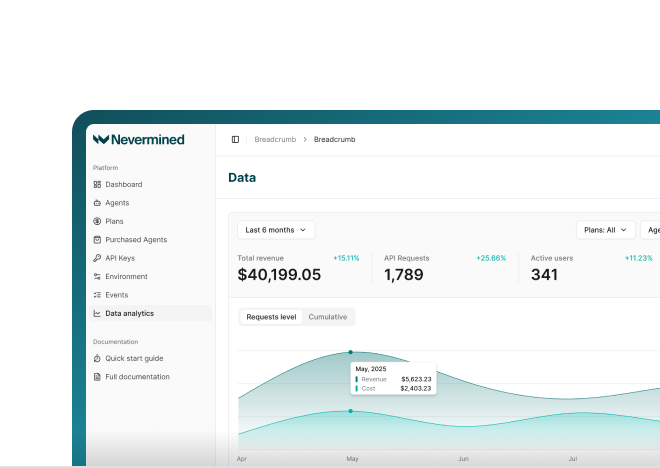
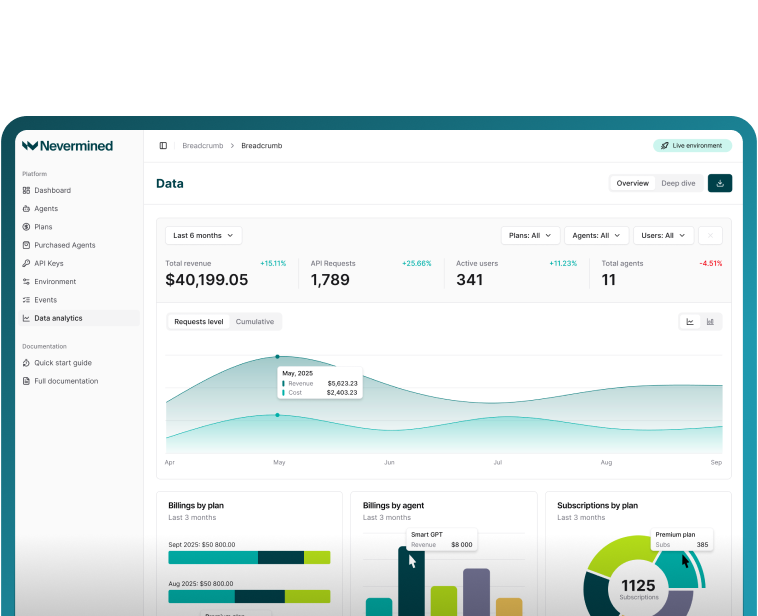
The observability dashboard becomes critical for understanding agent performance, user behavior, revenue analytics, hidden costs, and growth opportunities.
Without proper monitoring, AI agent costs can spiral quickly. Implement dashboards showing token consumption per request type, cost trends over time, and margin analysis per customer segment. Use tiered budget, quota, forecast, and anomaly alerts matched to each customer's spend profile to prevent bill shock.
Integration speed determines how quickly you can start monetizing your agents. Modern SDKs in TypeScript and Python enable rapid deployment, with some platforms offering setup in as little as 5 minutes.
The integration process typically follows three steps: install the SDK, register payment plans with pricing rules and access controls, and validate API requests while tracking costs through the observability layer. For detailed implementation guidance, refer to the official documentation.
Key integration considerations include:
Agent-to-agent payments represent a unique challenge. Standard payment implementations require wallet pop-ups or human approval for each request. Advanced platforms using ERC-4337 smart accounts with session keys enable users to authorize payment policies once, then agents interact freely within defined boundaries. Note that session key implementations are not yet standardized and vary by wallet provider, but the underlying mechanism is functional and maturing.
The agent-payments stack is still evolving across multiple open protocols, including Google's A2A, MCP, and AP2, enabling atomic "pay plus execute" business logic where payment and service delivery happen in a single verified transaction.
Pricing model selection directly impacts adoption, revenue, and customer satisfaction. Research from Forrester, McKinsey, and BCG indicates four dominant approaches for AI agent monetization, each suited to different use cases.
Charge per token, API call, or discrete action. This model works well for:
The downside is unpredictability for customers, potentially causing churn when bills spike unexpectedly.
Charge for results rather than activity. Outcome-based pricing can charge per resolved case, booked meeting, or qualified lead, aligning incentives between provider and customer. Forrester's pricing framework supports the logic and growing adoption of this model, though benchmark price points should be attributed to named vendors or specific case studies rather than cited as industry-wide standards. Implementation requires robust outcome verification.
Capture a percentage of ROI generated. This works for high-value use cases where agents deliver measurable business impact. Implementation requires clear ROI tracking and customer agreement on value metrics.
Credits and hybrid pricing are increasingly common in AI monetization. Prepaid credits redeemed against usage align price to value by charging for micro-actions and rewarding successful outcomes while providing customers with budget predictability.
Trust remains the central challenge for AI agent billing. According to a SumUp payment attitudes survey, only a minority of consumers are willing to trust AI with automated payments, making transparent, verifiable billing essential for adoption.
Tamper-proof metering requires cryptographically signed usage records pushed to an append-only log at creation. This makes every record immutable and independently verifiable. The exact pricing rule stamps onto each agent's usage credit, allowing developers, users, auditors, or agents to verify that usage totals match billed amounts per line item.
Key elements of auditable billing include:
On-chain verification through smart contracts enables atomic settlement where payment and execution happen together or not at all. This approach supports stateful billing for subscriptions and metering, escrow with conditional release, revenue splits across multiple parties, and programmable receipts through minted access credits.
Credit systems offer significant advantages for multi-agent billing, providing flexibility for variable usage patterns while maintaining predictable revenue for providers.
Ibbaka proposes an eight-step framework for designing credit-based pricing: value model, cost model, unit design, packages, and policies. Critical design decisions include:
As Ibbaka notes, you should have a frank conversation with your billing system before designing credit-based pricing, ensuring both parties understand implementation possibilities.
Multi-currency support becomes essential as global teams deploy AI agents. Modern platforms offer instant settlement in both fiat through card and ACH processing and cryptocurrency through stablecoin settlement. This flexibility allows customers to pay in their preferred method while providers receive settlement in their currency of choice.
Protocol standards for agent payments are evolving rapidly. Building on protocol-first architecture ensures your billing infrastructure remains compatible as the ecosystem matures.
Protocol-agnostic platforms provide native support for emerging standards including Google's Agent-to-Agent (A2A) protocol, Model Context Protocol (MCP), and Agent Payments Protocol (AP2). Google announced A2A in 2025 as an open agent interoperability standard, while Anthropic introduced MCP in 2024 and later moved it into broader neutral governance. This compatibility ensures your investment remains protected as standards evolve.
Interoperability matters because, according to Gartner, 40% of enterprise applications will be integrated with task-specific AI agents by end of 2026, up from less than 5% in 2025. Your agents need to transact with other agents across different platforms, marketplaces, and environments. Protocol-first architecture enables this cross-platform functionality without requiring custom integrations for each new partner.
Speed to revenue matters. Every week spent building custom billing infrastructure is a week your agents cannot generate revenue.
Low-code SDKs dramatically reduce implementation time. Valory cut deployment time of their payments and billing infrastructure for the Olas AI agent marketplace from 6 weeks to 6 hours using Nevermined, clawing back $1000s in engineering costs.
The time savings compound across your organization:
Leading platforms integrate with major components of the AI stack including LLM providers, agent frameworks like LangChain and CrewAI, observability tools, and blockchain networks for settlement. Pre-built connectors eliminate custom development while ensuring your billing scales with your agent deployment.
Nevermined provides purpose-built payments infrastructure specifically designed for AI agents and autonomous systems. Unlike traditional payment processors retrofitted for AI, Nevermined delivers agent-native billing from the ground up.
Nevermined delivers bank-grade enterprise-ready metering, compliance, and settlement so every model call turns into auditable revenue. Key capabilities include:
The platform provides native support for x402, Google's A2A protocol, MCP, and AP2, ensuring compatibility as agent commerce standards evolve. Integration takes approximately 5 minutes using TypeScript or Python SDKs, with comprehensive documentation guiding implementation.
For teams building multi-agent systems, Nevermined's agent-to-agent native payments enable transactions between AI agents without human involvement through smart accounts with session keys and delegated permissions. This capability distinguishes Nevermined from standard implementations requiring wallet pop-ups for each request.
The primary challenges include handling hundreds of micro-transactions with sub-cent costs that traditional processors cannot economically manage, tracking variable compute costs that differ materially by provider, model, modality, and context length, and attributing costs and revenue across multiple interacting agents in swarm architectures. Additionally, enabling autonomous agent-to-agent payments without human approval for each transaction requires specialized infrastructure that standard payment systems lack.
Tamper-proof metering works by cryptographically signing every usage record at creation and pushing it to an append-only log, making each record immutable. The exact pricing rule stamps onto each agent's usage credit, creating verifiable audit trails. This enables developers, users, auditors, or agents to independently verify that usage totals match billed amounts per line item, building trust through transparency rather than requiring blind faith in the billing provider.
Yes, modern agent-native billing platforms support instant settlement in both fiat through card and ACH processing and cryptocurrency through stablecoin settlement. This dual-rail approach allows customers to pay in their preferred method while providers receive settlement in their currency of choice, supporting global operations with multi-currency capabilities across different blockchain networks.
Four dominant pricing models serve different use cases: usage-based pricing charges per token or API call with guaranteed margins, outcome-based pricing charges for results like booked meetings or resolved tickets, value-based pricing captures a percentage of ROI generated, and hybrid credit systems combine prepaid consumption units with flexible redemption. The most effective implementations often blend multiple models, and hybrid pricing is increasingly common because it blends budget predictability with usage alignment.
Integration speed varies based on complexity, ranging from 5 minutes for basic usage tracking with low-code SDKs to 2-3 weeks for enterprise deployments requiring hybrid pricing models, multi-agent attribution, and custom compliance configurations. Platforms offering TypeScript and Python SDKs enable rapid setup, with some teams deploying production-ready billing infrastructure in under a day compared to 6 weeks for custom development.
See Nevermined
in Action
Real-time payments, flexible pricing, and outcome-based monetization—all in one platform.