MENU

Data analysis revealing how autonomous AI systems are reshaping commerce and why purpose-built payment infrastructure is essential to capture trillions in machine-driven transactions
Machine customers are no longer a futuristic concept. Gartner projects these autonomous AI systems will control $30 trillion in purchases by 2030, fundamentally transforming how commerce operates. Yet traditional payment processors were built for human buyers clicking checkout buttons, not AI agents executing thousands of micro-transactions per second. Nevermined's payment infrastructure addresses this gap directly, providing the billing, metering, and settlement capabilities that enable AI developers to monetize every agent interaction through flexible credits, subscriptions, and fiat or crypto settlement rails.
Gartner research cited by Digital Commerce 360 reveals that autonomous AI systems will control $30 trillion in purchases by 2030. This represents a fundamental shift where machines, not humans, make purchasing decisions at scale.
By 2030, eight billion internet-connected B2B products will function as potential machine customers. Each device represents a transaction endpoint that traditional payment systems cannot efficiently serve.
The a16z crypto State of Crypto Report shows stablecoins processed $8.5 trillion in transaction volume across 1.1 billion transactions in a single quarter. This volume demonstrates the infrastructure capacity needed for machine-scale commerce.
In Q2 2024, stablecoin transaction volumes exceeded Visa's $3.9 trillion in transactions. This milestone signals that blockchain-based payment rails can already handle enterprise-scale autonomous transactions.
Infrastructure scalability has improved dramatically, with blockchains now processing 50x more transactions per second compared to four years ago. This throughput expansion enables the high-frequency micro-transactions that machine customers generate.
Active blockchain participation has tripled since late 2023, reaching 220 million unique addresses. This growth reflects expanding infrastructure adoption that Nevermined's facilitator leverages for payment coordination.
Transaction costs for sending USDC on Ethereum have fallen from $12 to $1 on average since 2021. This cost reduction makes micro-transactions economically viable for machine customers.
Sending stablecoins on Base costs less than a cent on average, compared to $44 for international wire transfers. This 4,400x cost advantage makes autonomous agent transactions practical at any scale.
GM Insights reports the Web3 payment solutions market reached $9.64 billion in 2023, establishing the foundation for machine customer payment infrastructure.
The same research projects this market will surge to $93.5 billion by 2032, growing at 28.5% compound annual growth rate. Nevermined's dynamic pricing engine positions businesses to capture this growth through usage-based, outcome-based, and value-based models.
The NFT-based payments segment is expected to grow at 29% CAGR through 2032, indicating strong demand for tokenized transaction mechanisms that machine customers can leverage.
Stablecoins account for 32% of daily cryptocurrency usage, second only to DeFi at 34%. This adoption pattern validates stablecoin settlement as a primary rail for machine customer transactions.
The Payments Association reports 67% of merchants leverage network or gateway tokens for enhanced security in e-commerce. Machine customers require similar cryptographic verification that Nevermined delivers through tamper-proof metering.
Grand View Research reports the global Web 3.0 market reached $2.25 billion in 2023, providing the decentralized infrastructure foundation for verifiable machine customer transactions.
This market will expand to $33.53 billion by 2030 at 49.3% CAGR, reflecting the infrastructure buildout required for transparent, auditable machine commerce.
The banking, financial services, and insurance sector accounts for 36.12% of revenue in the Web 3.0 market, indicating that regulated industries are already investing in verifiable transaction infrastructure.
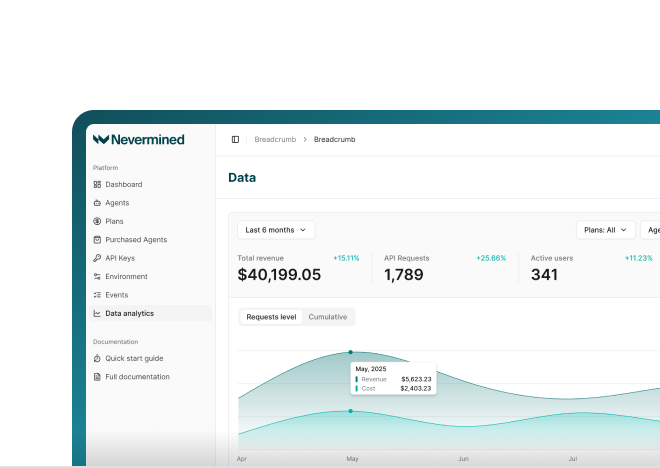
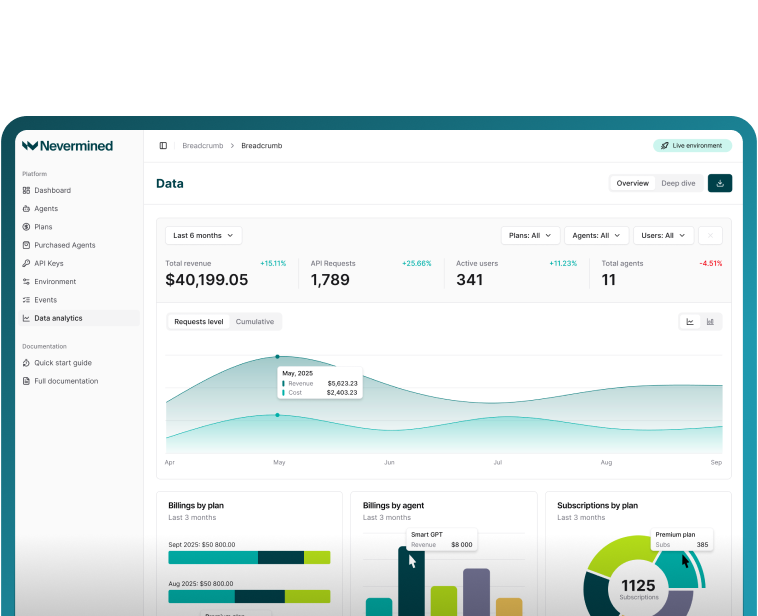
The Payments Association finds 60% of industry professionals maintain a positive outlook, recognizing the opportunity that machine customers represent. Nevermined's observability dashboard provides visibility into agent performance and revenue analytics.
Consumer preferences align with machine commerce requirements, with 62% viewing cashless options as very important. Machine customers operate exclusively in digital payment environments.
The Payments Association projects digital commerce will reach £8.49 trillion globally, creating the transaction volume that machine customers will increasingly dominate.
Gartner research shows CEOs and senior executives expect 21% or more of revenue to come from machine customers within this decade. This executive expectation demands robust analytics to track machine-driven revenue streams.
Gartner reports that 29% of organizations are actively working on a machine customer strategy, and half of those plan to have one within two years. This strategic urgency requires payment infrastructure that enables autonomous agent-to-agent transactions.
IndustryARC projects the blockchain market will reach $1,235.71 billion by 2030 at 28.1% CAGR, providing the settlement layer for machine-to-machine commerce.
The payment systems application segment within blockchain is growing at 29.4% CAGR through 2030, the fastest-growing application category for machine customer infrastructure.
Public blockchains accounted for 35% market share in 2023, providing the open infrastructure that enables interoperable machine customer transactions across ecosystems.
Straits Research reports the blockchain IoT market reached $390.19 million in 2024, connecting physical devices with blockchain payment capabilities for machine commerce.
This market will grow to $621.06 million by 2033 at 5.3% CAGR according to Straits Research, enabling billions of connected devices to participate in autonomous transactions.
Forbes data, as cited by Straits Research, indicates over 43 billion internet-connected devices were expected by 2023, each representing a potential machine customer requiring identity and payment capabilities.
Statista projects, as cited by Straits Research, that North America IoT connections will reach 8 billion by 2030, creating massive demand for regional machine customer payment infrastructure.
An alternative analysis from Precedence Research values the blockchain IoT market at $1,204.03 million in 2025, reflecting the convergence of connected devices and blockchain payment rails.
This aggressive projection shows the market reaching $95,535.22 million by 2035 at 54.86% CAGR, representing the infrastructure expansion required for universal machine commerce.
Grand View Research reports North America commands 37.3% of the Web 3.0 market, establishing regional infrastructure leadership for machine customer adoption.
The Asia-Pacific region is expanding at 30.5% CAGR through 2030, requiring multi-currency and cross-border payment capabilities that Nevermined delivers.
The cryptocurrency segment dominated Web 3.0 market revenue in 2023, establishing crypto rails as the primary settlement mechanism for machine customers. Nevermined's credits system enables prepaid consumption units that align perfectly with crypto-native payment flows.
The supply chain management end-use is growing at 29.8% CAGR through 2030, representing a key vertical where machine customers will automate procurement and logistics payments.
Traditional cross-border payment methods cost $44 on average, while blockchain alternatives cost pennies. This cost differential makes machine customer micro-transactions economically impossible on legacy rails.
Organizations preparing for machine customer transactions should prioritize infrastructure that handles autonomous commerce requirements:
Real-world results validate this approach. Valory cut deployment time of their payments and billing infrastructure for the Olas AI agent marketplace from 6 weeks to 6 hours using Nevermined, clawing back $1000s in engineering costs.
Machine customers are autonomous AI systems that make purchasing decisions and execute transactions without direct human involvement. They require specialized infrastructure because traditional payment processors cannot handle the micro-transactions, per-token billing, and agent-to-agent settlements that occur at machine speed. Gartner projects these systems will control $30 trillion in purchases by 2030, creating urgent demand for purpose-built payment rails.
Nevermined provides billing, metering, and settlement infrastructure designed specifically for autonomous systems. The platform supports usage-based, outcome-based, and value-based pricing models that align revenue with value delivered. Tamper-proof metering through cryptographically signed append-only logs creates verifiable transaction records, while support for both fiat and cryptocurrency settlement enables global machine commerce.
Blockchain payment rails offer dramatic cost advantages for machine transactions. Sending stablecoins on Base costs less than a cent compared to $44 for international wire transfers. Ethereum gas fees have dropped from $12 to $1 on average since 2021. These cost reductions make micro-transactions economically viable, enabling machine customers to execute thousands of small transactions that would be impossible on traditional payment networks.
Integration speed varies by solution, but Nevermined gets you from zero to a working payment integration in 5 minutes with SDKs for both TypeScript and Python. Valory demonstrated this by cutting deployment time from 6 weeks to 6 hours when building their Olas AI agent marketplace, recovering thousands in engineering costs while accelerating time-to-market.
Multiple market segments supporting machine customer transactions are experiencing explosive growth. The Web3 payment solutions market is projected to grow from $9.64 billion to $93.5 billion by 2032 at 28.5% CAGR. The broader blockchain market is forecast to reach $1.24 trillion by 2030. CEOs expect 21% or more of revenue to come from machine customers by 2030, with 29% of organizations actively working on strategies and half of those planning to have one within two years.
See Nevermined
in Action
Real-time payments, flexible pricing, and outcome-based monetization—all in one platform.