MENU


Data-driven analysis of transaction throughput, cost efficiency, and adoption metrics shaping the agentic economy's financial infrastructure
The Model Context Protocol (MCP) has emerged as the standardized communication layer enabling AI agents to interact, transact, and settle payments autonomously. With transaction counts increasing by 35,000% to over 1 million in just 30 days, the micro-payments infrastructure supporting agent-to-agent commerce is experiencing unprecedented growth. Nevermined's payment platform sits at the center of this shift, providing real-time metering, instant settlement, and tamper-proof audit trails that make sub-cent transactions economically viable for the first time.
The most striking metric in the MCP micro-payments space is the 35,000% surge in transactions recorded in October 2025, with total transactions exceeding 1 million in a single month. This explosive growth signals that agent-to-agent payments have crossed the threshold from proof-of-concept to production reality.
Alongside transaction growth, the buyer base expanded by 244,000% to more than 68,000 participants in 30 days. This rapid adoption demonstrates that both developers and enterprises are actively building on micro-payment infrastructure.
On October 18, 2025, the x402 ecosystem processed 239,505 transactions in 24 hours, establishing a new benchmark for agent payment throughput.
The highest single-day volume reached $332,000 on October 17, 2025, proving that micro-payments can aggregate into meaningful transaction value.
During the week of October 14-20, the ecosystem processed more than 500,000 transactions, representing a 10,780% surge compared to four weeks prior.
Since Coinbase's launch of x402 infrastructure in May, the ecosystem has recorded 1.38 million cumulative transactions with $1.48 million in total volume.
The marketplace has grown to include 72,500 buyers and 1,000 sellers, creating a liquid ecosystem for agent services.
The x402 protocol achieves transaction costs under $0.0001 on Base Layer 2, approximately 3,000 times cheaper than a typical credit card transaction minimum of $0.30.
With near-zero transaction costs, micropayments as small as $0.001 become practical, unlocking per-token, per-API-call, and per-GPU-cycle pricing models.
Agent-to-agent transactions achieve final confirmation in about 2 seconds, compared to days for traditional payment settlement. This speed enables real-time metering where agents pay as they consume resources.
For applications requiring even faster settlement, the x402 protocol delivers 200-millisecond finality on optimized Layer 2 infrastructure.
Unlike traditional payment rails that extract 2.9% plus fixed fees, x402 charges zero fees at the protocol layer, allowing facilitators to set competitive rates.
Pricing AI agents is complicated because cost can vary by 100x depending on workflow complexity. This variance makes flexible, usage-based billing essential rather than optional. Nevermined's documentation provides detailed guidance on implementing dynamic pricing that accounts for this variability.
Unlike credit cards with 120-day chargeback windows, blockchain-based micro-payments are irreversible once confirmed. This characteristic protects API providers from fraudulent usage claims.
In one documented implementation, Questflow successfully processed over 130,000 transactions with full auditability, demonstrating production-grade reliability.
Nevermined's tamper-proof metering extends these guarantees by pushing every usage record to an append-only log at creation. The exact pricing rule is stamped onto each agent's usage credit, allowing developers, users, auditors, or agents to verify that usage totals match billed amounts per line-item. This zero-trust reconciliation model satisfies enterprise procurement teams requiring bank-grade transparency.
Research shows that 75% of companies building AI agents lack a systematic approach to pricing their services. This gap represents both a risk and an opportunity for early adopters of structured billing infrastructure.
Among companies that have implemented pricing strategies, 45% have adopted usage-based models, reflecting the natural fit between AI consumption patterns and per-unit billing.
Leading AI agents are establishing pricing benchmarks. Cognition AI charges $2.25 per credit for its Devin software development agent, demonstrating premium positioning for high-value automation.
Outcome-based pricing is gaining traction, with Intercom charging $0.99 per successful resolution rather than per interaction. This model aligns cost with value delivered.
Enterprise platforms are establishing conversation-based pricing, with Salesforce charging $2 per conversation for its Agentforce product.
Time-based models persist for complex workflows, with Microsoft Security Copilot pricing at $4 per hour of active usage.
Nevermined supports all three pricing models, allowing AI companies to mix usage-based, outcome-based, and value-based approaches. Flex Credits operate as prepaid consumption units that align price to value, enable flexible scaling across users and departments, and provide predictable spend with real-time burn rate monitoring.
According to Cloudera research, 96% of enterprise IT leaders plan to expand AI agent deployments within the next 12 months. This near-universal adoption intent signals massive growth ahead for agent payment infrastructure.
The KPMG Q1 2025 AI Pulse Survey found that 65% of organizations have advanced to pilot stage with AI agent implementations, moving beyond experimentation.
Combining exploration and pilot phases, 90% of organizations are actively engaged with AI agent technology in some capacity.
Research indicates 85% of enterprises will have implemented AI agents by the end of 2025, creating a massive addressable market for billing infrastructure.
Venture capital is flooding into the space, with AI agent startups raising $3.8 billion in 2024 alone. This capital influx accelerates the need for monetization infrastructure.
The primary use case driving adoption is process automation, with 71% of organizations deploying agents for this purpose. Understanding which automations generate ROI requires granular metering.
Early adopters are seeing measurable business impact, with 6-10% average revenue increases reported from agentic AI implementations.
Expectations are high, with 62% of organizations expecting to double their investment through agentic AI returns according to PagerDuty and Wakefield Research.
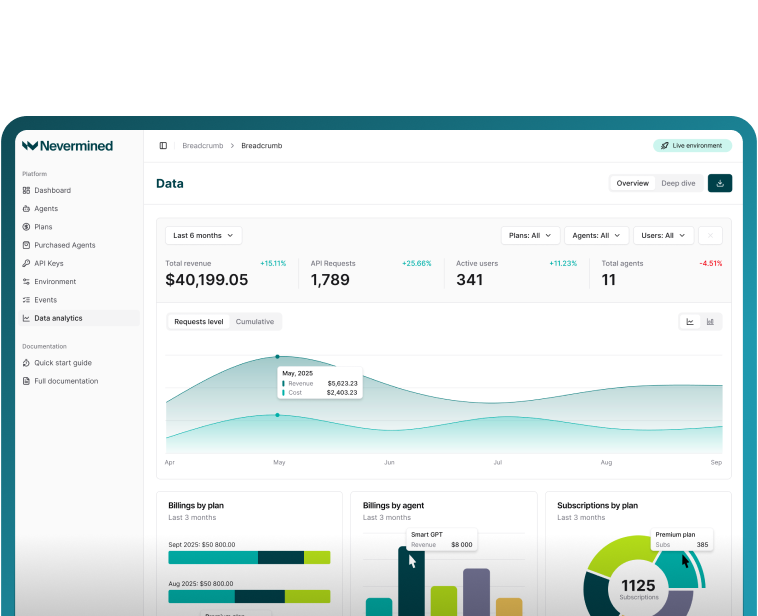
Nevermined Pay's observability dashboard provides visibility into agent performance, user behavior, and revenue analytics. The platform surfaces hidden costs and missed opportunities while identifying which features drive growth for scaling decisions.
The current AI agents market stands at $7.38 billion, representing the immediate addressable market for billing infrastructure.
Growth projections indicate the market will reach $47.1 billion by 2030, a 6x expansion from current levels.
This growth represents a 44.8% compound annual growth rate, among the fastest-growing segments in enterprise software.
Gartner's analysis projects that AI agents will intermediate $15 trillion in B2B purchases by 2028, encompassing a massive portion of agent-to-agent and agent-to-human commercial transactions.
For enterprise AI platforms and vendors, Nevermined Pay delivers bank-grade metering, compliance, and settlement so every model call turns into auditable revenue. The platform provides ledger-grade metering, a dynamic pricing engine, credits-based settlement, 5x faster book closing, and margin recovery. Nevermined's direct integration with x402 as an extension to the protocol enables advanced agent payment capabilities that traditional payment processors cannot match.
The Model Context Protocol is a standardized communication framework that enables AI agents to interact across different platforms and frameworks. For micro-payments, MCP provides the interoperability layer that allows agents to autonomously request services, verify delivery, and settle transactions. The protocol supports emerging payment standards like x402, which enable sub-cent transactions at costs below $0.0001 with 200-millisecond settlement finality.
Nevermined's tamper-proof metering system signs every usage record and pushes it to an append-only log at creation, making records immutable. The exact pricing rule is stamped onto each agent's usage credit, enabling any developer, user, auditor, or agent to verify that usage totals match billed amounts per line-item. This zero-trust reconciliation model satisfies enterprise procurement teams requiring audit-ready transparency. Unlike credit cards with 120-day chargeback windows, blockchain-based settlements are irreversible once confirmed.
Yes, Nevermined's infrastructure supports transactions as small as $0.001 through its integration with Layer 2 payment rails. The platform supports per-token, per-API-call, and per-GPU-cycle pricing with guaranteed margin built in. Flex Credits provide prepaid consumption units that align price to value while giving enterprises predictable spend with real-time burn rate monitoring. This addresses the 100x cost variance that exists between simple and complex agent workflows.
MCP payment channels generate comprehensive analytics including transaction throughput, settlement latency, cost per interaction, and revenue attribution by agent or endpoint. With 35,000% transaction growth recorded in recent months and over 72,500 active buyers, these channels produce rich datasets for optimizing pricing, identifying high-value use cases, and forecasting capacity requirements.
Nevermined supports three pricing models that can be mixed and matched: usage-based pricing (per-token, per-API-call), outcome-based pricing (charging for results achieved like successful resolutions), and value-based pricing (percentage of ROI or value generated). This flexibility addresses the fact that 75% of agent-building companies currently lack systematic pricing approaches. The Nevermined blog provides detailed guidance on selecting and implementing the right pricing strategy for different agent use cases.
See Nevermined
in Action
Real-time payments, flexible pricing, and outcome-based monetization—all in one platform.