MENU


The Model Context Protocol (MCP) has transformed how AI agents communicate with external tools, but it shipped without a critical component: payment infrastructure. As the AI agent market accelerates toward $52.62 billion by 2030, this gap creates massive opportunity for builders who need to monetize tool calling without building billing systems from scratch. Nevermined Pay delivers bank-grade enterprise-ready metering, compliance, and settlement so every model call turns into auditable revenue, featuring ledger-grade metering, a dynamic pricing engine, credits-based settlement, 5x faster book closing, and margin recovery.
The Model Context Protocol represents a fundamental shift in how AI agents interact with external systems. Think of MCP as the "USB-C for AI", providing a universal interface that eliminates the N×M integration problem where N AI models previously required custom code for M external tools.
MCP operates on a client-server architecture using JSON-RPC 2.0 messaging, enabling AI agents to:
The protocol has achieved rapid adoption since Anthropic introduced it in November 2024, growing to thousands of MCP servers in the ecosystem with support across platforms including Claude, ChatGPT, and Microsoft Copilot Studio.
Here's the critical gap: MCP standardizes tool invocation and context exchange, but does not define payment or metering primitives. When one agent wants access to resources or tools, there's no native payment mechanism in the protocol and no built-in metering. This forces every AI builder to solve billing independently, creating friction that slows the entire ecosystem.
The market opportunity is substantial. MCP transactions grew 35,000% in 30 days, with the buyer base expanding 244,000% to over 68,000 active participants. Yet most builders lack the infrastructure to capture this value.
Nevermined differentiates through protocol-native design rather than retrofitting human payment systems for autonomous agents. The platform provides native support for emerging standards:
This multi-protocol approach provides critical advantages for AI builders:
The facilitator component coordinates authorization, metering, and settlement across fiat, crypto, credits, and smart accounts, providing a unified payment handshake regardless of which protocol initiates the transaction.
Traditional SaaS pricing models break down for AI agents. A single conversation can trigger hundreds of micro-activities with sub-cent costs, while outcome value varies between simple queries and complex workflows.
Nevermined uniquely supports three pricing models simultaneously:
Charge per token, per API call, or per compute unit with guaranteed margins. The dynamic pricing engine enables cost-plus-margin automation where platforms define exact margin percentages locked onto usage credits.
Bill for results rather than activity. Examples include charging per successful ticket resolution, per booked meeting, or per completed analysis. This aligns incentives between builders and users.
Capture a percentage of ROI generated by agent actions. When an agent closes a deal or saves operational costs, pricing reflects the value delivered rather than resources consumed.
Autonomous AI agents raise a fundamental question: how do you trust billing when no human witnesses the transaction? Nevermined addresses this through cryptographic verification at the infrastructure level.
Every usage record is cryptographically signed and pushed to an append-only log at creation, making it immutable. The exact pricing rule stamps onto each agent's usage credit. This enables:
For enterprises, audit trails aren't optional. The documentation details how append-only logging satisfies regulatory requirements while providing the transparency autonomous systems demand. When agents transact millions of times per day, manual verification becomes impossible. Cryptographic proof scales where human oversight cannot.
Traditional payment processors assume a human clicks "buy" on a trusted surface. As Google's payment leaders noted, the rise of autonomous agents breaks this fundamental assumption and raises critical questions about authorization and authenticity.
Nevermined enables transactions between AI agents without human involvement through:
Standard x402 implementations require wallet pop-ups for each request, creating unacceptable friction for autonomous workflows. Nevermined's smart account integration enables atomic "pay plus execute" transactions where authorization, payment, and action occur in a single operation.
On many Ethereum Layer 2 networks, median transaction costs are often in the cents range (varying by network and congestion), while some stacks support ~200ms preconfirmation-style updates (not final settlement). This makes per-token billing economically viable for high-frequency agent interactions.
Speed matters in a market growing at 46.3% CAGR. Nevermined gets you from zero to a working payment integration in 5 minutes, with SDKs for both TypeScript and Python.
The three-step integration process includes:
The Agent Identity System issues each agent a unique wallet plus decentralized identifier (DID) with cryptographic proof of ownership at registration. These portable identities work across environments, swarms, and marketplaces without re-wiring.
Key capabilities include:
Flex Credits operate as prepaid consumption-based units redeemed directly against usage. This model solves critical problems for both builders and buyers.
Credits align price to value by:
For finance teams, credits transform unpredictable AI spending into trackable recurring billing:
Nevermined integrates across the AI stack, connecting with the tools builders already use:
LLM Providers: OpenAI, Anthropic, and other major model providers work seamlessly with Nevermined's metering layer.
Agent Frameworks: LangChain and CrewAI users can add payment capabilities to existing workflows.
Payment Processors: Traditional fiat processors handle card payments while blockchain infrastructure enables stablecoin settlement.
Blockchain Networks: Smart contract settlement on Polygon, Gnosis Chain, Ethereum, and their test networks.
Observability: Integration with Helicone provides performance monitoring alongside revenue metrics through the observability dashboard.
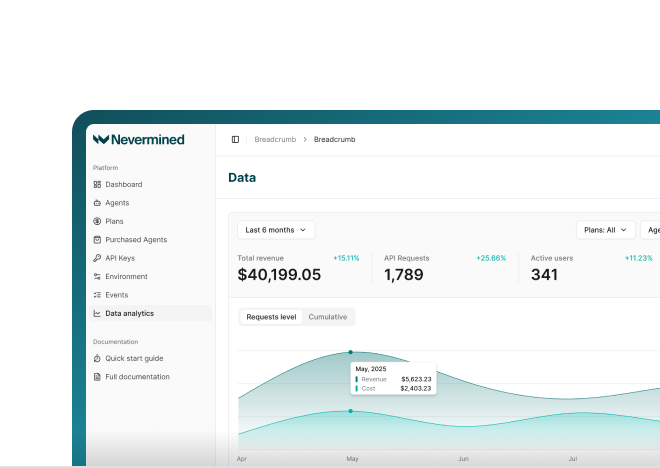
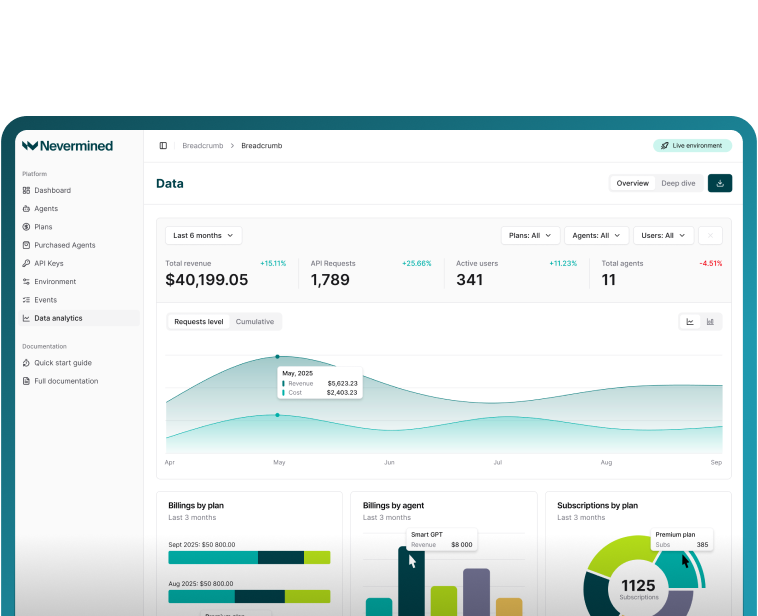
The dashboard delivers visibility into:
The convergence of MCP adoption and payment infrastructure creates unprecedented market opportunity.
Valory (Olas builders): Valory cut deployment time of their payments and billing infrastructure for the Olas AI agent marketplace from 6 weeks to 6 hours using Nevermined, clawing back $1000s in engineering costs. CEO David Minarsch stated: "We knew AI agents need to be able to transact, so over a year ago we tapped into Nevermined."
Naptha AI: Co-Founder Richard Blythman noted: "Whenever I need to understand AI agent monetization, I turn to the Nevermined team. They're world class and leading the agentic payments space."
Mother: Founding Member James Young stated: "Early on building Mother, we realized agent-to-agent payments get super complicated. Nevermined's solution is the perfect fit."
For AI builders evaluating payment infrastructure, Nevermined offers distinct advantages over both building custom solutions and using traditional processors.
Versus custom builds: Skip months of development. Valory's experience shows the platform replaces 6 weeks of engineering with 6 hours of integration. Your team ships AI features, not billing code.
Versus traditional processors: Standard online card processing fees (commonly structured around percentage plus fixed amounts) create unprofitable economics for micropayments. Nevermined's architecture handles sub-cent transactions profitably through credits-based settlement.
Versus crypto-only solutions: Get both fiat and crypto settlement. Enterprise customers pay with cards while web3-native users pay with stablecoins, all through unified infrastructure.
The solutions page showcases implementations across AI agent marketplaces, vertical specialist agents, and multi-agent systems. For technical details, the documentation provides implementation guides, sandbox environments, and API references.
MCP is an open standard introduced by Anthropic in November 2024 that provides a universal interface for AI agents to communicate with external tools and data sources. Nevermined supports MCP through native protocol integration, enabling builders to add monetization to any MCP server without custom billing development. The platform meters tool calls in real-time and settles payments instantly in fiat or cryptocurrency.
Nevermined supports three pricing models simultaneously for tool calling. Usage-based pricing charges per token or API call, outcome-based pricing bills for successful results like completed analyses, and value-based pricing captures a percentage of value generated. This flexibility lets builders match pricing to the actual value their tools deliver rather than being locked into per-request models.
Unlike traditional processors requiring human approval for each transaction, Nevermined uses ERC-4337 smart accounts with session keys and delegated permissions. Users authorize payment policies once, then agents transact autonomously within those boundaries. This enables true agent-to-agent commerce with efficient settlement on Layer 2 networks.
Every usage record is cryptographically signed and pushed to an immutable append-only log at creation. The exact pricing rule stamps onto each usage credit, enabling zero-trust reconciliation where any party can independently verify billing accuracy. This approach satisfies enterprise compliance requirements while scaling to millions of autonomous transactions.
Nevermined supports smart contract settlement on Polygon, Gnosis Chain, Ethereum, and their corresponding test networks. This multi-chain support provides flexibility for different use cases, from high-throughput micropayments on Layer 2 networks to high-value settlements on Ethereum mainnet. The platform handles gasless transactions through paymaster sponsorship.
See Nevermined
in Action
Real-time payments, flexible pricing, and outcome-based monetization—all in one platform.