MENU


Comprehensive data analysis revealing how granular usage tracking transforms AI agent monetization, billing accuracy, and enterprise-scale profitability
The AI agent economy faces a fundamental billing problem: a single agent conversation can trigger hundreds of micro-activities with sub-cent costs that make traditional payment systems obsolete. With the AI agents market valued at $7.38 billion in 2025 and projected to reach $47.1 billion by 2030, the stakes for accurate micro-task metering have never been higher. Nevermined Pay addresses this challenge through real-time metering infrastructure that tracks every token, API call, and GPU cycle, transforming chaotic AI billing into auditable revenue streams.
The global AI agents market is valued at $7.38 billion this year, establishing a massive foundation for the agentic economy. This valuation reflects rapid enterprise adoption and the growing sophistication of AI agent capabilities across industries. Traditional payment systems were never designed to handle the transaction volumes and complexity this market demands.
Market projections cited in AI agents reaching $47.1 billion by 2030, representing a 44.8% compound annual growth rate. This explosive trajectory means billing infrastructure must scale proportionally or become a critical bottleneck. Companies building on legacy payment rails face mounting technical debt as transaction volumes multiply.
Alternative forecasts are even more aggressive, estimating the market at $50.31 billion by 2030 with a 45.8% CAGR. The range of forecasts underscores the explosive growth trajectory while highlighting the uncertainty facing companies planning billing infrastructure investments.
Looking further ahead, Index.dev projects $103.6 billion market size in AI agents by 2032 at a 45.3% CAGR. This trajectory demands payment infrastructure capable of handling exponential transaction growth while maintaining accuracy at micro-task granularity.
Venture capital flooded the space with AI agent startups raising $3.8 billion in 2024, nearly triple the previous year's investment. This funding surge accelerates the need for specialized payment infrastructure as more companies bring agents to market.
Seat-based licensing and flat subscriptions fail to capture the true economics of AI agent operations, leaving both vendors and buyers frustrated with misaligned incentives.
Research reveals 75% of agent-building companies have no systematic pricing strategy, creating widespread uncertainty in the market. This gap represents both a challenge and an opportunity for companies implementing proper metering infrastructure. Without granular usage data, pricing becomes guesswork rather than strategy.
The staggering 100x cost difference between simple queries and complex multi-step agent workflows makes flat-rate pricing economically irrational. A single "conversation" might cost $0.001 or $0.10 depending on the tools invoked, models called, and processing required. Only micro-task metering can capture this variance accurately.
Within just 12 months, competitive AI SDR categories experienced 90% pricing compression, demonstrating how quickly margins erode without proper cost tracking. Companies without accurate metering cannot identify which features remain profitable as prices fall.
The Metronome State of Usage-Based Pricing Report confirms 85% of SaaS companies now use usage-based pricing models. This near-universal adoption validates micro-task metering as the standard approach for software billing. Nevermined's documentation provides implementation guidance for teams making this transition.
Among the largest software companies, 77% now offer usage-based options, demonstrating enterprise-grade validation of the model. These companies have invested heavily in metering infrastructure to support accurate billing at scale.
The rapid shift is evident: 78% of usage-based adoption occurred within the last five years. This recent surge reflects the growing complexity of software usage patterns and the inadequacy of traditional subscription models.
Among Forbes' most promising emerging companies, 64% have implemented usage-based pricing. This correlation between growth potential and pricing model sophistication highlights the competitive advantage of accurate metering.
Platform data shows an 8x year-over-year increase in usage-based billing transactions processed in 2024. This exponential growth in billing volume demonstrates the scalability requirements for modern AI payment infrastructure.
Financial planning evolves with the model: 73% of usage-based companies now actively forecast variable revenue streams. Accurate metering data enables this predictability despite usage-based billing models.
Billing frequency increases with granularity, as 43% of SaaS companies now bill more frequently than monthly. Real-time metering supports this shift toward continuous billing cycles that better reflect actual usage patterns.
Currently, 45% of AI companies have implemented usage-based pricing, leaving significant room for market evolution. The remaining 55% face increasing pressure to adopt more sophisticated billing approaches as competition intensifies.
The margin differential is stark: companies implementing outcome-based pricing achieve 94% gross margins compared to sometimes negative margins for pure usage-based models without proper cost tracking. This demonstrates the importance of aligning pricing with delivered value rather than just resource consumption.
Research confirms outcome-based models deliver 8.3x value relative to price, creating sustainable economics for both vendors and buyers. This value multiplier justifies premium pricing while maintaining customer satisfaction.
Currently, only 20% of AI companies have implemented outcome-based pricing models. The early adopters achieving superior margins are establishing competitive advantages that laggards will struggle to match.
Intercom's Fin AI demonstrates outcome-based pricing at $0.99 per successful resolution, aligning revenue directly with customer value. This model requires precise metering to distinguish successful resolutions from failed attempts.
Salesforce adopted conversation-based pricing at $2 per conversation for their Agentforce product. This approach simplifies billing while still requiring accurate conversation boundary detection and metering.
Microsoft implemented time-based pricing for Copilot at $4 per hour of active usage. This model demands precise session tracking and metering to ensure accurate billing.
Cognition AI prices Devin, their software development agent, at $2.25 per credit. Credit-based systems require clear definitions of credit consumption and transparent metering to maintain customer trust.
Organizations combining multiple pricing models achieve 21% median growth, outperforming single-model approaches. This hybrid flexibility requires sophisticated metering capable of tracking multiple value metrics simultaneously.
Valory cut deployment time of their payments and billing infrastructure for the Olas AI agent marketplace from 6 weeks to 6 hours using Nevermined, clawing back $1000s in engineering costs. This dramatic reduction demonstrates the value of purpose-built AI payment infrastructure versus custom development on traditional payment rails.
Nevermined's SDK enables developers to integrate full-cycle AI agent monetization in under 20 minutes. This rapid deployment capability transforms billing from a multi-week project into a same-day implementation. The low-code approach available in TypeScript and Python minimizes engineering overhead.
Investor confidence is clear with over $2 billion in VC funding directed toward agentic AI startups in the last two years. This capital influx accelerates market development while intensifying competition for billing infrastructure solutions.
The monetization trend is unmistakable: 44% of SaaS companies now charge separately for AI-powered features. This segmentation requires precise metering to distinguish AI-driven value from traditional software functionality.
Long-term commitments grew dramatically, with multi-year contracts representing 40% of SaaS agreements, up from just 14% in 2022. This 186% increase reflects enterprise preference for predictable spend, which credit systems support through prepaid allocation.
The infrastructure market itself is substantial, with usage-based billing software reaching $6.5 billion in 2025. Projections show growth to $15.3 billion by 2032 at 12.8% CAGR, validating investment in specialized billing platforms.
The broader micro-tasking market reaches $7.94 billion in 2025, projected to hit $28.10 billion by 2030 at 28.8% CAGR. This growth trajectory reflects increasing granularity in work decomposition and billing requirements.
Within micro-tasking, AI Training and Data-Labeling represents 42.5% of the market in 2024, advancing at 41.0% CAGR through 2030. This segment requires particularly precise metering due to high task volumes and low per-task costs.
Organizations deploying AI agents achieve 55% higher operational efficiency alongside 35% average cost reductions. Capturing this value requires metering systems that can attribute efficiency gains to specific agent actions.
Productivity data shows GitHub Copilot users completing tasks 126% faster than non-users. This measurable outcome enables value-based pricing when metering systems can track task completion alongside resource consumption.
Cornell University research confirms 15% productivity gains from AI pair programming tools. Quantifying these gains through metering data supports ROI justification for enterprise procurement.
The primary use case is clear: 64% of AI deployments target business process automation. This concentration creates opportunities for specialized metering focused on process completion metrics.
Among executive users, 58% leverage AI agents for research tasks and information summarization. Understanding usage patterns through metering enables product optimization and pricing refinement.
Customer service represents another dominant category, with 45.8% of companies deploying AI agents in support roles. Resolution tracking and metering enable outcome-based pricing in this segment.
Enterprise adoption accelerates with 85% expected to implement AI agents by year end. This wave of enterprise deployment demands billing infrastructure capable of meeting corporate compliance and audit requirements. Nevermined delivers bank-grade, enterprise-ready metering, compliance, and settlement so every model call turns into auditable revenue, with ledger-grade metering, a dynamic pricing engine, credits-based settlement, 5x faster book closing, and margin recovery.
Market readiness is high with 88% of organizations actively exploring or piloting AI agents. This exploration phase creates demand for flexible metering that can support proof-of-concept deployments before scaling to production.
Looking ahead, 82% of large businesses plan AI agent deployment within the next two years. This timeline creates urgency for billing infrastructure decisions that will support long-term scale.
Executive commitment is clear: 96% of enterprise leaders plan to expand AI agent usage over the next 12 months. This expansion requires metering systems that can scale with deployment growth.
The cost of billing failures is severe: 70% churn rates occur in certain AI agent segments, often driven by billing dissatisfaction rather than product problems. Transparent metering directly addresses this retention challenge.
ROI expectations are high: 62% of organizations anticipate returns exceeding 100% from agentic AI investments. Meeting these expectations requires metering that can demonstrate value delivery with precision.
Early adopters see 6-10% revenue increases from agentic AI implementation. Attributing these gains requires comprehensive metering across all agent interactions.
Marketing teams show particular enthusiasm, with 80% reporting AI tools exceeded ROI expectations in 2025. This satisfaction drives expansion, creating additional metering requirements as usage scales.
Market maturity advances with 65% of organizations moving from experimentation to formal pilot programs. This progression demands more robust billing infrastructure than early trials required.
Nevermined's x402 integration extends these capabilities by enabling direct protocol-level agent payment workflows, supporting the emerging standards like Google's A2A protocol and Model Context Protocol (MCP) that will define the agentic economy.
Trust considerations remain: 71% of employees prefer human review of AI agent outputs. This preference influences billing models, as oversight costs must be factored into pricing structures.
Governance lags adoption, with only 29% of companies having formal AI agent oversight mechanisms. As governance matures, metering requirements will expand to include audit trail capabilities.
Successful micro-task metering implementation depends on data architecture built for auditability and scale. Design for append-only logging from day one, ensure cryptographic signing of all usage records, and plan for 10x expected transaction volumes.
A strong pricing strategy starts simple and becomes more sophisticated over time. Begin with cost-covering baselines before adding success fees, use metering data to identify margin erosion points, and test hybrid models combining usage and outcome metrics.
For compliance readiness, bake governance into the initial build rather than treating it as a later add-on. Build audit export capabilities into the initial implementation, document pricing rules alongside usage data, and maintain immutable records for regulatory review.
Finally, integration planning ensures metering is practical and operationally useful. Prioritize SDK-based integration for speed, connect metering to observability dashboards, and enable real-time alerts for usage anomalies.
For teams ready to implement, Nevermined's solutions provide the infrastructure needed to deploy enterprise-grade metering without months of custom development.
Micro-task metering tracks granular AI agent activities at the level of individual tokens, API calls, and GPU cycles. Unlike traditional transaction-based billing, micro-task metering captures the hundreds of sub-cent activities that occur within a single agent conversation. This granularity enables accurate cost allocation and supports flexible pricing models including usage-based, outcome-based, and value-based approaches.
Traditional payment processors like Stripe were designed for discrete human-initiated transactions, not the continuous micro-activities generated by AI agents. With 100x cost variance between simple and complex agent workflows, flat-rate pricing leaves money on the table or creates unsustainable economics. Micro-task metering captures each activity with its associated cost, enabling accurate margin calculation and flexible pricing that adapts to actual resource consumption.
Micro-task metering supports three primary pricing models that can be combined: usage-based pricing charges per token, API call, or GPU cycle with guaranteed margin built in; outcome-based pricing charges for results achieved like completed resolutions or booked meetings; and value-based pricing captures a percentage of ROI or value generated. Companies with outcome-based pricing achieve 94% gross margins compared to sometimes negative margins for poorly-tracked usage models.
Nevermined creates buyer trust through independent verification where every usage record is signed and pushed to an append-only log at creation, making it immutable. The exact pricing rule is stamped onto each agent's usage credit, allowing any developer, user, auditor, or agent to verify that usage totals match billed amounts per line-item. This zero-trust reconciliation model satisfies enterprise procurement teams requiring audit-ready transparency.
Flex Credits operate as prepaid consumption-based units redeemed directly against usage, solving multiple problems: aligning price to value by charging for micro-actions, enabling flexible scaling where credits can be reallocated across users or departments without renegotiating licenses, and providing predictable spend where users prepay credits and monitor burn rate in real-time. With multi-year contracts representing 40% of SaaS agreements, credit systems support enterprise preferences for predictable budgeting.
Yes, micro-task metering is essential for agent-to-agent commerce in the emerging agentic economy. As AI agents increasingly interact autonomously without human involvement, payment infrastructure must track and settle transactions between agents in real-time. Nevermined supports emerging standards like Google's A2A protocol and Model Context Protocol (MCP) to enable seamless agent-to-agent payments, including through its x402 integration for advanced protocol-level payment capabilities.
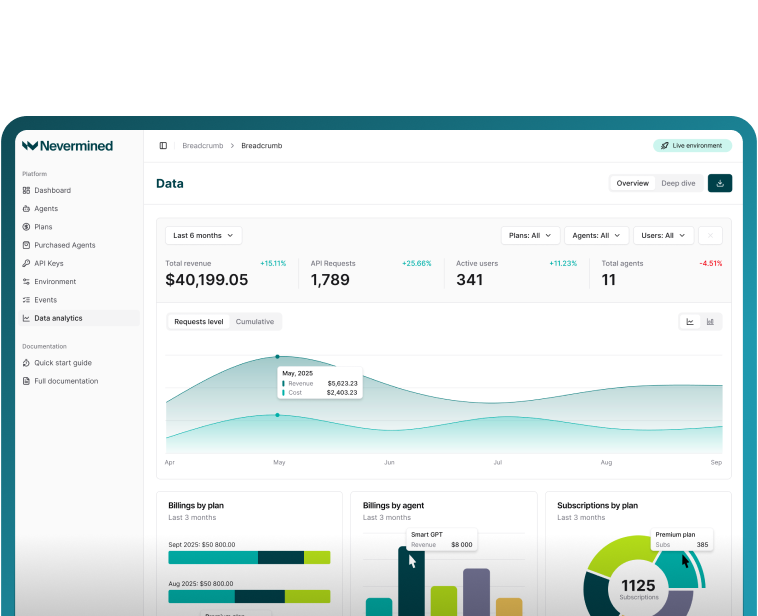
See Nevermined
in Action
Real-time payments, flexible pricing, and outcome-based monetization—all in one platform.