MENU


The AI agent economy has exploded, yet a stark reality persists: McKinsey found that 88% of organizations reported regular AI use in at least one business function in 2025, up from 78% a year earlier. Yet AI execution remains difficult: RAND cites estimates that more than 80% of AI projects fail, and BCG reports that 74% of companies have yet to show tangible value from their AI investments. The solution lies in purpose-built payment infrastructure that handles micro-transactions, agent-to-agent payments, and dynamic pricing models that traditional processors cannot support. With MarketsandMarkets forecasting the AI agents market will reach $52.62 billion by 2030, mastering monetization is no longer optional.
The shift from traditional software monetization to agent-native payments represents a fundamental economic transformation. AI agents perform autonomous, variable work unlike any software before them. A single conversation might involve multiple LLM calls, API requests, and tool invocations, each generating sub-cent costs that traditional pricing models cannot track profitably.
Traditional SaaS pricing relied on predictable patterns: per-seat licenses, flat subscriptions, and annual contracts. AI agents break every assumption underlying these models. Because agents autonomously understand context, identify tasks, and execute a series of steps, no two commands create the same amount of work for an AI agent.
This variability demands infrastructure capable of:
Standard payment processors impose fee structures that destroy AI agent economics. A 2.9% plus $0.30 transaction fee makes sub-dollar requests margin-negative. When AI agents generate hundreds of micro-interactions per session, traditional billing systems cannot reconcile costs profitably.
The infrastructure gap explains why only 26% of organizations have developed the capabilities needed to move beyond proofs of concept and generate tangible value from AI. Building custom billing systems takes months while competitors capturing early market share ship in weeks.
The market has converged on four fundamental pricing frameworks. Each serves different use cases based on value attribution, execution autonomy, and workload predictability. Understanding which model fits your AI agent determines monetization success.
Usage-Based Pricing charges per discrete action. Bland.ai exemplifies this approach with per-minute pricing for AI-powered calls, directly competing with traditional BPOs. This model works when:
Outcome-Based Pricing charges for results, not activities. Intercom prices its Fin AI Agent at $0.99 per outcome. Customers pay only for problems solved, not tokens consumed or minutes elapsed.
Agent-Based Pricing positions AI as FTE replacement. Companies like 11x and Harvey tap headcount budgets that can be 10x larger than IT budgets, pricing AI agents as virtual employees.
Hybrid Models combine predictable base fees with usage tails. Platforms like Lovable and Replit balance predictability for customers with fairness for variable workloads.
The most sophisticated builders implement dynamic pricing that adapts to context. A research agent delivering actionable market intelligence deserves different pricing than one performing routine data retrieval.
Credits serve as abstraction layers aggregating heterogeneous costs into understandable units. Platforms like Clay and Relevance use this approach to simplify billing while maintaining margin integrity.
As AI monetization evolves, trust becomes the critical differentiator. On January 16, 2026, OpenAI said it would begin testing ads in the U.S. for ChatGPT free and Go tiers, a development that signals a structural shift in AI neutrality assumptions.
Tamper-proof metering addresses concerns about trusting AI agents to manage tasks autonomously. Every usage record is cryptographically signed and pushed to an append-only log at creation, making it immutable. The exact pricing rule stamps onto each agent's usage, allowing developers, users, auditors, or agents to verify that usage totals match billed amounts per line-item.
This zero-trust reconciliation model provides:
Enterprise buyers demand infrastructure that satisfies compliance requirements from day one. Platform-managed opaque metering creates adoption barriers as organizations scale AI deployments. The preference-depth revolution moves choice upstream into policies and constraints that agents optimize within, requiring verifiable execution logs.
Multiple competing protocols are reshaping how AI agents transact. Google's A2A protocol launched with more than 50 technology partners including PayPal and Salesforce. Separately, the Universal Commerce Protocol (UCP) is an open-source standard for agentic commerce, and Google Cloud's Agent Payments Protocol (AP2) is a distinct payments-focused effort involving collaboration with more than 60 organizations. Understanding these standards determines infrastructure compatibility as the ecosystem evolves.
Agent-to-agent commerce enables transactions without human involvement through smart accounts with session keys and delegated permissions. Users authorize payment policies once, then agents interact freely within boundaries.
This contrasts with standard implementations requiring wallet pop-ups for each request. For agent-to-agent monetization, seamless autonomous payments become essential as multi-agent systems coordinate complex workflows.
McKinsey estimates global agentic-commerce orchestrated revenue could reach $3 to $5 trillion by 2030, primarily in goods. Morgan Stanley estimates agentic shoppers could represent $190 billion to $385 billion in U.S. e-commerce spending by 2030, equal to roughly 10% to 20% of the market.
Traditional payment infrastructure operates at human speed: business hours, multi-day settlement, manual authorization. AI agents require machine speed infrastructure with:
The x402 HTTP payment protocol enables AI agents to pay for APIs and services using stablecoins. A recent arXiv paper proposes a five-layer "Agent Economy" architecture that argues for permissionless participation and trustless settlement.
In AI payments infrastructure, implementation speed separates market winners from losers. Mordor Intelligence forecasts the agentic AI developer ecosystem and SDK market will grow from $2.40 billion in 2025 to $16 billion by 2030. Capturing this opportunity requires deploying monetization in minutes, not months.
Valory cut deployment time of their payments and billing infrastructure for the Olas AI agent marketplace from 6 weeks to 6 hours using Nevermined, clawing back $1000s in engineering costs. This 168x acceleration demonstrates how infrastructure choice determines competitive positioning.
GitHub reported that developers in one study completed tasks 55% faster with GitHub Copilot, underscoring how the right tooling accelerates development velocity. Nevermined gets you from zero to a working payment integration in 5 minutes, with SDKs for both TypeScript and Python.
In a Microsoft-sponsored IDC report, organizations reported an estimated $3.70 return per dollar invested in GenAI, with top leaders averaging $10.30. These returns materialize only when proper metering and billing infrastructure enables measurement from day one.
Modern documentation provides implementation guides, sandbox environments for testing, and API export for metering data verification. Low-code SDKs eliminate the weeks spent building custom billing systems.
As AI agents transact autonomously, verifiable identity becomes foundational. Each agent needs a unique wallet plus decentralized identifier with cryptographic proof of ownership, creating portable identities that work across environments, swarms, and marketplaces.
Agent identity enables critical capabilities:
Auto-discovery via Google's A2A protocol enables instant agent connection. The W3C DID v1.0 standard and ERC-8004 for on-chain agent identities provide frameworks for portable credentials.
As one industry observer notes, while you can automate commerce, you cannot automate trust. Developing frameworks for identifying legitimate agents, strengthening authentication, and capturing intent when AI transactions go wrong requires robust identity infrastructure.
NVIDIA reports that 86% of respondents expected AI budget increases in 2026, while 88% reported revenue impact and 87% reported cost reductions from AI implementation. Scaling from developer prototypes to enterprise deployments demands infrastructure supporting both extremes.
Multi-chain support across Polygon, Gnosis Chain, and Ethereum enables settlement at scale. Key capabilities include:
Enterprise buyers require bank-grade metering and compliance. Global Market Insights estimates the AI in BFSI market was $26.2 billion in 2024 and could reach $192.7 billion by 2034. Serving this segment demands audit-ready transparency, multi-region deployment, and multi-currency support.
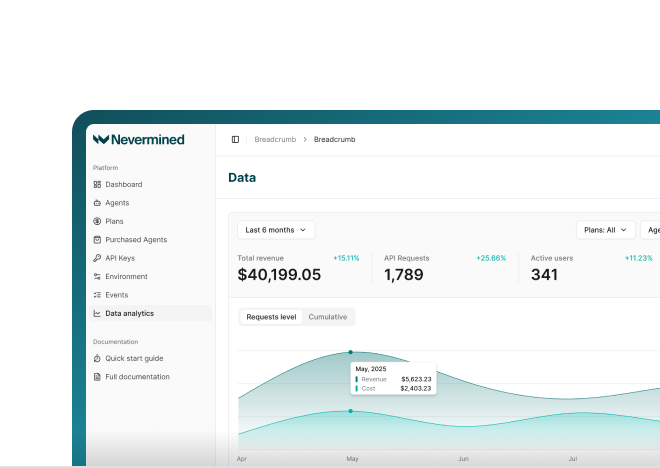
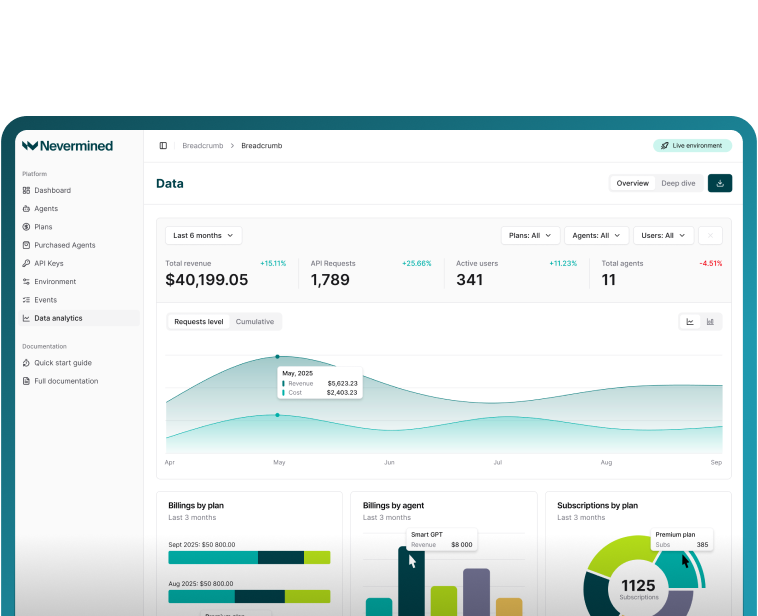
Visibility into agent performance transforms monetization from guesswork to strategy. Real-time observability enables identifying hidden costs and growth opportunities before they impact margins.
Track every request in real-time, billing by cost, usage, or event according to chosen model. Performance dashboards reveal:
By 2026, businesses that thrive will be those that transition from viewing payments as transactional cost to treating them as strategic data assets.
Credits operate as prepaid consumption-based units redeemed directly against usage. This model aligns price to value by charging for micro-actions and rewarding successful outcomes.
Credits enable flexible scaling where resources reallocate across users, departments, or agents without renegotiating licenses. Users prepay credits, monitor burn rate in real-time, and avoid surprise overruns. Finance teams receive trackable recurring billing instead of complex sub-cent charge reconciliation.
The EU AI Act entered into force on 1 August 2024 and applies progressively through 2027, with many rules beginning to apply in 2025 and 2026. Building compliant infrastructure from the start avoids costly retrofitting.
Key compliance considerations include:
Audit-ready traceability through append-only logging satisfies enterprise procurement while enabling independent verification.
While numerous payment platforms exist, Nevermined delivers purpose-built infrastructure specifically designed for AI agents and autonomous systems.
Nevermined delivers bank-grade enterprise-ready metering, compliance, and settlement so every model call turns into auditable revenue. The platform provides:
Unlike generic payment processors, Nevermined provides native support for x402 (HTTP payment protocol), Google's Agent-to-Agent (A2A) protocol, Model Context Protocol (MCP), and Agent Payments Protocol (AP2). This protocol-agnostic approach ensures compatibility as standards evolve, avoiding vendor lock-in.
The platform enables instant settlement in both fiat and cryptocurrency, with card/ACH processing alongside stablecoin settlement. For builders serious about capturing the AI agent opportunity, Nevermined's solutions provide the monetization infrastructure needed for sustainable growth.
Four core models dominate AI agent monetization: outcome-based pricing (charging for results like Intercom's $0.99 per outcome), usage-based pricing (per-token or per-API-call), hybrid pricing (combining base fees with usage tails), and agent-based pricing treating AI as FTE replacement. Most successful implementations combine multiple models through hybrid approaches that balance predictability with fairness. The choice depends on value attribution clarity, workload predictability, and customer willingness-to-pay alignment.
Trust requires tamper-proof metering where every usage record is cryptographically signed and pushed to an append-only log at creation. This creates immutable records that developers, users, auditors, or agents can independently verify. The exact pricing rule stamps onto each agent's usage, enabling line-item reconciliation between usage totals and billed amounts. Zero-trust reconciliation models provide audit-ready transparency that platform-managed opaque metering cannot match.
Agent-to-agent native payment enables transactions between AI agents without human involvement through smart accounts with session keys and delegated permissions. Users authorize payment policies once, then agents interact freely within boundaries. This contrasts with traditional implementations requiring wallet pop-ups for each request. With McKinsey estimating agentic-commerce orchestrated revenue could reach $3 to $5 trillion by 2030, autonomous agent payments become essential infrastructure for the emerging multi-agent economy.
Implementation speed varies dramatically by platform choice. Custom billing systems typically require 4 to 6 weeks of development. Purpose-built infrastructure like Nevermined gets you from zero to a working payment integration in 5 minutes with TypeScript and Python SDKs. Valory demonstrated this acceleration by cutting deployment time for the Olas AI agent marketplace from 6 weeks to 6 hours. Speed determines competitive positioning as early movers capture network effects before competitors finish building custom billing systems.
Yes, often through smart account architectures such as ERC-4337-compatible accounts, with policy controls and session-key mechanisms implemented by specific wallet systems. Users authorize payment policies upfront, then agents execute transactions autonomously within defined boundaries. The x402 HTTP payment protocol enables AI agents to pay for APIs and services using stablecoins, with growing transaction volume across the ecosystem. Blockchain-based settlement provides the 24/7 availability and instant finality that traditional payment infrastructure cannot support for machine-speed transactions.
See Nevermined
in Action
Real-time payments, flexible pricing, and outcome-based monetization—all in one platform.