MENU


Multi-agent systems represent the next frontier of enterprise automation, where specialized AI agents collaborate to solve complex problems no single agent can handle alone. Unlike monolithic AI solutions that attempt everything, these distributed networks assign domain experts to focused tasks: one agent handles research, another validates data, and a third executes transactions. The multi-agent systems market is still early and estimates vary, but Market.us projects the market at $7.2 billion in 2024 growing to $375.4 billion by 2034 (48.6% CAGR), making this one of the fastest-growing enterprise technology segments. For businesses building these systems, the critical challenge lies not in the AI itself but in how agents transact, meter usage, and settle payments at scale. Nevermined's payment infrastructure addresses this gap by enabling AI builders to price, meter, and settle every autonomous agent interaction in real time.
Multi-agent systems coordinate networks of specialized AI agents working together autonomously to handle workflows too complex for individual agents. Each agent focuses on a narrow task, communicates with peers, and collectively delivers enterprise-grade outcomes that single-agent architectures cannot match.
The business case is compelling. In a PagerDuty survey of decision-makers, respondents expected 171% average ROI (and 192% expected ROI in the U.S.), highlighting the perceived upside while outcomes still depend on governance and execution. The same survey reported 51% have deployed agents and 35% plan to deploy within two years.
Key advantages driving adoption include:
Industries leading adoption include financial services (fraud detection), supply chain (logistics optimization), software development (automated SDLC), and customer service (multi-tier support escalation).
Traditional payment processors were built for human-initiated transactions with predictable volumes and human approval workflows. AI agents operate differently, generating high volumes of micro-transactions per minute that require real-time metering, instant settlement, and programmable authorization.
The fundamental mismatch between legacy payment infrastructure and agentic commerce creates several obstacles:
Purpose-built AI payment infrastructure addresses these gaps through usage-based pricing (per-token, per-API-call), outcome-based pricing (charging for results like booked meetings), and value-based pricing (percentage of ROI generated). The ability to support flexible pricing models differentiates modern agentic commerce platforms from retrofitted legacy systems.
Implementation complexity varies dramatically based on framework choice and architecture decisions. The right approach can mean the difference between weeks and months of development time.
Modern frameworks offer dramatically different setup experiences. Typical developer estimates for basic deployments include:
For payment integration specifically, Nevermined gets you from zero to a working payment integration in 5 minutes, with SDKs for both TypeScript and Python. This integration speed has real business impact: Valory cut deployment time of their payments and billing infrastructure for the Olas AI agent marketplace from 6 weeks to 6 hours using Nevermined, clawing back $1000s in engineering costs.
The typical implementation sequence follows seven phases:
Monetizing AI agents requires pricing models that align cost with value delivered. The dynamic pricing engine approach enables cost-plus-margin automation where platforms define exact margin percentages locked onto usage credits.
Three pricing models dominate agentic commerce:
Most competitors support only usage-based models. The ability to implement outcome and value-based pricing creates differentiation and aligns incentives between providers and consumers.
Credits systems operate as prepaid consumption-based units redeemed directly against usage. Users prepay credits, monitor burn rate in real-time, and avoid surprise overruns. Finance teams receive trackable recurring billing instead of complex sub-cent charge reconciliation. This approach proves particularly valuable given that multi-agent workflows can materially increase token consumption compared to single-agent implementations, making cost monitoring non-negotiable.
Enterprise adoption hinges on trust, yet Capgemini reports trust in fully autonomous AI agents fell to 27%, down from 43%, a major adoption barrier enterprises must solve with auditability and controls.
Tamper-proof metering addresses trust concerns by ensuring every usage record is cryptographically signed and pushed to an append-only log at creation. The exact pricing rule stamps onto each agent's usage credit, allowing developers, users, auditors, or agents to verify that usage totals match billed amounts per line-item.
This zero-trust reconciliation model provides:
Gartner predicts over 40% cancellation of agentic AI projects by the end of 2027 due to escalating costs, unclear business value, or inadequate risk controls, making governance and metering non-optional. Organizations implementing tamper-proof metering from day one avoid this failure mode.
The agentic economy requires standardized protocols enabling agents to communicate, authenticate, and transact across organizational boundaries. Protocol-first architecture ensures compatibility as standards evolve while avoiding vendor lock-in.
Key protocols shaping the landscape include:
Agent identity systems issue each agent a unique wallet plus decentralized identifier (DID) with cryptographic proof of ownership. These portable identities work across environments, swarms, and marketplaces without re-wiring, enabling persistent reputation tracking and fine-grained entitlement control.
Microsoft's reference architecture emphasizes that agent registries and identity management become critical infrastructure as multi-agent deployments scale beyond pilot programs.
The most transformative capability of multi-agent systems is enabling transactions between AI agents without human involvement. This requires fundamentally different payment architecture than traditional consumer or B2B processing.
Agent-to-agent payments leverage ERC-4337 smart accounts with session keys and delegated permissions. Users authorize payment policies once, then agents interact freely within defined boundaries. This contrasts with standard implementations requiring wallet pop-ups for each request, which creates unacceptable friction in autonomous workflows.
Technical capabilities enabling agent-to-agent monetization include:
Forbes contributor Mark Minevich predicts multi-agent orchestration will be pivotal in 2026, with autonomous commerce representing the economic layer enabling this transformation.
Production multi-agent systems require comprehensive observability and regulatory compliance capabilities that exceed typical software deployments.
Effective observability encompasses several dimensions:
Compliance requirements for enterprise deployments include GDPR (with explicit article citations), SOC 2 Type II certification, and industry-specific standards like HIPAA for healthcare or PCI-DSS for financial services. Audit-ready traceability through append-only logging satisfies most regulatory frameworks.
Multi-agent security threats require specific mitigation strategies:
Circuit breakers, runtime monitoring, and human-in-the-loop approval for critical actions address these vulnerabilities.
The multi-agent systems market growing at 48.6% CAGR through 2034 signals a fundamental shift in how enterprises operate. Early movers gain competitive advantages through process automation, cost reduction, and capability expansion that laggards cannot quickly replicate.
Strategic considerations for sustainable multi-agent deployments include:
The Anthropic research system demonstrates production patterns for parallel agent coordination and evaluation strategies that enterprises can adapt. Similarly, Microsoft case studies show organizations achieving results such as allowing MSSPs to manage 3 times more customers per analyst through well-architected multi-agent deployments.
For businesses building multi-agent systems, Nevermined provides the payment infrastructure that makes autonomous commerce possible. Nevermined Pay delivers bank-grade enterprise-ready metering, compliance, and settlement so every model call turns into auditable revenue, highlighting ledger-grade metering, dynamic pricing engine, credits-based settlement, 5x faster book closing, and margin recovery.
The platform's protocol-first architecture natively supports x402, Google's A2A protocol, Model Context Protocol (MCP), and Agent Payments Protocol (AP2), ensuring compatibility as standards evolve. This approach avoids the vendor lock-in that plagues proprietary systems while enabling agent-to-agent payments without human intervention.
Key differentiators for enterprise multi-agent deployments:
As David Minarsch, CEO of Valory, stated: "We knew AI agents need to be able to transact, so over a year ago we tapped into Nevermined. Nevermined was, and continues to be, the best solution for AI payments."
Multi-agent systems are coordinated networks of specialized AI agents that work together autonomously to solve complex business problems. Unlike single agents attempting all tasks, MAS distribute work across domain experts. Vendor reports cite 30-50% reduction in manual task completion and $2.1 million average annual savings per implementation, though results depend on scope, governance, and execution. For businesses facing complex workflows with multiple handoffs, MAS provide the distributed intelligence architecture that monolithic AI cannot match.
Agent monetization requires purpose-built payment infrastructure supporting usage-based pricing (per-token, per-API-call), outcome-based pricing (charging for results like completed tasks), and value-based pricing (percentage of ROI generated). Credits systems allow prepaid consumption units redeemed against usage, enabling real-time burn rate monitoring and predictable billing. Most legacy payment processors support only usage-based models, limiting monetization flexibility.
The primary challenges include handling micro-transaction volumes that overwhelm traditional batch processing, achieving sub-second payment confirmation versus T+1 settlement windows, and managing the significant token consumption increase that multi-agent workflows introduce over single-agent systems. Additionally, authorization models must support autonomous operation without human approval bottlenecks while maintaining security through session keys, spending limits, and audit trails.
Yes, modern frameworks provide extensive integration capabilities. LangChain offers ecosystem connectors for common business tools, Google ADK provides 100+ native connectors for Google Cloud services, and protocol standards like MCP enable standardized agent-to-tool connections. API integration with existing ERP, CRM, and data warehouse systems typically requires thin wrappers around existing endpoints, with implementation timelines of 2-4 weeks for simple integrations.
Protocol-first architecture ensures compatibility as industry standards evolve while avoiding vendor lock-in from proprietary systems. Native support for x402, Google's A2A, MCP, and AP2 enables seamless agent-to-agent communication across organizational boundaries. This approach future-proofs investments by allowing agents to transact with any compliant counterparty, regardless of underlying technology stack, creating network effects that amplify business value over time.
Join the Autonomous Business Hackathon on March 5 to 6, 2026 in downtown San Francisco to build autonomous businesses where agents make real economic decisions, transact with each other, and run with minimal human oversight.
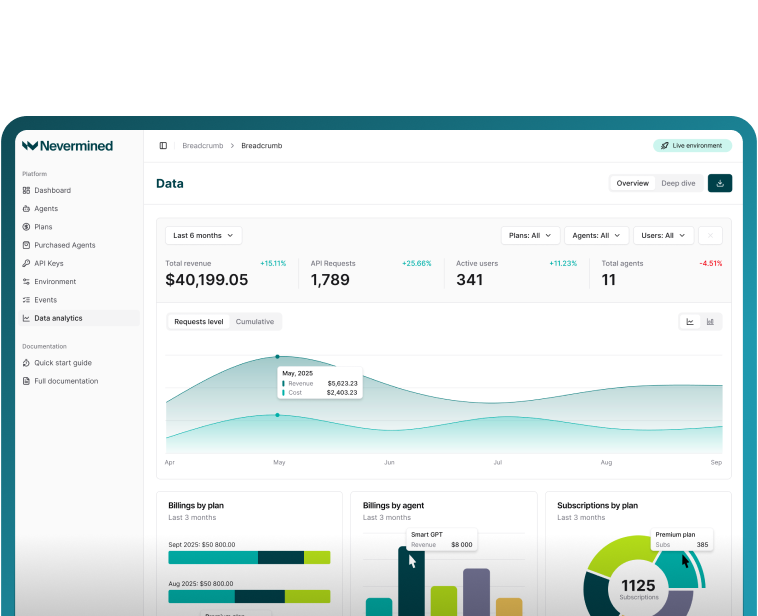
See Nevermined
in Action
Real-time payments, flexible pricing, and outcome-based monetization—all in one platform.