MENU


Comprehensive data analysis revealing the explosive growth trajectory of multi-agent systems and the critical payment infrastructure required to monetize autonomous agent interactions
The multi-agent systems market is poised for extraordinary expansion, with projections showing growth from USD 7.2 billion in 2024 to USD 375.4 billion by 2034. This 50x surge creates unprecedented opportunities for AI builders, but traditional payment processors cannot handle the micro-transactions, per-token billing, and agent-to-agent settlements that define autonomous commerce. Nevermined's payment infrastructure addresses this gap directly, enabling real-time metering, flexible pricing models, and instant settlement in fiat or cryptocurrency for every agent interaction.
Market.us reports the global multi-agent system market reached USD 7.2 billion in 2024, establishing the foundation for explosive growth in distributed AI architectures.
The same research projects this market will surge to USD 375.4 billion by 2034, representing a 48.6% compound annual growth rate throughout the forecast period.
Precedence Research provides an even more aggressive estimate, projecting the market will reach USD 391.94 billion by 2035 at 47.52% CAGR from 2026 to 2035.
Mordor Intelligence confirms the platform segment alone reached USD 7.81 billion in 2025 and is projected to touch USD 54.91 billion by 2030.
The platform segment is growing at 47.71% CAGR over the forecast period, indicating sustained demand for multi-agent coordination capabilities.
Grand View Research reports the multi-agent systems segment generated USD 2,156.1 million in 2024 and is expected to reach USD 22,419.5 million by 2030.
Market Intelo provides a more conservative projection, valuing the market at $2.1 billion in 2024 and forecasting USD 8.7 billion by 2033 at 16.9% CAGR.
About 25% of organizations using generative AI plan to implement autonomous AI agents as part of their operational workflows in 2025, creating immediate demand for agent monetization infrastructure.
According to PwC's 2025 survey cited by Market.us, 88% of company decision-makers increased their AI budgets, signaling substantial investment in agent capabilities.
Among companies investing in AI, 35% reported improved performance due to agentic AI systems, validating the business case for autonomous agent deployment.
About 33% of enterprise software platforms will feature agentic AI capability with intelligent orchestration within the next few years, embedding agents throughout business operations.
Large enterprises account for over 60% of market revenue in 2024, establishing enterprise-grade requirements for payment and billing infrastructure that Nevermined delivers through bank-grade metering and compliance.
Precedence Research confirms large enterprises held approximately 65.1% revenue share in the multi-agent system platform market in 2025.
The small and medium enterprises segment is expected to grow at a solid CAGR between 2026 and 2035 as agent technology becomes more accessible.
Mordor Intelligence reports the convergence of LLM-based agents and traditional reinforcement learning frameworks adds 9.1% impact on CAGR forecast, driving innovation.
Cloud-native MAS deployment contributes an additional 8.2% impact on CAGR forecast as enterprises migrate from pilots to production.
Warehouse-automation demand for multi-robot orchestration adds 6.4% impact on CAGR forecast, reflecting logistics sector investment.
Edge-AI cost decline enabling on-device agents adds 5.8% impact on CAGR forecast, expanding deployment possibilities.
Decision-support and planning agents will grow the fastest at 48.8% CAGR, indicating demand for strategic AI capabilities.
Autonomous-agent SaaS is slated for a 53.2% CAGR, representing the fastest-growing delivery model for multi-agent systems.
Cloud deployment captured 72.1% of the market, driven by scalability, faster data processing, and ease of integration across distributed AI systems.
Mordor Intelligence reports cloud delivery held 78.4% market share in 2024, confirming cloud dominance in agent deployment.
Edge setups are expected to grow at a 58.4% CAGR as organizations seek low-latency control and data-sovereignty compliance.
The hybrid/edge deployment segment is expected to expand at the fastest CAGR from 2026 to 2035, balancing cloud benefits with local control.
The software segment dominates the multi-agent systems market, contributing over 55% of total revenue in 2024.
MAS solutions and platforms held a dominant revenue share of approximately 61.7% in 2025, establishing platforms as the primary delivery mechanism.
The professional services segment for integration and consulting is expected to grow at the highest CAGR between 2026 and 2035.
Scarcity of MAS-ready talent and standards subtracts 4.3% from prospective growth, highlighting the need for low-code integration solutions.
Cyber-security and agent-level attack surface shaves 3.8% off forecast expansion, underscoring the importance of secure payment infrastructure.
Orchestration platforms contributed 41.2% of 2024 revenue, coordinating agent workflows that require granular usage tracking. Nevermined's tamper-proof metering ensures every usage record is cryptographically signed and pushed to an append-only log, enabling audit-ready traceability across agent operations.
The workflow and process orchestration segment held a major revenue share of approximately 35% in 2025, managing complex agent interactions.
The BFSI segment contributed the biggest revenue share of approximately 21% in 2025, where compliance and audit requirements are most stringent.
The manufacturing industry led end-use adoption with 28.7%, reflecting growing use of multi-agent coordination in robotics, automation, and predictive maintenance.
Mordor Intelligence confirms manufacturing generated 28.3% of 2024 spending on multi-agent systems.
The robotics application segment leads the market, accounting for approximately 27% of total MAS deployments in 2024.
Multi-robot coordination applications captured 34.6%, supported by advancements in autonomous systems and collaborative industrial robotics.
Coordinating fleets of robots accounts for 33.4% of 2024 revenue, requiring real-time metering for each robot interaction.
The multi-robot and autonomous systems coordination segment is expected to grow at the highest CAGR between 2026 and 2035.
Smart cities and infrastructure will clip along at 48.1% CAGR, deploying agents for traffic management and urban optimization.
The global operational stock of industrial robots reached 4,664,000 units in 2024, marking a 9% rise from 2023.
The Business Research Company reports the market reached USD 5.97 billion in 2025, projected to expand to USD 8 billion by 2026 at 33.9% CAGR.
The same source projects the market will hit USD 25.47 billion by 2030 with a 33.6% CAGR.
Grand View Research reports the multi-agent systems segment is expected to grow at 48.4% CAGR by 2030.
Manufacturing facilities reported double-digit scrap reduction after deploying reinforcement-learning agents for quality control.
Warehouse operators slash picker walking distance and boost order throughput using multi-agent coordination.
In 2024, North America held 46.7% market share, capturing USD 3.3 billion in revenue.
The U.S. market reached USD 3.01 billion in 2024, expanding at an exceptional 45.1% CAGR.
Precedence Research projects the U.S. market will reach USD 124.28 billion in 2035 at 47.79% CAGR.
North America led the multi-agent system platform market with approximately 41.5% global share in 2025.
Asia-Pacific is set to post a blistering 47.9% CAGR through 2030, representing the fastest-growing region.
South Korea is expected to register the highest CAGR from 2025 to 2030 among individual countries.
Market Intelo projects Asia-Pacific at 19.7% CAGR during the forecast period, the highest regional growth rate.
The path to monetizing multi-agent systems requires purpose-built payment infrastructure rather than retrofitted traditional solutions. Organizations successfully deploying agent payment systems share these characteristics:
Architecture Priorities:
Pricing Configuration:
Integration Approach:
The Nevermined documentation provides comprehensive implementation guides for TypeScript and Python SDKs.
A multi-agent system consists of multiple autonomous AI agents that coordinate, communicate, and collaborate to accomplish tasks that would be difficult or impossible for a single agent. Unlike traditional AI applications that respond to individual requests, multi-agent systems feature distributed intelligence where agents specialize in different functions such as planning, execution, and error correction. This architecture enables real-time responsiveness in dynamic environments and enhanced operational efficiency through parallel processing.
Traditional payment processors were designed for human-initiated transactions with predictable timing and value ranges, making them fundamentally incompatible with agent-generated micro-transactions. AI agents generate sub-cent charges at machine speed, often requiring per-token or per-API-call billing that legacy systems cannot process efficiently. Additionally, agent-to-agent interactions occur without human oversight, requiring automated authorization, metering, and settlement that traditional processors lack.
Tamper-proof metering works by cryptographically signing every usage record and pushing it to an append-only log at creation, making records immutable and independently verifiable. The exact pricing rule stamps onto each agent's usage credit, allowing developers, users, auditors, or agents to verify that usage totals match billed amounts per line item. This zero-trust reconciliation model addresses the trust deficit that causes many organizations to require human oversight for autonomous agents.
Outcome-based pricing charges for results rather than resource consumption, aligning costs with the actual value delivered by agents such as completed tasks, booked meetings, or resolved support tickets. Value-based pricing calculates charges as a percentage of ROI generated, ensuring that pricing scales with business impact. These models create stronger alignment between agent providers and customers compared to usage-only billing, which can penalize efficiency improvements.
Nevermined gets you from zero to a working payment integration in five minutes, with SDKs for both TypeScript and Python that handle metering, pricing, and settlement automatically. This speed advantage is demonstrated by real-world deployments where teams have cut implementation timelines from weeks to hours. The low-code approach minimizes professional services requirements while comprehensive documentation and sandbox environments support rapid testing and iteration.
See Nevermined
in Action
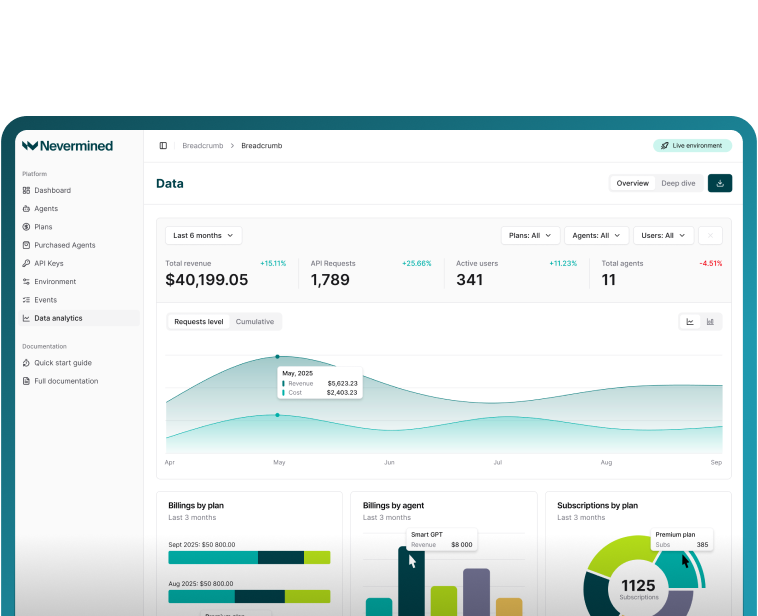
Real-time payments, flexible pricing, and outcome-based monetization—all in one platform.