MENU


Comprehensive data analysis revealing why the agentic economy demands purpose-built payment infrastructure for AI monetization
The multi-agent systems market is surging toward a $375.4 billion valuation by 2034, yet most AI builders struggle to capture their share of this growth. The core problem: traditional billing systems cannot handle the micro-transactions, real-time metering, and autonomous agent interactions that define the agentic economy. Nevermined provides payments infrastructure specifically designed for AI agents, enabling usage-based billing, instant settlement, and agent-to-agent transactions that turn every model call into auditable revenue.
Multi-agent systems represent coordinated networks of AI agents that operate autonomously, communicate with each other, and execute complex tasks without constant human oversight. The global market generated $7.2 billion in 2024 and continues expanding at an exceptional pace.
The multi-agent system market reached $7.2 billion in 2024, establishing a substantial foundation for the explosive growth ahead. This baseline reflects increasing enterprise adoption of coordinated AI agent architectures.
Market forecasts project the multi-agent system market will grow to $375.4 billion by 2034, representing a 52x increase from current valuations. This trajectory creates urgent demand for payment infrastructure capable of handling billions of autonomous transactions.
The market is expanding at a 48.6% compound annual growth rate through 2034, making it one of the fastest-growing segments in enterprise technology. This growth rate outpaces most AI subsectors.
The multi-agent system platform market specifically reached $7.81 billion in 2025, indicating strong demand for orchestration and deployment infrastructure.
Mordor Intelligence projects the MAS platform market will reach $54.91 billion by 2030, growing at 47.71% CAGR. This creates a massive opportunity for builders who can effectively monetize their agent deployments.
The broader AI agents market is projected to grow from $7.84 billion in 2025 to $52.62 billion by 2030, registering 46.3% CAGR. This encompasses all intelligent agent deployments across industries.
A single AI "conversation" can trigger hundreds of micro-activities with sub-cent costs. Traditional seat-based or subscription pricing models break down when unit economics become unreadable at this granularity. The agentic economy requires per-token, per-API-call, and per-GPU-cycle pricing with guaranteed margin built in.
The agentic AI market, which drives much of multi-agent system demand, was valued at $5.25 billion in 2024. This segment requires payment systems that can meter autonomous actions in real-time.
The agentic AI market is forecast to reach $199.05 billion by 2034, growing at 43.84% CAGR. Traditional payment processors lack the infrastructure to handle this scale of autonomous transactions.
A PwC survey found that 88% of company decision-makers increased their AI budgets in 2025. This spending surge demands billing systems that can track and meter diverse AI workloads accurately.
About 25% of organizations using generative AI plan to implement autonomous AI agents in 2025. These deployments require payment infrastructure capable of agent-to-agent transactions without human involvement.
Nevermined Pay addresses these limitations through real-time metering, flexible pricing models, and instant payouts in fiat or cryptocurrency, enabling AI builders to capture revenue from every micro-action.
As multi-agent systems mature, agents must transact with each other without human intervention. This requires payment infrastructure that supports emerging standards like Google's Agent-to-Agent (A2A) protocol and Model Context Protocol (MCP).
Reports indicate 79% of organizations will have adopted agentic AI by 2025. This widespread adoption accelerates demand for agent-native payment capabilities.
An overwhelming 96% of organizations plan to expand their agentic AI usage in 2025. This expansion requires scalable billing infrastructure that can grow with deployment complexity.
Nearly 47% of Fortune 500 companies have implemented multi-agent systems for business process automation. Enterprise-scale deployments demand audit-ready payment systems with compliance guarantees.
Market adoption data shows 40% of Fortune 500 companies using CrewAI's AI agents, demonstrating how quickly enterprise adoption is scaling. These complex deployments generate millions of billable micro-transactions daily.
Nevermined's x402 integration extends payment capabilities for advanced agent interactions, enabling seamless agent-to-agent commerce across decentralized networks.
Enterprise procurement teams require audit-ready transparency before approving AI agent deployments. Tamper-proof metering systems create buyer trust through independent verification where every usage record is signed and pushed to an append-only log.
PwC research shows 35% of decision-makers report improved performance due to agentic AI systems. Capturing this value requires billing systems that accurately meter every contributing action.
Large enterprises account for over 60% of MAS market revenue in 2024. Enterprise buyers demand bank-grade metering, compliance, and settlement before signing contracts.
Projections indicate 33% of enterprise software platforms will feature intelligent orchestration capability within the next few years. This integration requires verifiable billing for every orchestrated action.
The software segment contributes over 55% of total MAS market revenue in 2024. Software-based deployments benefit most from automated, transparent billing systems.
Nevermined's documentation provides implementation guides for ledger-grade metering, dynamic pricing engines, and credits-based settlement that deliver 5x faster book closing and margin recovery for enterprise deployments.
The agentic economy supports three pricing models that can be mixed: usage-based (pay-per-request), outcome-based (charging for results), and value-based (percentage of ROI). This flexibility allows AI companies to start with cost-covering baselines and layer success fees where appropriate.
Companies achieve an average ROI of 171% from agentic AI deployments. Capturing this return requires billing systems that can price based on value delivered, not just resources consumed.
U.S. enterprises specifically achieve 192% ROI from agentic deployments, demonstrating the premium value these systems deliver. Value-based pricing can capture a portion of this ROI uplift.
Agentic AI delivers 3x higher ROI compared to traditional automation approaches. This performance differential justifies outcome-based pricing models that reward successful completions.
MAS implementations deliver $2.1 million in annual cost reductions on average. Value-based pricing models can capture a percentage of these savings as recurring revenue.
Deployments achieve 28% customer satisfaction improvements, creating measurable outcomes that support outcome-based billing strategies.
North America held a dominant 46.7% share of the multi-agent system market in 2024. This leadership position reflects concentrated AI investment and enterprise adoption.
North American MAS market revenue reached $3.3 billion in 2024, establishing the region as the primary revenue driver for the industry.
The United States specifically generated $3.01 billion in MAS market revenue in 2024, comprising the vast majority of North American activity.
The U.S. multi-agent system market is expanding at an exceptional 45.1% CAGR, outpacing many other technology segments.
The Asia-Pacific MAS platform market is poised to grow fastest at 47.9% CAGR through 2030. This expansion creates opportunities for builders serving global markets.
North America's agentic AI market accounted for about 46% of 2024 global revenues (roughly $2.4 billion), with the overall market projected to grow at a 43.84% CAGR through 2034.
Cloud deployment dominates the multi-agent system market with 72.1% share in 2024. Cloud-native architectures require billing systems that scale elastically with usage.
Cloud delivery specifically dominated the MAS platform market with 78.4% share in 2024, underscoring the importance of cloud-compatible payment infrastructure.
Edge implementations will advance at 58.4% CAGR through 2030, creating new billing challenges for distributed agent deployments.
Orchestration platforms captured 41.2% of the MAS platform market in 2024. These platforms coordinate complex agent interactions requiring granular billing.
Autonomous-agent SaaS is set to compound at 53.2% CAGR through 2030, representing the fastest-growing deployment model.
The cloud-based agentic AI segment accounted for 62% market share in 2024, confirming cloud as the dominant delivery mechanism.
The manufacturing sector leads multi-agent system adoption with 28.7% of total market share in 2024. Industrial applications generate high volumes of metered transactions.
The technology and software segment dominated the agentic AI market with 38% share in 2024, driven by code generation, testing, and optimization use cases.
Customer service and virtual assistants are expected to account for approximately 78.65% of AI agent market share by 2035, representing the dominant application category.
Cognitive agents including virtual assistants held 34% market share in 2024, demonstrating strong demand for conversational AI monetization.
Valory cut deployment time of their payments and billing infrastructure for the Olas AI agent marketplace from 6 weeks to 6 hours using Nevermined, clawing back $1000s in engineering costs. This acceleration demonstrates how purpose-built payment infrastructure transforms time-to-market for AI agent builders.
A financial services case study showed multi-agent systems improved fraud detection from 87% to 96% accuracy. This outcome improvement supports value-based billing models.
The same deployment achieved a 65% reduction in false positives, creating measurable value that justifies premium pricing.
The implementation generated $18.7 million in annual fraud prevention savings, demonstrating the enterprise-scale revenue potential of well-monetized multi-agent systems.
For teams building AI agent platforms, Nevermined's solutions provide the complete monetization stack from real-time metering to instant settlement.
Hybrid belief-desire-intention agents generated 41% market share in 2024, indicating complex agent architectures that require sophisticated billing approaches.
Learning and adaptation frameworks captured 29% market share in 2024. These evolving systems benefit from dynamic pricing that adjusts with capability improvements.
Nevermined's open-protocol-first approach builds compatibility with emerging standards like Google's A2A protocol and Model Context Protocol (MCP), ensuring AI builders avoid rebuilds and vendor lock-in as standards evolve.
Successful multi-agent system monetization requires infrastructure that handles complexity without burdening development teams. Key priorities include:
For implementation guidance, contact Nevermined to discuss your multi-agent monetization requirements.
Traditional billing systems cannot handle the micro-transactions inherent in AI workloads, where a single conversation can trigger hundreds of sub-cent costs that make unit economics unreadable with seat-based or subscription models. Multi-agent systems require per-token, per-API-call billing with real-time metering and instant settlement capabilities. Purpose-built AI payment infrastructure addresses these challenges through specialized transaction processing designed for autonomous agents.
Purpose-built AI payment infrastructure provides agent-to-agent native transactions without human involvement and support for emerging protocols like A2A and MCP. These systems offer tamper-proof metering that creates audit-ready transparency, capabilities that are absent from legacy payment processors designed for human commerce. This specialized infrastructure enables the micro-transaction volumes and autonomous operations that define the agentic economy.
Companies achieve an average ROI of 171% from agentic AI deployments, with U.S. enterprises reaching 192%. Additional benefits include $2.1 million in annual cost reductions and 28% customer satisfaction improvements, making proper monetization infrastructure essential for capturing full value. These returns demonstrate why purpose-built payment systems are critical for maximizing multi-agent system revenue potential.
Yes, modern AI payment platforms support three pricing models that can be combined: usage-based (cost-inferred pay-per-request), outcome-based (charging for results achieved), and value-based (percentage of ROI generated). This flexibility allows builders to start with cost-covering baselines and layer success fees where appropriate. The hybrid approach enables revenue optimization as agent capabilities and customer value evolve.
Every usage record is cryptographically signed and pushed to an append-only log at creation, making it immutable. The exact pricing rule is stamped onto each agent's usage credit, allowing developers, users, auditors, or agents to verify that usage totals match billed amounts per line-item. This zero-trust reconciliation satisfies enterprise procurement requirements and creates the transparency necessary for large-scale multi-agent system adoption.
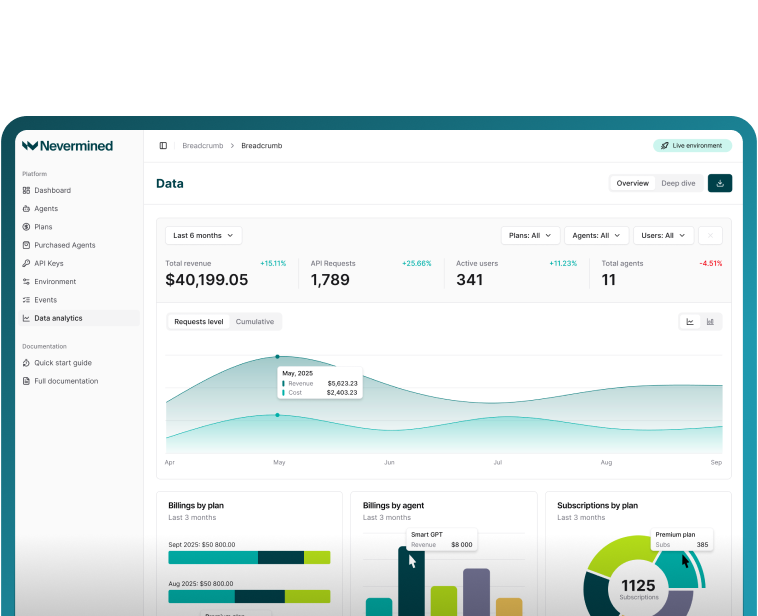
See Nevermined
in Action
Real-time payments, flexible pricing, and outcome-based monetization—all in one platform.