MENU


AI agent builders face a critical tension: enterprise buyers demand predictable costs for OPEX budgeting, but AI workloads vary widely between simple and complex tasks. Traditional seat-based pricing leaves money on the table, while pure usage-based pricing creates bill shock and churn. Modern AI payment infrastructure solves this dilemma through hybrid pricing models that combine platform fees with flexible usage and outcome components, enabling AI companies to capture the agentic economy often forecast to grow from $7.38 billion to $47.1 billion by 2030.
The fundamental problem with AI agent pricing stems from the massive variance in compute costs. A simple chatbot query might cost fractions of a cent, while a complex multi-step research workflow can consume dollars in LLM calls, API integrations, and vector database queries. This substantial variance breaks traditional pricing models entirely.
Traditional pricing approaches fail for AI agents because:
The buyer expectation gap compounds these challenges. CFOs want predictable OPEX budgets with annual contracts and clear line items. AI agents deliver variable consumption, token-based billing, and usage spikes during complex tasks. Research shows 47% of buyers struggle to define measurable outcomes, while 36% cite cost predictability as their primary concern.
Usage-based pricing aligns costs with value delivered, but requires safeguards to maintain predictability. The key is implementing granular metering with built-in protections against bill shock.
Effective usage-based systems include multiple protection layers:
Different metrics suit different buyer personas:
Token-based pricing works for technical buyers who understand infrastructure costs. Example: pricing per 1,000 tokens with millions of tokens included monthly.
Task-based pricing resonates with business workflow buyers. Example: pricing per conversation, per resolution, or per meeting booked.
Time-based pricing simplifies complex workflows. Example: pricing per hour of agent work.
The common pattern combines a predictable platform fee with flexible usage pricing. A monthly base covers fixed costs and guarantees revenue, while usage charges capture upside from heavy adopters.
Outcome-based pricing represents the frontier of AI agent monetization, charging for results achieved rather than resources consumed. Companies using outcome-based models can achieve 94% gross margins compared to sometimes negative margins for pure usage approaches.
Outcome-based pricing excels when:
Successful outcome pricing requires careful structuring:
Real examples include Intercom listing $0.99 per successful resolution in customer service or outcome-based pricing per qualified opportunity in recruiting. The key is explicit success criteria documented before deployment.
Trust becomes critical when vendors run both the agent and the meter. Buyers must take billing on faith unless independent verification exists. This is where tamper-proof metering creates competitive advantage.
Effective metering systems provide:
This zero-trust reconciliation model satisfies enterprise procurement teams requiring audit-ready transparency. Any developer, user, auditor, or agent can verify that usage totals match billed amounts per line item.
For enterprises, this translates to audit-ready metering with ledger-grade accuracy, a dynamic pricing engine that adapts to business rules, credits based settlement for predictable spend, and the potential for 5x faster closing through automated reconciliation.
Agent-to-agent transactions represent a unique challenge that traditional payment processors cannot handle. When AI agents autonomously trigger workflows, make purchases, or pay for services without human involvement, they need payment rails designed for machine-to-machine commerce.
Key capabilities for autonomous agent payments include:
The agentic economy requires payment infrastructure that understands these unique requirements. Traditional processors may require extensive custom development for AI-specific use cases, consuming significant time on access control and subscription setup.
Implementation speed determines competitive advantage. Custom-built billing systems require significant time and investment in engineering resources. Purpose-built platforms compress this timeline considerably.
Choose a platform if:
Build custom if:
The hidden costs of building include ongoing maintenance as AI provider APIs change frequently, edge case handling for custom deals and failed payments, and opportunity cost where every hour on billing is an hour not improving agents.
Modern platforms offer low-code SDKs in TypeScript and Python with rapid integration times. The typical setup sequence includes:
Detailed implementation guidance is available in the Nevermined documentation.
Secure, persistent identity becomes essential as agents operate across multiple platforms and marketplaces. Without standardized identification, agents cannot maintain reputation, payment history, or authorization across environments.
Effective agent identity systems provide:
This approach reduces platform lock-in fears by ensuring that even if an agent moves platforms, its identity and revenue streams remain intact.
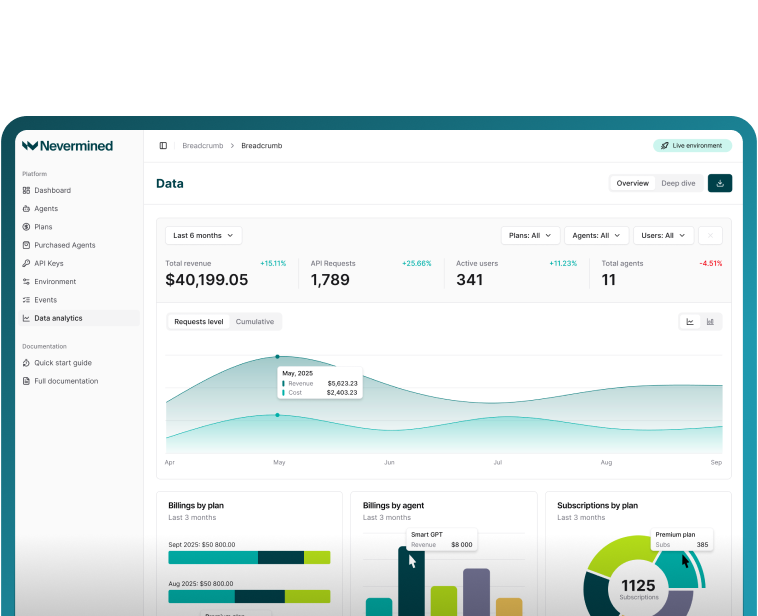
Visibility into agent economics enables data-driven pricing decisions. Without real-time analytics, teams cannot identify which features drive growth, which customers erode margins, or where pricing leaves money on the table.
Essential analytics capabilities include:
Research suggests many pricers experience margin erosion on complex workflows. Simple tasks can yield 80%+ margins while complex tasks drop to 0-20%. Real-time analytics reveal these patterns before they destroy unit economics.
Different customer segments require different solutions. Solo developers need plug-and-play API libraries and open-source code. AI startups need fast time-to-market for billing infrastructure. Enterprise platforms need audit-ready metering and compliance at global scale.
Solo developers and solopreneurs:
AI agent startups:
Enterprise AI platforms:
Leading AI companies have significantly reduced deployment time for payments and billing infrastructure using purpose-built platforms, recovering substantial engineering costs.
The agentic economy requires open standards to prevent fragmentation and vendor lock-in. Support for emerging protocols like Google's Agent-to-Agent (A2A) and Model Context Protocol (MCP) ensures compatibility as the ecosystem evolves.
Open-protocol approaches provide:
With many organizations expecting significant ROI from AI agents, the pressure to monetize effectively will only increase. Building on open standards today prevents costly rebuilds tomorrow.
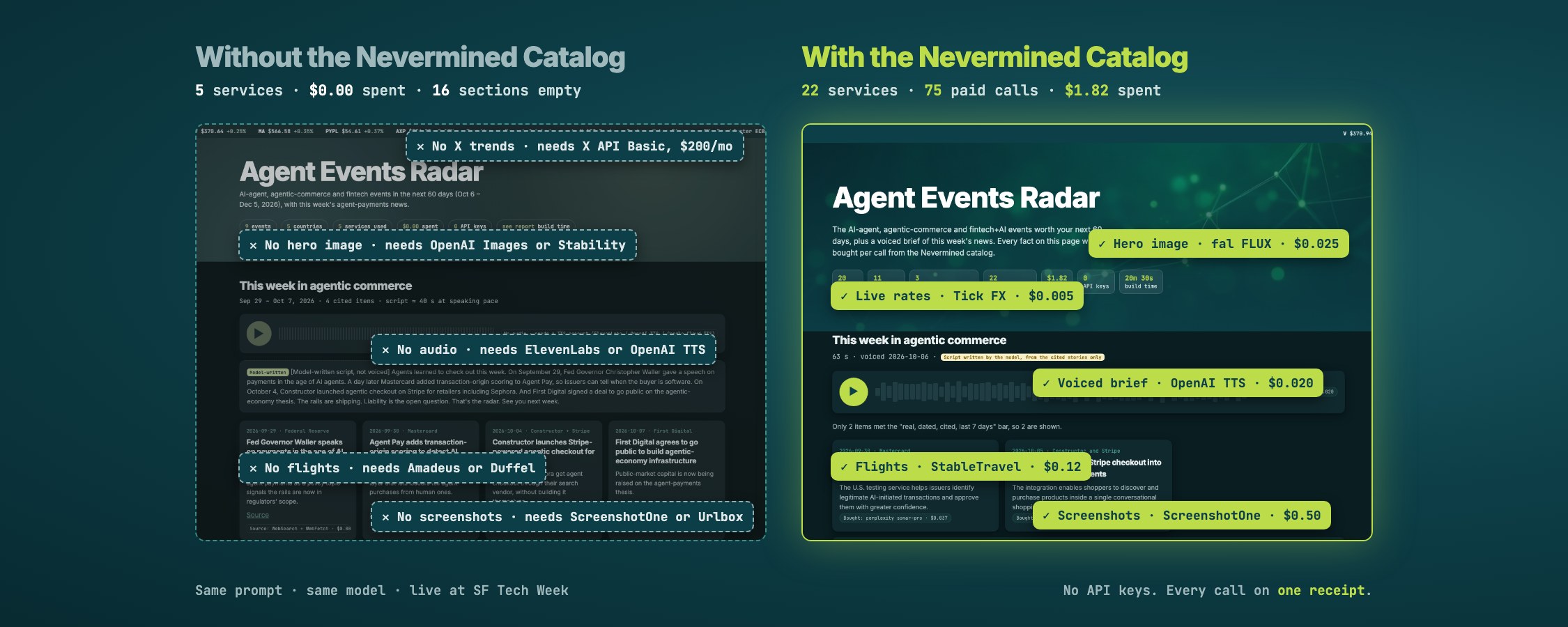
While multiple approaches exist for AI agent monetization, Nevermined provides purpose-built infrastructure specifically designed for the pricing challenges outlined in this article.
Nevermined Pay addresses the predictability-flexibility dilemma through:
For enterprises, Nevermined Pay delivers audit-ready enterprise metering, compliance, and settlement so every model call turns into auditable revenue. This includes ledger grade metering, a dynamic pricing engine, credits based settlement, faster book closing, and margin recovery capabilities.
Nevermined ID provides persistent agent identification through cryptographically-signed wallet addresses and DIDs that persist across networks and marketplaces, solving the identity fragmentation problem that plagues multi-agent systems.
To explore how Nevermined can solve your AI agent monetization challenges, visit the solutions page or contact the team directly.
Traditional payment processors like Stripe may require extensive custom development for AI-specific use cases. They lack agent-native integrations, support for emerging protocols like MCP, and agent-to-agent payment capabilities. A single agent conversation can trigger hundreds of micro-activities with sub-cent costs that traditional systems cannot meter or bill efficiently. Purpose-built AI infrastructure handles per-token pricing with guaranteed margins.
Implement tamper-proof metering where every usage record is cryptographically signed and pushed to an append-only log at creation. The exact pricing rule should be stamped onto each transaction, allowing any developer, user, auditor, or agent to verify that usage totals match billed amounts per line item. This zero-trust model satisfies enterprise procurement teams requiring audit-ready transparency.
Outcome-based pricing aligns vendor and buyer incentives by charging for results achieved rather than resources consumed. Companies using this model can achieve 94% gross margins compared to sometimes negative margins for pure usage approaches. This model also future-proofs revenue against AI cost deflation since you charge for value delivered, not underlying compute costs.
Purpose-built platforms offer low-code SDKs enabling rapid integration for experienced developers. The typical process involves installing the SDK, registering agents with pricing plans, and emitting usage events. This compares to significantly longer timelines and substantial costs for custom-built billing systems.
Flex Credits operate as prepaid consumption-based units that users purchase upfront and redeem against usage. This model provides budget predictability because users know exactly how much they have committed, can monitor burn rates in real-time, and avoid surprise overruns. Credits can be reallocated across users, departments, or agents without renegotiating licenses, giving finance teams trackable recurring billing instead of complex sub-cent charge reconciliation.
See Nevermined
in Action
Real-time payments, flexible pricing, and outcome-based monetization—all in one platform.