MENU


Product automation AI agents are transforming how businesses operate, but turning these autonomous systems into sustainable revenue streams requires specialized infrastructure that traditional payment processors cannot provide. Precedence Research projects the agentic AI market will grow from $7.55 billion in 2025 to $199 billion by 2034, yet many organizations still struggle to monetize their AI agents effectively. The solution lies in purpose-built billing infrastructure that handles micro-transactions, supports flexible pricing models, and enables autonomous agent-to-agent payments. Companies can accelerate their AI monetization by leveraging a payments infrastructure platform that handles metering, settlement, and compliance without requiring custom engineering builds.
Product automation AI agents represent autonomous systems that execute complex business workflows without constant human oversight. These agents handle everything from customer support resolution to sales development, inventory optimization, and cross-functional process coordination. The market opportunity is substantial: a PwC executive survey of 300 senior leaders found that 79% of organizations are already adopting AI agents, and surveys report an expected ROI around 192% among U.S. respondents for agentic AI deployments.
The convergence of AI capabilities and Web3 infrastructure creates unique conditions for monetization. Market.us estimates the Web3 blockchain market is expanding from $4.43 billion to $226.4 billion by 2034 at a 48.2% CAGR, while over 17,000 AI agents have launched on Virtuals since late 2024. This intersection demands payment infrastructure capable of handling:
Despite this growth, reporting suggests 95% of AI pilots fail to reach production deployment, whether due to lack of measurable ROI or inability to operationalize. The primary cause is often not the AI technology itself but the inability to create sustainable unit economics with existing billing infrastructure.
A single AI agent conversation can trigger hundreds of micro-activities with sub-cent costs, creating significant cost variance between simple and complex requests. Standard payment processors were built for static transactions where prices remain predictable. AI agents are inherently dynamic.
The economic reality is stark. In early 2023, reporting indicated that GitHub Copilot was losing approximately $20 per user monthly because flat-rate pricing could not account for variable AI consumption patterns. Many flat-rate aggregators charging around 2.9% plus $0.30 for online transactions make micropayments impossible: a five-cent transaction could cost 20 to 30 cents in processing fees alone.
Key infrastructure gaps include:
Purpose-built AI billing platforms solve these problems through real-time metering at granular levels, instant settlement, prepaid credit systems eliminating per-transaction fees, and dynamic pricing engines supporting multiple models simultaneously.
Major industry players launched payment protocol initiatives in 2025, including Google's Agent Payments Protocol (AP2) with more than 60 partners, Mastercard's Agent Pay with Microsoft Azure integration, and Visa's AI partnerships with eight-plus platforms. The x402 payment standard and Anthropic's Model Context Protocol (MCP) are gaining significant traction as infrastructure components.
Proprietary payment systems face obsolescence risk. Interoperability is widely recognized as crucial among IT decision-makers, and the pace of AI feature adoption across SaaS is accelerating rapidly. Companies locked into single-vendor solutions face costly rebuilds as standards evolve.
Protocol-first architecture provides:
As MCP adoption accelerates across enterprise application vendors, protocol support is becoming a competitive necessity rather than a feature.
The AI agent monetization landscape has crystallized around four fundamental frameworks proven by leading companies:
Hybrid models combining two to three frameworks are becoming standard. Companies layer usage tails onto subscription bases or add outcome bonuses to workflow pricing. As AI inference costs drop, outcome-based pricing becomes the only model maintaining margins by decoupling price from technology costs.
According to Deloitte, citing Gartner research, by 2030 at least 40% of SaaS spend will shift from seat-based to usage, agent, or outcome-based pricing models. Purpose-built billing infrastructure must support multiple pricing paradigms simultaneously rather than forcing customers into single models.
Trust remains the critical adoption barrier. Menlo Ventures reports that fewer than one in five U.S. adults use AI to help with paying bills, and just 29% of Brits trust AI to make small automated payments. Enterprise compliance concerns remain widespread, and Infosys estimates global non-compliance costs reach $14 billion.
Resolution-based pricing models create fundamental trust problems:
Tamper-proof metering addresses these concerns through cryptographic signatures on every usage record, pushed to append-only logs at creation. This makes records immutable and enables zero-trust reconciliation where any party can independently verify that usage totals match billed amounts per line-item.
Enterprise procurement teams require:
Agent-to-agent commerce represents the next trillion-dollar frontier. McKinsey projects $3 to $5 trillion in global agentic commerce opportunity by 2030, with up to $1 trillion in US B2C retail alone. Multi-agent systems where research agents hire data extraction agents require instant micropayment settlement without human involvement.
ERC-4337 smart accounts with session keys enable autonomous transactions within defined boundaries:
Users authorize payment policies once, then agents interact freely within boundaries. This contrasts with standard x402 implementations requiring wallet pop-ups for each request, which break autonomous workflows.
The payment facilitator coordinates authorization, metering, and settlement for AI agents across fiat, crypto, credits, and smart accounts. Capabilities include unified x402 payment handshake, usage-driven programmable settlement, escrow with conditional release, and revenue splits across multiple parties.
Speed-to-market determines competitive advantage. Valory cut deployment time of their payments and billing infrastructure for the Olas AI agent marketplace from 6 weeks to 6 hours using Nevermined, clawing back $1000s in engineering costs.
Integration complexity has historically blocked AI monetization. Custom builds require months of engineering time, regulatory research, and ongoing maintenance. Purpose-built platforms reduce this to minutes through low-code SDKs.
Nevermined gets you from zero to a working payment integration in 5 minutes, with SDKs for both TypeScript and Python. The three-step integration process includes:
Credits operate as prepaid consumption-based units redeemed directly against usage. This system aligns price to value by charging for micro-actions and rewarding successful outcomes while solving the micropayment economics problem.
The credits approach provides:
Agent identity capabilities through the ERC-8004 standard provide each agent a portable on-chain identifier (via an ERC-721-based identity registry and agent ID) with cryptographic proof of ownership, and support verifying an agent payment wallet via signature. This creates portable identities working across environments, swarms, and marketplaces without re-wiring.
The identity layer enables:
Capgemini research projects AI agents generating $450 billion in economic value by 2028 across the 14 countries surveyed. Capturing this value requires enterprise-grade observability and compliance infrastructure.
The observability dashboard provides visibility into:
Compliance considerations include EU AI Act obligations phasing in across several deadlines, with key deadlines in 2026 for certain GPAI and systemic-risk provisions, carrying fines up to €35M or 7% of global revenue. GDPR requirements demand data minimization, consent mechanisms, and clear retention policies. SOC 2 and ISO 27001 certifications are becoming baseline requirements for enterprise deployments.
Per Capgemini's research, only 22% of executives trust fully autonomous AI agents, down from 43% in 2024. This trust deficit requires human-in-the-loop checkpoints, override mechanisms, spending caps, and fail-safes built into the infrastructure.
A robust partner ecosystem strengthens AI monetization capabilities. LLM providers like OpenAI and Anthropic power the underlying AI capabilities. Agent frameworks such as LangChain and CrewAI enable composable multi-agent workflows. Payment processors provide the financial rails for both fiat and stablecoin settlement.
Blockchain networks including Polygon, Gnosis Chain, and Ethereum support smart contract settlement with multi-chain flexibility. Observability partners like Helicone provide performance monitoring alongside revenue metrics.
Development platforms like Buildship enable workflow-driven agent creation with native payment integration. Additional partners including Xpander, Naptha AI, Mother, and Olas extend the ecosystem across specialized use cases.
This ecosystem approach ensures that AI builders can combine best-in-class tools while maintaining unified billing and monetization infrastructure.
Nevermined provides the specialized payments infrastructure that product automation AI agents require. Unlike traditional payment processors retrofitted for AI or generic billing platforms lacking agent-native capabilities, Nevermined was built specifically for the agentic economy.
Nevermined Pay delivers bank-grade enterprise-ready metering, compliance, and settlement so every model call turns into auditable revenue. Key capabilities include ledger-grade metering, a dynamic pricing engine supporting usage, outcome, and value-based models, credits-based settlement, 5x faster book closing, and margin recovery.
The platform supports native integration with x402, Google A2A, MCP, and AP2 protocols, ensuring compatibility as standards evolve. Transaction-based pricing of 1% per transaction with a free tier for limited volume makes the platform accessible to solo developers while scaling to enterprise deployments.
As David Minarsch, CEO of Valory noted: "We knew AI agents need to be able to transact, so over a year ago we tapped into Nevermined. Nevermined was, and continues to be, the best solution for AI payments."
For companies building product automation AI agents, Nevermined eliminates the infrastructure barrier standing between AI capabilities and sustainable revenue.
Outcome-based pricing charges for successful results rather than inputs or activities. For multi-task agents, companies define specific measurable outcomes such as resolved support tickets, qualified leads generated, or completed transactions. Each outcome type receives its own price point, and the billing system tracks successful completions against those definitions. This requires clear success criteria co-defined with customers and robust attribution tracking to verify which agent actions produced which outcomes.
Enterprise AI agent deployments typically require SOC 2 Type II certification for security controls, ISO 27001 for information security management, PCI compliance for handling payment data, and GDPR compliance for data privacy. The EU AI Act adds requirements for transparency, human oversight, and explainability in high-risk AI systems, with key obligations phasing in through August 2026. Platforms should also provide audit-ready logging, data minimization capabilities, and configurable retention policies.
ERC-4337 smart accounts provide programmable authorization logic that traditional wallets lack. While standard wallets require human approval for each transaction through pop-ups or manual signing, smart accounts support session keys with configurable expiration windows, spending limits, and conditional rules. This enables autonomous agent operation within pre-defined boundaries. Smart accounts also support batching for atomic multi-step operations and gasless transactions through paymaster sponsorship.
Key metrics include revenue per agent interaction, cost per outcome achieved, margin by pricing model type, credit burn rate versus customer lifetime value, and time to first revenue for new agent deployments. Companies should also monitor churn rates segmented by pricing model, customer acquisition cost relative to average contract value, and the ratio of usage-based versus outcome-based revenue streams. Real-time dashboards tracking these metrics enable rapid pricing optimization.
Agent reputation systems track performance history, successful outcome rates, and reliability metrics across interactions. Higher reputation scores command premium pricing in marketplace environments where agents compete for tasks. Decentralized identifiers ensure reputation portability across platforms, preventing agents from abandoning poor records by creating new identities. For marketplace operators, reputation data informs matching algorithms that pair tasks with agents likely to succeed, improving overall marketplace economics.
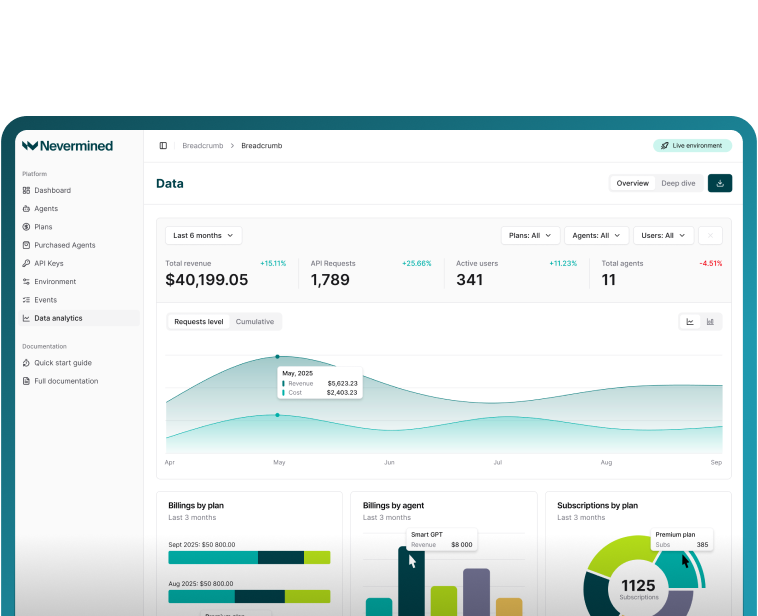
See Nevermined
in Action
Real-time payments, flexible pricing, and outcome-based monetization—all in one platform.