MENU


Data-driven analysis revealing how usage-based billing infrastructure is transforming AI agent monetization, with market projections, adoption rates, and implementation benchmarks
Per-request billing has emerged as the dominant monetization model for AI agents and autonomous systems, fundamentally changing how developers capture value from every interaction. Traditional subscription models cannot accommodate the micro-transactions that AI agents generate, creating urgent demand for purpose-built billing infrastructure. Nevermined Pay delivers bank-grade enterprise-ready metering, compliance, and settlement so every model call turns into auditable revenue, with features including ledger-grade metering, a dynamic pricing engine, credits-based settlement, 5x faster book closing, and margin recovery. The shift toward per-request billing reflects a broader transformation as businesses align costs with actual consumption rather than flat-rate access.
McKinsey projects the global agentic commerce market will reach $3-5 trillion by 2030. This staggering projection represents the total addressable market for AI agents conducting transactions autonomously. Per-request billing infrastructure becomes essential to capture this opportunity, as traditional payment systems cannot handle the volume and granularity of agent interactions.
The US B2C retail market alone could generate up to $1 trillion in orchestrated revenue from agentic commerce by 2030. This domestic opportunity underscores why American enterprises are rapidly adopting per-request billing models. Nevermined's solutions position businesses to capture this revenue through flexible pricing that adapts to any transaction type.
The AI-driven invoice processing market is projected to grow from $2.8B to $47.1B by 2034, representing a CAGR of 32.6%. This explosive growth reflects the fundamental shift toward automated, per-transaction billing across all industries. Organizations implementing AI billing now gain significant competitive advantage as the market expands.
The real-time payments market is projected to rise from $12.30 to $114.94 billion by 2032, with a compound annual growth rate of 32.23%. This growth trajectory validates the demand for instant settlement capabilities in per-request billing systems. Nevermined's payment facilitator enables instant settlement in both fiat and cryptocurrency to meet this demand.
The AI in IVR payment market will grow by $538.5 million by 2029, at a CAGR of 24.9%. This growth indicates expanding use cases for automated payment processing across customer service channels. Per-request billing enables precise monetization of each automated interaction.
Global non-cash payments infrastructure handles 3.4 trillion transactions annually with $1.8 quadrillion in total transaction value. This massive scale demonstrates the infrastructure requirements for handling per-request billing at global levels. Purpose-built platforms must process enormous volumes while maintaining accuracy and compliance.
A Kyle Poyar study reveals that 56% of AI leaders use a hybrid pricing model combining subscription and usage-based fees. This majority adoption signals that pure subscription models have become insufficient for AI monetization. Nevermined's dynamic pricing engine supports all three pricing approaches: usage-based, outcome-based, and value-based.
Hybrid pricing among software companies increased from 27% to 41% year-over-year, representing a 51% increase in adoption. This rapid shift demonstrates market validation for consumption-based billing models. Companies maintaining only flat-rate pricing risk falling behind competitors offering flexible payment options.
An overwhelming 92% of AI companies that sold products with usage-based pricing subsequently adjusted their pricing models. This high adjustment rate underscores the complexity of getting per-request pricing right initially. Platforms supporting rapid pricing iteration, like those described in Nevermined's documentation, provide essential flexibility for optimizing revenue.
The ACH Network payment volume rose 4.9% to 35.2 billion in 2025, with value reaching $93 trillion (7.9% increase). This growth in traditional payment rails demonstrates overall market expansion that per-request billing systems must accommodate. Integration with established payment networks remains critical for enterprise adoption.
Same Day ACH payment volume reached 1.4 billion in 2025, valued at $3.9 trillion, growing 16.7% in volume and 21.4% in value year-over-year. This acceleration in same-day settlement reflects demand for faster transaction finality. Per-request billing systems must support instant or near-instant settlement to remain competitive.
Business-to-Business ACH payments reached 8.08 billion payments and $63.11 trillion in value, growing 9.9% and 8.4% respectively. This substantial B2B volume represents a prime opportunity for per-request billing in enterprise AI applications. Agent-to-agent transactions will increasingly flow through these channels.
Best-in-class AP departments using AI automation spend just $2-$4 per invoice, representing up to 80% reduction compared to manual methods costing $12-$15 per invoice. This dramatic cost reduction makes per-request billing economically viable even for micro-transactions. Nevermined's credits system enables this efficiency by automating the entire billing lifecycle.
The average cost to process a single invoice manually is $22.75 per invoice. This high per-transaction cost makes manual billing impossible for AI agents generating thousands of micro-interactions. Automated per-request billing eliminates this cost burden entirely.
Enterprises using accounts payable software reduce invoice processing time by an average of 62%, cutting the cycle from 20.8 days to just 7.9 days per invoice. This time savings compounds across thousands of transactions in per-request billing scenarios. Faster processing means faster revenue recognition and improved cash flow.
Automation shortens AI invoice processing times by up to 70%. This speed improvement enables real-time billing that traditional systems cannot match. Per-request billing requires this level of automation to remain practical at scale.
Valory cut deployment time of their payments and billing infrastructure for the Olas AI agent marketplace from 6 weeks to 6 hours using Nevermined, clawing back $1000s in engineering costs. This 98% reduction in implementation time demonstrates the advantage of purpose-built billing infrastructure over custom development.
Nevermined gets you from zero to a working payment integration in 5 minutes, with SDKs for both TypeScript and Python. This rapid deployment capability enables developers to start monetizing AI agents immediately rather than spending months building billing infrastructure.
Small and mid-sized businesses typically achieve payback within 6-9 months after implementing AI invoice processing. This rapid ROI timeline makes investment in per-request billing infrastructure highly attractive. The sooner implementation begins, the sooner businesses capture revenue from AI interactions.
Enterprises often see payback within 3-6 months for AI invoice processing implementation. Larger transaction volumes accelerate the ROI timeline for per-request billing adoption. Enterprise-grade platforms like Nevermined deliver these results through proven infrastructure.
Integration complexity with legacy infrastructure can increase AI payment automation project costs by over 30%. This premium underscores the value of platforms with native protocol support and pre-built integrations. Nevermined's protocol-first architecture minimizes integration complexity.
Currently, 75% of AP departments use some form of AI or automation, encompassing data extraction, classification, and workflow optimization. This high adoption rate indicates broad market readiness for advanced per-request billing capabilities. Organizations not yet automated face increasing competitive pressure.
Technology and SaaS companies lead with 72% adoption of automated invoice processing tools. This sector leadership reflects the natural fit between software companies and per-request billing models. Nevermined's SDKs integrate seamlessly with existing tech stacks.
The manufacturing sector shows 65% adoption of automated invoice processing. Industrial applications of AI agents will increasingly require per-request billing for equipment monitoring, predictive maintenance, and supply chain optimization. Cross-industry adoption validates the universal need for consumption-based billing.
Retail and eCommerce businesses report adoption rates near 60% for automated invoice processing. Customer-facing AI agents in these sectors generate high transaction volumes requiring robust per-request billing. The credits system approach aligns particularly well with retail use cases.
Despite high overall automation adoption, only 8% are fully automated, while 60-64% remain partially or significantly dependent on manual tasks. This automation gap represents significant opportunity for per-request billing platforms to capture market share through complete solutions.
Projections indicate 75-90% of customer queries will be handled by bots by 2025. This massive shift toward AI-powered customer service creates enormous demand for per-request billing of agent interactions. Each automated query represents a billable event in usage-based models.
Currently, 65% of utilities are adopting AI for real-time fraud detection and personalized payment solutions. This regulated industry adoption validates per-request billing's compliance capabilities. Nevermined's audit-ready traceability meets stringent regulatory requirements.
A striking finding reveals that only 19% of US consumers are comfortable with AI submitting payments on their behalf. This trust deficit creates both challenge and opportunity for per-request billing platforms. Nevermined's tamper-proof metering addresses this concern through cryptographic verification.
Similarly, only 29% of UK consumers would trust AI to make small, automated payments. This marginally higher trust level for micro-transactions suggests per-request billing should start with lower-value interactions. Building trust through transparent, verifiable billing creates foundation for larger transactions.
Approximately 68% of businesses report a decrease in financial fraud risks after implementing automated AP solutions. This security improvement addresses one of the primary concerns about automated payment systems. Tamper-proof metering with append-only logs provides the verification layer businesses need.
Voice biometrics integration has led to a 30% fraud decrease in some IVR payment systems. Multi-factor authentication enhances security in per-request billing scenarios. Nevermined's agent identity system provides cryptographic proof of ownership for every transaction.
Global non-compliance costs are substantial, with AML fines alone exceeding $6 billion in 2023. This massive penalty exposure drives demand for compliant per-request billing solutions. Platforms lacking audit trails expose businesses to significant regulatory risk.
The average cost of data breaches is $4.88 million globally. Security must be foundational to per-request billing infrastructure, not an afterthought. Zero-trust reconciliation models protect both providers and consumers from breach-related losses.
Virtual cards represent only 9% of fraud, demonstrating effectiveness of tokenized payment credentials. This security advantage supports the use of digital payment methods in per-request billing. Nevermined's smart account integration leverages similar tokenization approaches.
North America holds 40% market share of the global AP automation software market as of 2023. This regional leadership positions North American companies as early adopters of per-request billing innovation. Nevermined's multi-region deployment serves this concentrated market demand.
Asia-Pacific represents 30% market share of the 2023 AP automation market and is the fastest-growing region. This growth trajectory indicates expanding international demand for per-request billing infrastructure. Multi-currency support becomes essential for capturing this market.
Europe accounts for around 20% market share in the AP automation market as of 2023. GDPR compliance requirements make European adoption particularly dependent on privacy-preserving billing solutions. Nevermined's GDPR-compliant infrastructure addresses these regional requirements.
North America will contribute 42.5% to growth of the global AI in IVR payment market during the forecast period. This concentrated growth reinforces the region's leadership in AI billing innovation. Per-request billing providers must prioritize North American enterprise requirements.
Canada's total payment market reached 22.5 billion transactions valued at $12.2 trillion in 2024, growing 3% in both volume and value. This substantial market demonstrates the scale of per-request billing opportunities in developed economies. Cross-border capabilities become essential for North American platforms.
Online transfer payment volume in Canada increased 175% over five years, while value increased 219%. This dramatic shift toward digital payments creates ideal conditions for per-request billing adoption. Consumer comfort with digital transactions removes adoption barriers.
Some usage-billing platforms are designed to ingest 200,000 events per second, depending on workload. This processing capacity enables true per-request billing at enterprise scale. Nevermined's infrastructure handles the event volumes that AI agents generate.
Google launched Agent Payments Protocol (AP2) with major industry partners including PayPal, Mastercard, and American Express. This industry-wide protocol adoption validates the need for standardized agent payment infrastructure. Nevermined's native A2A integration positions developers for this ecosystem.
ChatGPT now serves more than 800 million weekly users. This massive user base represents the scale of potential per-request billing transactions as AI interactions become monetizable. Infrastructure must handle billions of micro-transactions across this user population.
Currently, 50% of all consumers now use AI when searching online, with 44% stating it has become their primary and preferred source. This behavioral shift creates revenue opportunities for per-request billing of search and discovery interactions. Each AI-assisted search represents a potential billable event.
AI model task completion capability has been doubling every seven months since 2019. This exponential capability growth expands the range of tasks suitable for per-request billing. More capable agents can complete higher-value tasks, supporting outcome-based and value-based pricing models.
Stablecoin transaction volumes are projected to grow from $450 billion monthly in 2024 to $710 billion by 2025, representing 58% growth. This cryptocurrency payment growth enables frictionless cross-border per-request billing. Nevermined's x402 protocol support enables stablecoin settlement.
The number of unique stablecoin addresses increased 50% to 35 million year-on-year. This expanding user base creates the infrastructure foundation for cryptocurrency-based per-request billing. Multi-rail settlement options become essential as payment preferences diversify.
These challenges underscore the value of platforms like Nevermined that minimize implementation complexity through pre-built infrastructure and comprehensive SDKs.
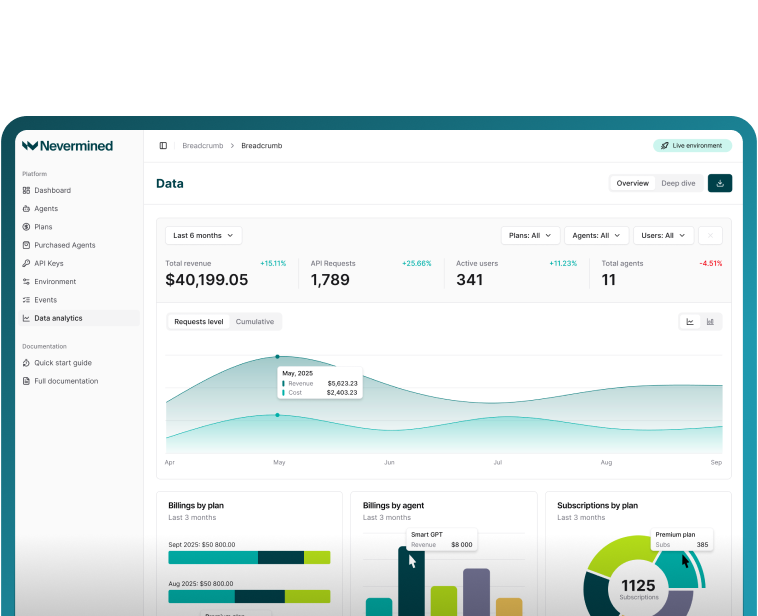
Nevermined's observability dashboard provides visibility into agent performance, user behavior, revenue analytics, hidden costs, and growth opportunities to track these metrics in real-time.
Organizations that establish per-request billing infrastructure now position themselves to capture this growth. Nevermined's protocol-first architecture ensures compatibility as standards evolve, avoiding the vendor lock-in that will trap competitors using proprietary systems.
Per-request billing charges for each individual AI agent interaction rather than using flat subscription fees. This model aligns costs directly with value delivered, making it essential for AI agents that generate variable transaction volumes. With the agentic commerce market projected to reach $3-5 trillion by 2030, per-request billing enables developers to capture revenue from every agent interaction while giving customers transparent, usage-based pricing.
Nevermined implements tamper-proof metering where every usage record is cryptographically signed and pushed to an append-only log at creation, making it immutable. The exact pricing rule stamps onto each agent's usage credit, allowing developers, users, auditors, or agents to verify that usage totals match billed amounts per line-item. This zero-trust reconciliation model addresses the 81% trust gap among consumers who do not yet trust AI to manage payments autonomously.
Nevermined uniquely supports three flexible pricing models: usage-based pricing (per-token, per-API-call with guaranteed margins), outcome-based pricing (charging for results like booked meetings), and value-based pricing (percentage of ROI generated). With 56% of AI leaders now using hybrid pricing models, this flexibility is essential for optimizing revenue capture across different use cases and customer segments.
Nevermined gets you from zero to a working payment integration in 5 minutes, with SDKs for both TypeScript and Python. This rapid deployment contrasts sharply with custom development timelines, as demonstrated when Valory reduced deployment from 6 weeks to 6 hours using Nevermined. The low-code SDK enables developers to start monetizing AI agents immediately.
Nevermined enables agent-to-agent transactions through ERC-4337 smart accounts with session keys and delegated permissions. Users authorize payment policies once, then agents interact freely within those boundaries without requiring wallet pop-ups for each request. This capability supports the Google A2A protocol ecosystem, enabling seamless autonomous transactions in multi-agent architectures.
Join the Autonomous Business Hackathon on March 5 to 6, 2026 in downtown San Francisco to build autonomous businesses where agents make real economic decisions, transact with each other, and run with minimal human oversight.
See Nevermined
in Action
Real-time payments, flexible pricing, and outcome-based monetization—all in one platform.