MENU


Traditional subscription pricing models are failing AI agent companies. When a single agent conversation can trigger hundreds of micro-activities with sub-cent costs, seat-based licensing becomes economically irrational. The solution lies in usage-based, event-driven pricing that captures value at the granular level where AI agents actually operate. Nevermined's platform provides the billing infrastructure purpose-built for this transition, enabling SaaS companies to meter every token, API call, and workflow completion in real time while maintaining the audit-ready transparency enterprise buyers demand.
Traditional SaaS billing was designed for predictable, seat-based consumption. A company pays per user, and usage is relatively uniform across accounts. AI agents shatter this assumption entirely.
When your product is an autonomous agent performing variable work, the disconnect between flat pricing and actual value delivered becomes stark:
BCG's B2B pricing analysis identifies five emerging agentic pricing models to address these challenges. Traditional processors like Stripe may require extensive custom development for AI-specific use cases, burning weeks on access control and subscription setup before a single agent can be monetized.
Most AI agent operators underestimate their true cost structure. Beyond the obvious LLM inference costs lie:
Nevermined Pay addresses these billing limitations by enabling real-time metering of every billable event, ensuring that pricing reflects actual resource consumption rather than guesswork.
Usage-based pricing aligns revenue with the value your AI agents deliver. Instead of hoping your flat rate averages out across customers, you capture margin on every interaction.
The mechanics of usage-based pricing for AI agents involve tracking specific metrics and converting them to billable events:
The transition from flat to usage-based pricing requires instrumenting your product to emit billing events. Each billable action needs:
For implementation details on configuring payment plans and agent APIs with pricing rules, see the getting started guide.
While usage-based pricing captures resource consumption, outcome-based and value-based models tie revenue directly to business results.
Nevermined supports all three pricing model categories, allowing AI companies to mix and match approaches:
This flexibility prevents leaving money on the table with flat pricing while maintaining accessibility for customers with variable needs.
Enterprise buyers require verifiable billing. When charges depend on usage counts, both vendors and customers need confidence in the accuracy of those counts.
Nevermined's tamper-proof metering system creates buyer trust through independent verification:
This zero-trust reconciliation model satisfies enterprise procurement teams requiring audit-ready transparency. Unlike traditional billing systems where vendors control the count, immutable metering provides third-party verifiable proof of consumption.
For enterprise AI platforms and vendors, Nevermined Pay delivers bank-grade, enterprise-ready metering, compliance, and settlement so every model call turns into auditable revenue. Key capabilities include:
The technical implementation of usage-based pricing follows a predictable sequence that many teams can complete in under four weeks.
Week 1: Define Value Metrics
Week 2: Select and Configure Platform
Week 3: Instrument and Test
Week 4: Build Customer-Facing Components
For detailed SDK installation and configuration steps, refer to the getting started guide.
As AI agents proliferate across platforms and marketplaces, persistent identification becomes essential for billing, trust, and interoperability.
Nevermined ID provides universal agent identification through:
The platform supports emerging standards including Google's Agent-to-Agent (A2A) protocol and Model Context Protocol (MCP) for standardized agent communication. This open-protocol-first approach avoids vendor lock-in as standards evolve.
Nevermined's x402 integration extends the protocol with advanced agent payment capabilities, enabling direct agent-to-agent transactions without human involvement. This positions the platform for fully autonomous workflows where agents negotiate, transact, and settle payments independently.
Credits-based billing bridges the gap between enterprise procurement requirements and usage-based economics.
Flex Credits operate as prepaid consumption-based units redeemed directly against usage. They solve multiple problems simultaneously:
For finance teams, credits transform unpredictable usage-based charges into trackable recurring billing. Instead of reconciling thousands of sub-cent transactions, they approve credit purchases at predictable intervals.
This model addresses enterprise reluctance toward minimum commitments that stall adoption. Teams can start small, validate value, and scale credit purchases as confidence grows.
Different customer segments require different approaches to AI agent monetization.
Solo Developers and Solopreneurs
AI Agent Startups
Enterprise AI Platforms
Nevermined serves all three segments through a tiered approach that scales with customer sophistication.
Traditional payment processors were built for human-initiated transactions with predictable patterns. AI agents break these assumptions.
Legacy payment systems struggle with AI workloads because:
Companies building billing in-house may typically spend six or more months of engineering time before launching. This delay costs more than platform fees while diverting resources from core product development.
Nevermined differentiates through three core capabilities legacy systems cannot match:
Valory cut deployment time of their payments and billing infrastructure for the Olas AI agent marketplace from 6 weeks to 6 hours using Nevermined, clawing back $1000s in engineering costs. This speed advantage compounds as AI agent deployment accelerates.
The AI agent ecosystem spans LLM providers like OpenAI and Anthropic, agent frameworks like LangChain and CrewAI, monitoring tools, and development platforms. Billing infrastructure must integrate across this stack.
Modern AI billing platforms provide native integrations with:
Platforms with 60+ integrations may reduce implementation time and ongoing maintenance burden. Webhook-based architectures enable real-time event processing without polling or batch delays.
The transition to usage-based pricing represents an industry-wide shift. Hybrid models can deliver consistent growth advantages over pure subscription approaches.
For companies ready to begin this transition, contact Nevermined to discuss implementation options tailored to your AI agent architecture and customer base.
Implement minimum commitments or base platform fees to establish a revenue floor. Use 3-month rolling averages rather than point-in-time projections, as aggregate usage across your customer base is typically more predictable than individual account variation. Commitment tiers offering discounts for guaranteed minimums help stabilize forecasting while incentivizing customer growth.
Configure your billing platform with overage policies before launch, including hard caps that pause service, soft caps with automatic tier upgrades, and usage alerts at 50%, 80%, and 100% of quota. The best approach depends on your customer segment: enterprise buyers often prefer hard caps with clear overage rates, while startups may prefer automatic scaling with retroactive adjustments.
Restructure compensation to reward customer lifetime value and expansion revenue rather than initial contract value, measuring account health metrics like usage growth rate instead of just booking numbers. Consider paying initial commission on minimum commitments, then ongoing bonuses based on usage expansion over 6 to 12 months. This aligns sales incentives with land-and-expand usage models rather than traditional upfront deal sizes.
For enterprise customers, SOC 2 Type II certification is the baseline requirement, with HIPAA compliance and Business Associate Agreements for healthcare customers. GDPR compliance with data residency options matters for European customers, while PCI DSS Level 1 applies when handling payment card data. Audit trail capabilities with immutable logs satisfy procurement teams requiring verifiable billing records.
Build margin buffers into your pricing that absorb cost fluctuations without requiring price changes, using cost-plus pricing with guaranteed margins rather than fixed per-unit rates. Many companies set prices quarterly based on trailing cost averages plus target margin, giving them room to absorb short-term cost spikes. Communicate to customers that pricing reflects value delivered, not raw costs passed through.
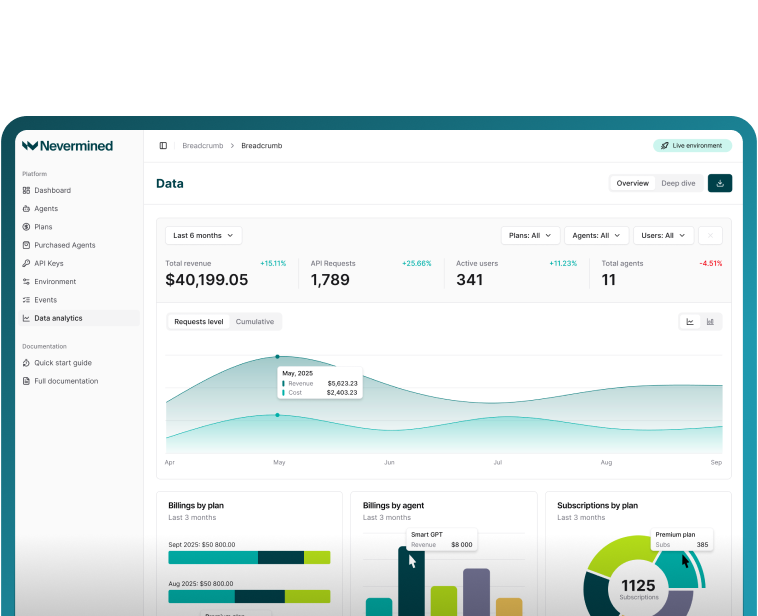
See Nevermined
in Action
Real-time payments, flexible pricing, and outcome-based monetization—all in one platform.