MENU


The agentic commerce landscape has fundamentally shifted. With Stripe's agreement to acquire Metronome announced in December 2025 and Metronome confirming it became part of Stripe in January 2026, Stripe's payment processing infrastructure and Metronome's usage-based billing capabilities have moved under one roof. Yet this merger still leaves a critical gap: programmatic agent-to-merchant settlement. While Stripe excels at processing fiat transactions and Metronome handles high-volume event metering, neither platform has historically been centered on autonomous AI agents transacting under delegated payment policies without a human checkout flow. This is where Nevermined provides a specialized third layer in the agentic commerce stack. Nevermined delivers bank-grade enterprise-ready metering, compliance, and settlement so every model call turns into auditable revenue, with ledger grade metering, a dynamic pricing engine, credits-based settlement, 5x faster book closing, and margin recovery.
Before examining where these platforms diverge, understanding what each traditionally delivers helps clarify the gaps in the current agentic commerce stack.
Stripe has been a major online payment processing provider since 2010, building infrastructure that powers credit card transactions, ACH transfers, and digital wallets for merchants globally. Businesses running on Stripe generated $1.9 trillion in total volume in 2025, establishing the platform as a widely used choice for SaaS companies, e-commerce platforms, and marketplaces requiring fiat payment rails.
Stripe's core capabilities include:
Metronome positioned itself as a usage-based billing platform for companies that need to meter high-volume API events and translate them into accurate invoices. The platform supports large-scale usage data workflows and complex pricing logic for usage-based charges.
Following Metronome's acquisition announcement, the combined company says it can provide foundational infrastructure and workflows for flexible monetization. This combination creates a powerful stack for traditional usage-based billing scenarios, but the merged entity still operates primarily within the constraints of human-initiated commerce.
AI agents generate transaction patterns that fundamentally differ from human-initiated commerce. These autonomous systems can create high volumes of small, machine-initiated interactions, require fast settlement for multi-agent workflows, and need authorization mechanisms that do not depend on human approval loops for every transaction.
The current Stripe plus Metronome combination faces several structural challenges when applied to agentic commerce:
Agentic commerce requires infrastructure built from the ground up for autonomous execution. Nevermined supports this through ERC-4337 smart accounts, session keys, scoped permissions, time-bound access, and automatic revocation, enabling agents to transact within predefined boundaries without constant human oversight.
Nevermined addresses the settlement gap that persists even after the Stripe-Metronome combination. The platform provides billing, metering, compliance, and settlement capabilities specifically designed for AI agents, enabling developers to monetize agent interactions through models that traditional processors were not designed to support.
The core innovation lies in programmatic agent-to-merchant settlement. Nevermined connects agent payment authorization, x402 payment flows, and merchant settlement through existing payment service providers while supporting autonomous agent payment policies. Users authorize payment policies once, then agents interact freely within defined boundaries.
Nevermined's settlement advantages include:
Where Metronome is primarily positioned around usage-based billing and monetization infrastructure, Nevermined is purpose-built for AI agent commerce, supporting cost-based, usage-based, and outcome-based pricing models that better match how autonomous agents create value.
Rather than charging per API call regardless of result, outcome-based pricing ties revenue to successful agent actions. An AI sales agent might only incur charges when it successfully books a meeting, aligning costs with actual value delivered.
For higher-value workflows, pricing can be structured around predefined success events or custom usage metrics, allowing monetization to reflect the value delivered rather than only the number of API calls.
Nevermined's pricing flexibility includes:
This flexibility matters because AI agent economics vary dramatically by use case. A coding assistant generating thousands of low-value completions requires different pricing than a legal AI reviewing high-stakes contracts.
When AI agents manage tasks autonomously, verifiable transaction records become essential. Nevermined addresses this through audit-ready metering and settlement records for every agent interaction.
Nevermined’s metering and settlement layer creates audit-ready transaction records for agent interactions, helping developers reconcile usage, entitlements, and billing activity across payment flows.
Pricing rules, credit balances, and settlement activity can be tied to the relevant plan and transaction flow, making usage and billing easier to reconcile.
This zero-trust reconciliation model solves a fundamental concern: how do you trust AI agents to manage tasks autonomously when traditional audit trails were designed for human-initiated transactions?
The compliance layer provides:
The agentic commerce space evolves rapidly, with multiple competing protocols emerging from major technology companies. Nevermined's architecture ensures compatibility regardless of which standards gain adoption.
Nevermined supports x402 payment flows through its x402 Facilitator and provides integrations across agent commerce standards including A2A, AP2-style payment intent messaging, and MCP through its payments library. This protocol-agnostic approach ensures compatibility as standards evolve.
Nevermined’s agent and payment plan model can associate services with agent identifiers, access rules, payment plans, and settlement logic, supporting portable monetization across agent workflows. These capabilities enable:
Nevermined's protocol-first design helps agent infrastructure adapt as the ecosystem evolves. Nevermined’s public smart contract repositories provide transparency into parts of the protocol’s settlement mechanics.
Time-to-market defines success in the AI agent space. Nevermined's SDK-first approach prioritizes developer velocity over configuration complexity.
Nevermined gets you from zero to a working payment integration in 5 minutes, with SDKs for both TypeScript and Python. The setup flow covers obtaining an API key, installing the SDK, creating a paid endpoint, and validating payment-protected requests.
Comprehensive technical documentation provides quick starts, SDK references, payment pattern guides, and integration resources for developers building monetized agent services.
Valory cut deployment time of their payments and billing infrastructure for the Olas AI agent marketplace from 6 weeks to 6 hours using Nevermined, clawing back $1000s in engineering costs.
The payment facilitator coordinates authorization, metering, and settlement for AI agents across fiat, crypto, credits, and smart accounts. This unified layer handles the complexity of multi-rail transactions while exposing simple APIs to developers.
The facilitator provides:
On-chain verification and settlement through smart contracts enable sophisticated business logic that traditional processors cannot support:
Traditional subscription models can struggle with AI agent workloads that involve variable consumption patterns. The credits system operates as prepaid consumption-based units redeemed directly against usage, providing predictability without sacrificing flexibility.
Credits help align price to value by letting builders charge for agent micro-actions and successful outcomes. The system enables:
Users prepay credits, monitor consumption in real-time, and maintain full visibility into spend patterns across their agent fleet.
The framing of Stripe versus Metronome versus Nevermined as a competitive comparison misses the complementary nature of these platforms. Most companies building agentic commerce applications will benefit from deploying multiple layers.
Nevermined supports fiat payments through Stripe-powered flows and supports x402-based payment verification and settlement through its x402 Facilitator. Coinbase developed x402 as an HTTP-native payment standard for APIs, apps, and AI agents. This means companies can:
Choose Nevermined when you need:
Choose Stripe/Metronome when you need:
The agentic commerce stack benefits from a purpose-built settlement layer because traditional processors are primarily designed around human-initiated checkout and card flows. Nevermined delivers bank-grade enterprise-ready metering, compliance, and settlement so every model call turns into auditable revenue.
Core advantages that differentiate Nevermined:
Naptha AI Co-Founder Richard Blythman summarized the market position: "Whenever I need to understand AI agent monetization, I turn to the Nevermined team. They're world class and leading the agentic payments space."
For companies building the next generation of autonomous AI applications, Nevermined provides the settlement infrastructure that completes the agentic commerce stack.
Stripe is built for mainstream payment processing across cards, ACH, and digital wallets, and Stripe reported that businesses on its platform generated $1.9 trillion in 2025. Nevermined focuses specifically on programmatic agent-to-merchant settlement, enabling AI agents to execute transactions autonomously without human approval loops. Stripe’s standard US domestic card pricing includes a fixed $0.30 component, which can be inefficient for very small transactions. The platforms serve complementary roles: Stripe for traditional commerce, Nevermined for autonomous agent transactions.
Nevermined supports blockchain-based stablecoin settlement, with on-chain settlement via smart contracts and a documented 1% Nevermined fee with no additional processing surcharge. Traditional card processors often include fixed per-transaction fees, which can make very small payments inefficient. The credits system allows users to prepay consumption-based units, monitor burn rates in real-time, and avoid surprise overruns while maintaining granular billing visibility.
Nevermined supports flexible pricing models for AI agent monetization, including cost-based pricing that tracks underlying AI infrastructure costs, usage-based pricing such as per-request or per-API-call pricing, and outcome-based pricing tied to successful results. The dynamic pricing engine supports variable pricing patterns based on token count, request complexity, time, usage tiers, or custom metrics, helping builders align pricing with underlying AI infrastructure costs.
Yes, Nevermined works alongside existing payment processors rather than replacing them. The platform supports fiat payments through Stripe-powered flows and x402-based payment verification and settlement through its x402 Facilitator. For AI frameworks, Nevermined is designed to work across major agent development tools in the broader ecosystem. The protocol-first architecture supports x402 settlement for APIs, agents, MCP tools, and protected resources, while Nevermined’s broader ecosystem support is designed to work across emerging agent commerce standards.
Nevermined gets you from zero to a working payment integration in 5 minutes, with SDKs for both TypeScript and Python. The quickstart flow involves installing the SDK, registering an agent and payment plan, and validating paid API requests. Valory cut deployment time of their payments and billing infrastructure for the Olas AI agent marketplace from 6 weeks to 6 hours using Nevermined, clawing back $1000s in engineering costs.
See Nevermined
in Action
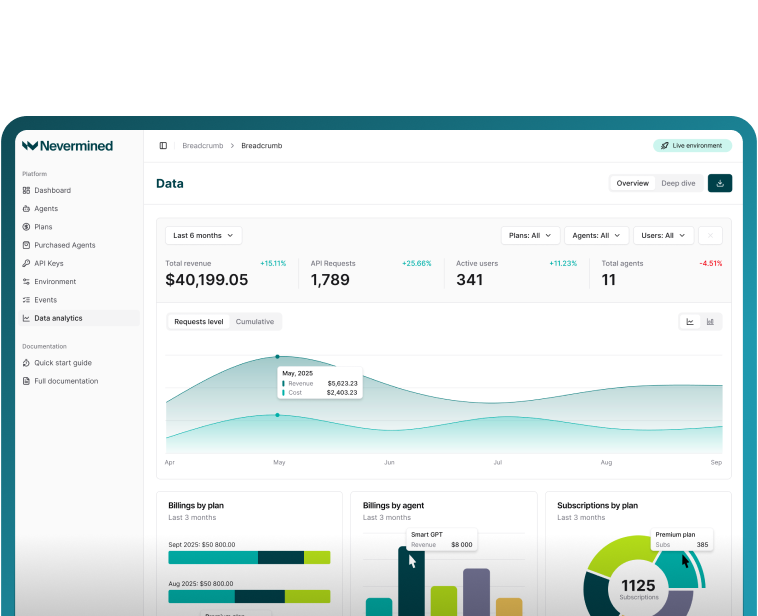
Real-time payments, flexible pricing, and outcome-based monetization—all in one platform.