MENU


When AI agents need to transact autonomously, three distinct infrastructure layers come into play: payment processing, usage-based billing, and settlement. Stripe is one of the most widely used payment infrastructure providers for mainstream digital commerce. Orb handles sophisticated metering and usage-based billing for SaaS and AI companies. Nevermined provides AI-native payments infrastructure for agent monetization, delegated spending, real-time metering, and autonomous settlement, enabling AI agents to transact without human approval loops while ensuring every transaction is verifiable and auditable.
The payment infrastructure that powers today's digital economy was built for a different era. Traditional payment processors optimize for human-initiated transactions: a customer clicks "buy," a merchant receives funds, and the transaction completes within familiar parameters.
AI agents operate differently. Some agentic workloads may generate high volumes of small transactions and require low-latency authorization, metering, and settlement to support real-time workflows. Many agentic use cases involve small, usage-based charges, such as per-call, per-task, per-token, or per-resource-access pricing, which can make fixed card processing fees difficult to absorb.
Why legacy systems struggle with agent transactions:
This mismatch explains why building payments infrastructure for AI agents requires purpose-built solutions rather than retrofitted legacy systems.
Nevermined is purpose-built for the agentic economy, where AI agents, AI services, and autonomous workflows need to price, meter, and settle interactions in real time. Rather than treating agent payments as an extension of human checkout flows or traditional SaaS invoicing, Nevermined combines access control, metering, credits-based settlement, delegated spending, and fiat and crypto payment rails for AI-native commerce.
Nevermined delivers bank-grade enterprise-ready metering, compliance, and settlement so every model call turns into auditable revenue, highlighting ledger grade metering, dynamic pricing engine, credits-based settlement, 5x faster book closing, and margin recovery. For teams building autonomous agent systems, multi-agent workflows, and AI-powered services, Nevermined provides the settlement layer and monetization infrastructure needed to move beyond seat-based pricing and traditional invoice-based billing.
Stripe is one of the most widely used digital payment infrastructure providers. The platform processes payments for 78% of Forbes AI 50 companies and handled $1.4 trillion in total payment volume in 2024. More than 350,000 companies use Stripe Billing to scale globally.
However, Stripe's architecture has traditionally been optimized around mainstream payment flows for businesses and their customers. The platform has introduced an Agent Toolkit to help developers bring Stripe workflows into AI systems, and Stripe is participating in emerging agent-payment infrastructure through efforts such as AWS AgentCore Payments. Nevermined remains differentiated by focusing specifically on AI-native metering, monetization, delegated spending, and autonomous settlement for agent services.
Orb has established itself as a prominent usage-based billing platform for SaaS and AI companies, with public case studies and customer materials for companies such as Vercel, Supabase, and Pinecone. The platform processes 250,000+ events per second with real-time metering capabilities.
For traditional SaaS companies billing human customers, Orb provides strong value. The platform helps companies meter and bill for usage, supporting sophisticated pricing strategies that align revenue with customer value. But Orb primarily focuses on usage-based and hybrid billing workflows, including metering, pricing, invoicing, credits, and revenue operations. The platform calculates what customers owe and supports billing operations around that usage. Nevermined is purpose-built for agent monetization, delegated spending, real-time metering, and autonomous settlement.
Nevermined adds an agent-native settlement layer for autonomous transactions, complementing traditional payment processing and usage-based billing systems with metering, entitlement checks, access control, and settlement designed for agent interactions.
Protocol-first architecture ensures compatibility with emerging standards:
This protocol-aware approach helps builders support emerging standards while reducing dependence on any single payment or agent protocol.
Nevermined lets builders register monetizable agent APIs, MCP tools, and protected resources, attach payment plans, validate requests, meter usage, and settle payments in real time. Agents and services can transact within defined payment plans, access rules, and spending constraints.
Settlement capabilities include:
Trust represents the central challenge in autonomous agent transactions. How do you verify that an AI agent accurately reported its usage? How do you ensure billing matches actual consumption?
Nevermined supports metering, transaction trails, and observability so builders can track usage, costs, and settlement activity with clearer auditability. The exact pricing rule stamps onto each agent's usage credit, allowing developers, users, auditors, or agents to verify that usage totals match billed amounts per line-item.
Nevermined emphasizes verification in the context of autonomous agent interactions, combining metering, entitlement checks, access control, and settlement in one agent-native flow.
Nevermined supports flexible pricing models:
Many billing tools focus on usage-based or subscription billing, while Nevermined extends pricing into agent-native payment flows that combine metering, access control, credits, subscriptions, and programmable settlement. Nevermined's dynamic pricing engine enables cost-plus-margin automation where platforms define exact margin percentages locked onto usage credits.
The x402 facilitator coordinates authorization, metering, and settlement for AI agents across fiat, crypto, credits, and smart accounts. This component enables transactions between AI agents without human involvement.
How it works:
This contrasts with standard x402 implementations that require human confirmation for each request. Nevermined enables true autonomy while maintaining security through programmable constraints.
The facilitator enables:
For multi-agent architectures, this capability can be especially valuable because agents may need to negotiate, transact, and settle across services in real time, creating fluid marketplaces for AI capabilities.
Nevermined serves three distinct customer segments with appropriate solutions for each:
Solo developers and solopreneurs get from zero to a working payment integration in 5 minutes, with SDKs for both TypeScript and Python. The free tier provides full platform access for limited volume, enabling experimentation without financial commitment.
AI agent startups benefit from rapid time-to-market. Valory cut deployment time of their payments and billing infrastructure for the Olas AI agent marketplace from 6 weeks to 6 hours using Nevermined, clawing back $1000s in engineering costs.
Enterprise AI platforms receive bank-grade enterprise-ready metering, compliance, and settlement so every model call turns into auditable revenue, highlighting ledger grade metering, dynamic pricing engine, credits-based settlement, 5x faster book closing, and margin recovery.
Implementation follows three steps:
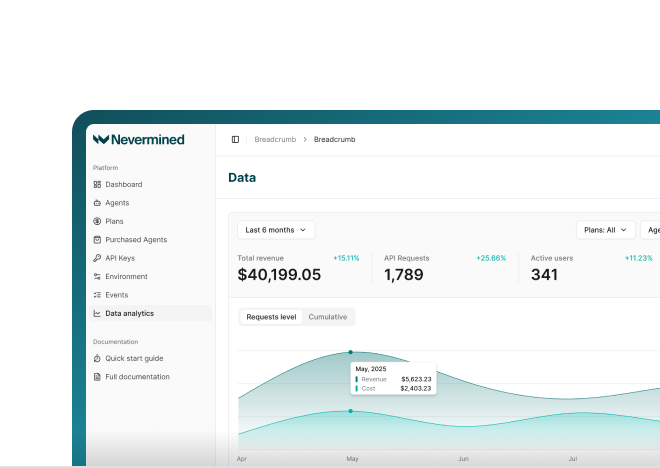
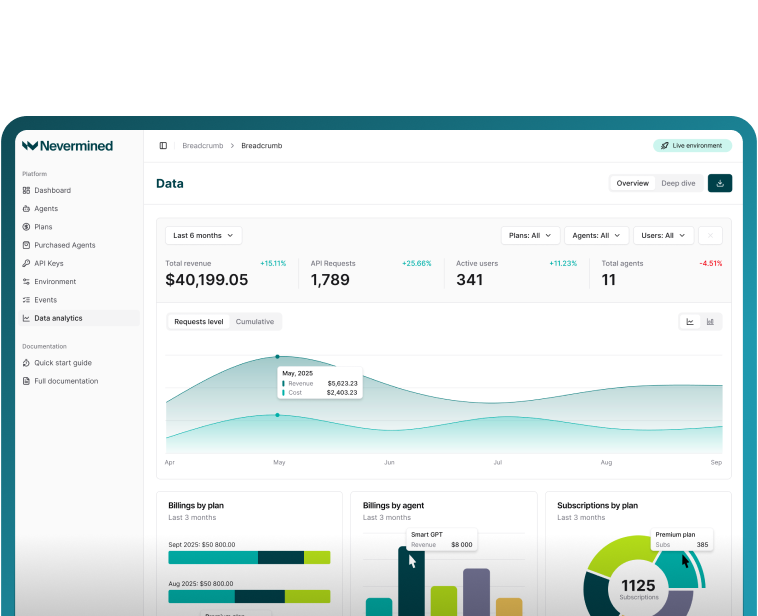
The observability dashboard provides visibility into agent performance, usage patterns, token usage, costs, request logs, custom metadata, and real-time monitoring. Finance teams receive clearer usage and cost tracking instead of relying on manual reconciliation for high-volume agent activity.
Nevermined's Credits system operates as prepaid consumption-based units redeemed directly against usage. This model aligns price to value by charging for micro-actions and rewarding successful outcomes.
Benefits for different stakeholders:
The credit model solves a fundamental challenge in AI commerce: how do you handle millions of sub-cent transactions without overwhelming accounting systems? By abstracting individual transactions into credit consumption, Nevermined simplifies both the technical and financial aspects of agent monetization.
Pricing structure:
For AI builders evaluating payment infrastructure, the choice depends on what problem you need to solve.
Choose Nevermined when:
Choose Stripe when:
Choose Orb when:
Nevermined serves a different primary use case from traditional checkout and SaaS billing platforms. Stripe is widely used for human-facing payment processing. Orb focuses on SaaS usage-based billing workflows. Nevermined is purpose-built for autonomous agent payments, metering, and settlement. For companies building in the agentic economy, all three layers may eventually prove necessary, but only Nevermined answers the question: do you actually want to receive or send the money for AI agents?
The protocol-first architecture, traceable metering, and flexible pricing models position Nevermined as the infrastructure layer purpose-built for autonomous commerce. As AI agents become more prevalent and capable, the need for dedicated settlement infrastructure will only intensify.
Stripe is primarily designed for merchants charging customers through established payment methods such as cards and ACH. When AI agents need to transact autonomously, conventional checkout flows usually require additional authorization, policy, metering, and settlement layers. Nevermined enables agents to transact within pre-authorized boundaries using smart accounts with session keys. This supports repeat agent transactions within scoped permissions and spending limits, without requiring a new manual approval flow for every request. Additionally, Nevermined's credits-based model is designed to support high-volume, low-value agent interactions without forcing every micro-action into a separate traditional card transaction.
Orb is primarily positioned around usage-based billing, metering, invoicing, and revenue workflows for SaaS companies, while Nevermined focuses on autonomous agent payments, access, metering, and settlement. Companies could theoretically use Orb for metering human-facing SaaS products while using Nevermined for agent-to-agent settlement. However, Nevermined's built-in observability tracks validated calls, credit redemption, caller identity, revenue, and traceable paid-access records, making it well suited for AI agent use cases where usage and settlement need to be auditable.
AI agents generate high volumes of low-value transactions that traditional processors cannot always handle economically. Some recent crypto-market reporting has cited sub-dollar AI agent payment averages, illustrating why fixed per-transaction fees can be challenging for high-volume micropayment use cases. Agents also benefit from real-time validation, metering, and settlement workflows that can support automated decision-making. Traditional payment processors assume human cardholders and batch settlement cycles that conflict with many agent requirements.
Credits provide prepaid consumption units that simplify both technical and financial aspects of agent transactions. Developers prepay and monitor burn rates in real-time to avoid surprise overruns. Finance teams receive trackable recurring billing instead of reconciling millions of sub-cent charges. Platform operators can reallocate credits across users or departments without renegotiating licenses. The model aligns price to value while maintaining audit-ready traceability.
Yes. Solo developers can get from zero to a working payment integration in 5 minutes, with SDKs for both TypeScript and Python. Enterprise AI platforms can use Nevermined for bank-grade enterprise-ready metering, compliance, and settlement so every model call turns into auditable revenue, with ledger grade metering, a dynamic pricing engine, credits-based settlement, 5x faster book closing, and margin recovery. Valory cut deployment time of their payments and billing infrastructure for the Olas AI agent marketplace from 6 weeks to 6 hours using Nevermined, clawing back $1000s in engineering costs.
See Nevermined
in Action
Real-time payments, flexible pricing, and outcome-based monetization—all in one platform.