MENU


AI agents generate wildly unpredictable workloads. For example, one interaction might trigger dozens or even thousands of downstream calls, depending on workflow design, making traditional subscription pricing a poor fit for the economics of autonomous systems. Usage-based pricing solves this by charging customers based on actual consumption, whether measured in tokens, API calls, tasks completed, or outcomes delivered. Purpose-built platforms like Nevermined handle the unique requirements of AI workloads, including sub-cent micropayments, real-time metering, and autonomous agent-to-agent transactions that traditional payment processors simply cannot support.
Usage-based pricing is a monetization approach that charges customers based on actual consumption rather than flat subscription fees. For AI agents, this typically means metering tokens processed, API calls made, tasks completed, or outcomes delivered. The model addresses a fundamental mismatch: AI workload intensity varies dramatically between interactions, yet traditional seat-based pricing treats every user identically.
The core mechanism involves three components working together:
This approach matters because AI agents operate with unpredictable resource demands. A customer service agent resolving a simple FAQ costs a fraction of what handling a complex technical escalation requires. Consumption-based models ensure that pricing reflects actual value delivered rather than arbitrary user counts.
Standard payment processors were built for human-initiated transactions with predictable values. AI agents break these assumptions in several critical ways.
Micropayments are difficult on traditional card rails because fixed and percentage-based fees can consume a large share of small transactions. The ECB has noted that traditional payment methods face challenges for micropayments because of processing costs and pricing, while U.S. interchange fees range 2% to 3% before accounting for fixed per-transaction charges. On a $1 agent interaction, these combined fees can consume a third or more of revenue. When agents generate thousands of sub-dollar transactions daily, these fees compound into margin destruction.
AI agents can execute hundreds of requests per minute. Legacy systems can support automatic payments, but many existing authorization, liability, and risk assumptions were designed for human purchases. Standard payment authorization, risk, and settlement flows can add friction that is poorly matched to high-frequency autonomous agent interactions.
Autonomous agent payments can stress existing fraud, authorization, and liability controls, which may increase review friction depending on the payment stack. When AI agents initiate transactions programmatically, these controls can block valid payments and disrupt operations.
Purpose-built infrastructure like Nevermined's payment facilitator addresses these limitations by supporting micropayment economics, real-time settlement, and agent-native transaction patterns.
Implementing usage-based pricing for AI agents requires specific capabilities that generic billing systems lack.
Effective platforms track billable events at sufficient granularity for accurate metering, pricing, and auditing, capturing tokens, API calls, agent runs, and custom metrics. This granularity enables accurate cost attribution and supports multiple pricing dimensions simultaneously.
The pricing engine must support variable rules including:
Prepaid credit systems provide budget predictability for customers while ensuring revenue security for providers. Users prepay credits, monitor burn rates in real-time, and avoid surprise overruns. Finance teams receive trackable recurring billing instead of complex sub-cent charge reconciliation.
SDKs in TypeScript and Python enable rapid deployment. The best platforms offer 5-minute setup through low-code integration paths that handle authentication, metering, and settlement without extensive custom development.
When AI agents manage tasks autonomously, both providers and consumers need assurance that billing reflects actual usage. This zero-trust reconciliation challenge requires technical solutions beyond standard audit trails.
Every usage record should be cryptographically signed at creation and pushed to an append-only log, making records immutable after the fact. This architecture ensures that neither party can dispute usage after the fact without technical evidence.
The exact pricing rule should stamp onto each agent's usage credit, allowing developers, users, auditors, or agents to verify that usage totals match billed amounts per line item. This transparency eliminates disputes before they occur.
Audit-ready traceability means providing API and CSV export capabilities so customers can independently verify metering data against their own records. Platforms that lock customers into opaque billing create friction and erode trust.
Pure usage-based pricing has limitations. Charging by tokens works for infrastructure alignment but confuses business buyers who think in outcomes. Advanced pricing models extend beyond simple consumption metrics.
Charging for results rather than activities aligns revenue with customer value. Intercom publicly prices its Fin AI Agent at $0.99 per outcome, meaning customers pay for value delivered, not infrastructure consumed. This model incentivizes continuous improvement of AI resolution quality.
Percentage-of-ROI models capture a share of the value agents generate. This approach works particularly well for agents that drive measurable business outcomes like booked meetings, closed deals, or cost savings identified.
Hybrid pricing is common in SaaS; one 2025 hybrid adoption benchmark put hybrid adoption at 61%, combining base platform fees with usage charges. This structure provides revenue predictability while capturing additional value from heavy users. A typical implementation includes a monthly base fee with included credits, then overage charges above the threshold. Note that outcomes-based pricing remains rarer in general SaaS: an SBI 2025 survey of 321 respondents found only a small fraction using pure outcomes or performance pricing.
Dynamic pricing engines that support all three models give builders flexibility to optimize monetization as their understanding of customer value evolves.
The agentic economy requires agents to transact with each other autonomously. Traditional payment flows built around human-controlled purchase surfaces create unacceptable friction.
ERC-4337 smart accounts with wallet-specific session-key patterns enable delegated permissions for agent transactions. Users authorize payment policies once, defining budgets, timeframes, and allowed counterparties. Agents then interact freely within those boundaries without requiring wallet pop-ups for each request.
Native support for emerging standards ensures compatibility as the ecosystem evolves:
A2A and MCP handle interoperability and tool access; payments require a separate payment layer such as AP2, while ERC-4337 smart accounts and wallet-specific session-key patterns can provide delegated authorization.
Platforms supporting these protocols via native integrations avoid vendor lock-in while ensuring interoperability across agent frameworks.
A2A standardizes agent self-description through Agent Cards, but discovery and trust establishment still vary by deployment environment and security requirements. AP2 also acknowledges that real-time trust establishment remains an adjacent problem and expects allowlists or registries in the short term. Combined with instant settlement on purpose-built rails, agents can discover services, negotiate terms, execute payments, and receive deliverables in an automated flow.
Implementation speed determines whether teams build custom billing infrastructure or adopt purpose-built platforms. The difference is stark.
Nevermined gets you from zero to a working payment integration in 5 minutes, with SDKs for both TypeScript and Python. The integration involves installing the SDK, registering payment plans with pricing rules and access controls, and validating API requests while tracking costs through the observability layer.
Enterprise billing implementations are often materially slower and more service-intensive than lightweight developer-first integrations, sometimes requiring many weeks of professional services engagement. These timelines make sense for complex quote-to-cash requirements at scale but create unnecessary delays for AI builders who need to iterate quickly.
Valory cut deployment time of their payments and billing infrastructure for the Olas AI agent marketplace from 6 weeks to 6 hours using Nevermined, clawing back $1000s in engineering costs. This dramatic acceleration demonstrates the value of agent-native architecture over retrofitted traditional systems.
Blockchain infrastructure provides capabilities that traditional payment systems cannot match for AI agent use cases.
Decentralized identifiers (DIDs) are a type of identifier whose DID documents may include cryptographic public keys, depending on the DID method used. These portable identities work across environments, swarms, and marketplaces without re-wiring. The identity layer enables:
On-chain verification and settlement through smart contracts enable atomic "pay plus execute" business logic. This architecture supports stateful billing including subscriptions, metering, credits, and time windows. Additional capabilities include escrow with conditional release, revenue splits across multiple parties, and programmable receipts via minted access credits.
Deployment across Polygon, Gnosis Chain, and Ethereum with their corresponding test networks provides flexibility for different cost and security requirements. Gasless transactions with paymaster sponsorship remove friction for end users while maintaining cryptographic guarantees.
Successfully implementing usage-based pricing requires strategic decisions beyond technical integration.
Most companies fail by picking tokens (infrastructure-aligned) when customers think in tasks or outcomes (value-aligned). Run customer interviews to validate your metric before building anything. The Van Westendorp willingness-to-pay analysis generally requires a much larger sample than many teams assume; one common rule of thumb is at least 200 responses and 100 per segment to produce actionable pricing insights.
Usage spikes will happen. Hard caps, soft alerts, and budget controls are requirements, not nice-to-haves:
Recent AI cost curves have fallen sharply; Stanford HAI reports a 280-fold inference cost drop in GPT-3.5-level inference cost from November 2022 to October 2024, with hardware costs declining 30% annually. Form a pricing committee including Product, Engineering, Finance, and Sales meeting monthly to adapt pricing as costs evolve. Without governance, you hemorrhage margin or market share.
Observability dashboards should track not just revenue but margin per customer segment. If your top 10% of users by usage are also your worst margin accounts, your pricing model needs adjustment. Volume discounts or outcome-based pricing for heavy usage can restore healthy economics.
Nevermined delivers bank-grade enterprise-ready metering, compliance, and settlement so every model call turns into auditable revenue. The platform combines ledger-grade metering with a dynamic pricing engine, credits-based settlement, 5x faster book closing, and margin recovery capabilities that generic billing systems lack.
For AI builders specifically, Nevermined provides:
The platform supports solo developers building their first agent, AI startups requiring rapid time-to-market, and enterprise AI platforms needing compliance and auditability. Partners including Buildship, Xpander, Olas, Naptha AI, and Helicone validate the approach across diverse use cases.
AI agents generate high volumes of micropayments that traditional processors cannot handle economically. Fixed and percentage-based fees, with U.S. interchange fees ranging 2% to 3% before per-transaction charges, make sub-dollar interactions unprofitable. Additionally, agents operate autonomously at speeds that human-controlled purchase flows cannot support, and existing fraud and authorization controls may increase friction for legitimate programmatic transactions.
Tamper-proof metering uses cryptographic signatures on every usage record, pushing them to append-only logs at creation time. This makes records immutable after the fact, preventing disputes about actual consumption. The exact pricing rule stamps onto each usage credit, enabling independent verification by developers, customers, or auditors that billed amounts match actual usage.
Yes, advanced pricing engines support outcome-based and value-based models alongside pure usage metrics. Outcome-based pricing charges for results like resolved support tickets or booked meetings; for example, Intercom prices Fin AI Agent at $0.99 per outcome. Value-based pricing captures a percentage of ROI generated. Hybrid models combining base fees with usage or outcome charges provide the most flexibility; one 2025 hybrid adoption benchmark put hybrid pricing adoption at 61% across SaaS companies.
ERC-4337 smart accounts with wallet-specific session-key patterns enable delegated payment permissions for autonomous agents. Users define payment policies including budgets, timeframes, and allowed counterparties once. Agents then transact freely within those boundaries without requiring human approval for each request, eliminating the wallet pop-ups that standard implementations require.
Integration speed varies dramatically by platform. Agent-native platforms like Nevermined offer 5-minute setup through low-code SDKs, while traditional enterprise billing systems can require many weeks with professional services. This dramatic deployment speed difference makes purpose-built platforms the practical choice for AI builders who need to iterate quickly on monetization strategies.
See Nevermined
in Action
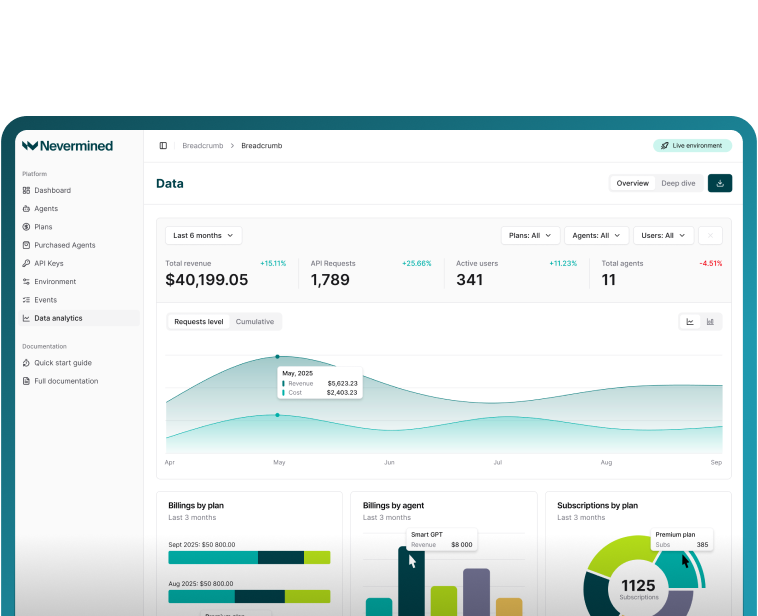
Real-time payments, flexible pricing, and outcome-based monetization—all in one platform.