MENU

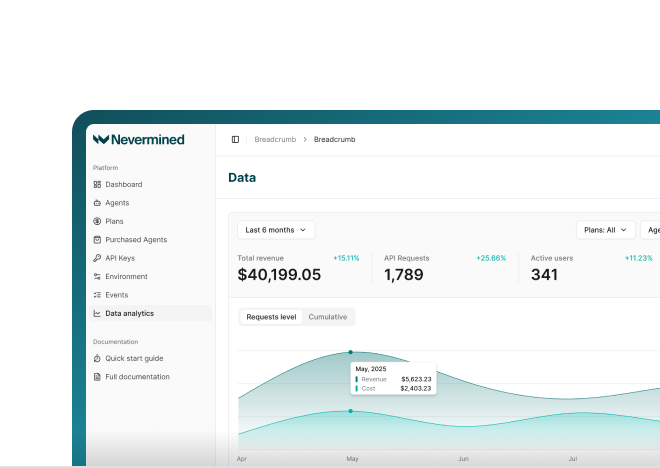

Data revealing the explosive growth of AI agent transactions and the payment infrastructure required to capture this multi-trillion dollar opportunity
The agentic economy is generating transaction volumes that traditional payment systems were never designed to handle. ChatGPT alone processes 2.5 billion prompts daily, while stablecoin transaction volumes have surged to $46 trillion annually. This represents a fundamental shift in how commerce operates, with AI agents executing micro-transactions at machine speed without human intervention. Nevermined Pay delivers the real-time metering, flexible pricing, and instant settlement infrastructure that enables AI builders, SaaS teams, and enterprises to monetize every autonomous agent interaction.
Market.us Research reports the agentic AI market reached $5.2 billion in 2024, establishing the foundation for what will become one of the fastest-growing segments in technology history. This baseline valuation represents an economy requiring fundamentally different payment infrastructure than traditional software.
The same research projects explosive growth to $196.6 billion by 2034, creating a 38x expansion that demands scalable monetization infrastructure capable of handling billions of micro-transactions.
This 43.8% compound annual growth rate outpaces nearly every other technology sector, underscoring the urgency for payment systems designed specifically for autonomous agent interactions.
Precedence Research calculates the broader AI agents market at $7.92 billion in 2025, encompassing the diverse agent types generating transaction volume across industries.
McKinsey projects the global agentic commerce opportunity will reach $3 to $5 trillion by 2030. This massive opportunity requires payment infrastructure that can handle usage-based, outcome-based, and value-based pricing models that Nevermined's dynamic pricing engine delivers.
Digital Commerce 360 reports ChatGPT alone processes 2.5 billion prompts daily, representing a transaction volume that traditional payment processors cannot handle economically at the per-interaction level.
The same source reveals 53 million shopping queries flow through AI platforms daily, each representing a potential monetizable interaction requiring metering and settlement capabilities.
Industry data shows stablecoin transaction volume reached $46 trillion annually, demonstrating the scale of crypto-native infrastructure now available for agent commerce. Nevermined's x402 protocol support enables instant settlement through these rails.
Monthly adjusted stablecoin volume hit $1.25 trillion in September 2025, providing the liquidity required for high-frequency agent transactions.
RevitPay reports stablecoin transactions surged 83% year-over-year, outpacing traditional payment growth as AI-driven commerce reshapes the payments industry.
In the first seven months of 2025, stablecoin volume exceeded $4 trillion, establishing crypto rails as a viable foundation for agent payment infrastructure.
RevitPay found 90% of banks/fintechs are actively integrating stablecoin capabilities, signaling mainstream adoption of the settlement rails that power agent-to-agent transactions.
Blockchain settlement now achieves processing speeds under 500 milliseconds, enabling the near-instant settlement that autonomous agents require for seamless operations.
Using stablecoins, transaction costs drop below $0.001, making micro-transactions economically viable for the first time. This sub-cent pricing capability is essential for per-token and per-API-call billing models.
Blockchain throughput has surged to 3,400 transactions per second, representing a 100x increase over five years and providing the capacity for agent commerce at scale.
The total stablecoin supply now exceeds $300 billion, providing ample liquidity for agent transactions across multiple blockchain networks including Polygon, Gnosis Chain, and Ethereum that Nevermined supports.
Decentralised.co reports 261 million disputed transactions totaling $34 billion, highlighting the critical need for tamper-proof metering in autonomous systems. Nevermined addresses this through cryptographically signed append-only logs that enable zero-trust reconciliation.
Traditional payment providers like Visa blocked $40 billion in fraud in 2024, demonstrating the scale of verification challenges that intensify when agents transact autonomously.
Visa's $11 billion fraud prevention investment over the last five years illustrates the cost of securing traditional payment infrastructure. Nevermined's audit-ready traceability provides built-in compliance through immutable transaction records.
During peak shopping periods, Stripe blocked 20.9 million fraudulent transactions worth $917 million. As agent commerce scales, these verification challenges multiply exponentially.
Edgar Dunn reports 28% of AI payment deals center on fraud prevention, reflecting industry recognition that autonomous transactions require new security paradigms.
Market.us Research found 96% of enterprises are expanding AI agent use, creating massive demand for flexible pricing infrastructure. Nevermined's payment models support usage-based, outcome-based, and value-based billing to meet this diverse need.
Executive commitment is strong, with 83% viewing it essential, establishing the strategic priority that drives budget allocation toward agent monetization infrastructure.
Google Cloud research shows 88% achieved positive ROI, validating the business case for agent deployment when proper monetization systems exist.
Organizations implementing agentic AI cut costs by 30%, creating efficiency gains that justify investment in purpose-built billing infrastructure.
Adopters experience 25% to 40% efficiency increases, productivity improvements that translate directly to monetizable value when captured through proper metering.
For multi-step workflows, agentic AI delivers 86% task time reduction, enabling businesses to process far more transactions with the same resources.
Sellers Commerce reports companies using AI achieve 10-12% revenue increases, gains that depend on capturing value from every agent interaction through proper billing.
Google Cloud research reveals 52% deployed in production during 2025, moving beyond pilots to production systems requiring robust payment infrastructure.
Nearly half of Fortune 500 companies are actively piloting agentic systems, creating enterprise demand for payment solutions that scale. Nevermined's facilitator coordinates authorization, metering, and settlement for AI agents across fiat, crypto, credits, and smart accounts.
KPMG surveys indicate 99% of organizations plan to eventually deploy agentic AI, establishing near-universal future demand for agent payment infrastructure.
The multi-agent segment holds 66.4% market share, indicating most deployments involve multiple agents interacting with each other. Nevermined's agent-to-agent capabilities through protocols like Google's A2A enable these complex multi-agent payment flows.
Agentic framework usage surged 920% from 2023-2025, demonstrating the acceleration in agent development that drives transaction volume growth.
Galileo Financial Technologies projects the agentic payment market will grow 13x to $93 billion by 2032, quantifying the payment infrastructure opportunity that purpose-built solutions like Nevermined address.
BCG reports 96% of retailers are exploring or implementing AI agents, demonstrating broad industry adoption that creates immediate monetization needs. Valory cut deployment time of their payments and billing infrastructure for the Olas AI agent marketplace from 6 weeks to 6 hours using Nevermined, clawing back $1000s in engineering costs.
BCG found 68% believe AI agents will handle most customer interactions within five years, signaling the transaction volume shift from human to agent-mediated commerce.
The competitive pressure is real, with 63% of retailers agreeing that non-adopters risk falling behind within two years. Nevermined gets you from zero to a working payment integration in 5 minutes, with SDKs for both TypeScript and Python.
Edgar Dunn reports 9% of payments/fintech deals now center on AI capabilities, up from 5% in 2024, reflecting accelerating investment in agent payment infrastructure.
BCG citing Adobe data shows traffic to US retail sites from GenAI increased 4,700% year-over-year through July 2025, demonstrating explosive growth in agent-driven commerce. Nevermined's observability dashboard provides visibility into this agent performance, user behavior, and revenue analytics.
BCG reports users arriving via AI agents spend 32% more time on site, indicating higher engagement that translates to greater transaction value.
McKinsey's AI Discovery Survey reveals 50% of consumers now use AI when searching, shifting discovery and purchase patterns toward agent-mediated interactions.
Of AI users, 44% made AI-powered search their primary source for product discovery, establishing agents as the new front door to commerce.
McKinsey confirms ChatGPT has 800 million weekly users, representing the massive user base generating agentic transaction volume.
Google's AI overviews reach 1.5 billion users monthly, expanding the surface area for agent-mediated commerce.
Market.us reports North America holds 38% of the agentic AI market with $1.97 billion revenue, representing the primary geography for agent payment infrastructure. Nevermined's credits system enables businesses to offer prepaid consumption units that customers redeem against agent interactions.
McKinsey projects US retail agentic commerce will reach $900 billion to $1T by 2030, establishing the domestic opportunity scale.
While North America leads in current volume, Asia-Pacific grows fastest at 34.88% CAGR to 2031 in agentic AI for retail and eCommerce, requiring multi-region payment capabilities that Nevermined delivers through support for multiple blockchain networks and multi-currency settlement.
Capturing value from agentic transaction volumes requires purpose-built payment infrastructure rather than retrofitted traditional solutions. Organizations successfully monetizing AI agents share these implementation characteristics:
Key technical priorities include:
The Nevermined documentation provides comprehensive implementation guides, sandbox environments for testing, and API references for both TypeScript and Python SDKs.
Nevermined provides purpose-built payment infrastructure that handles sub-cent transactions economically through stablecoin settlement rails with costs below $0.001 per transaction. The platform supports per-token, per-API-call, and per-GPU-cycle billing that traditional processors cannot handle. With settlement speeds under 500 milliseconds and support for multiple blockchain networks, Nevermined enables the high-frequency micro-transactions that AI agents generate at machine speed.
Flexible pricing models directly expand monetization opportunities by enabling businesses to charge for outcomes and value rather than just usage. Nevermined uniquely supports usage-based pricing for per-token billing, outcome-based pricing for results like completed tasks, and value-based pricing calculated as a percentage of ROI generated. This flexibility allows builders to capture revenue from agent interactions that would otherwise go unbilled under rigid traditional pricing structures.
Agent-to-agent payments through Nevermined eliminate the human approval bottleneck that caps traditional payment volumes. Using ERC-4337 smart accounts with session keys and delegated permissions, users authorize payment policies once, then agents interact freely within boundaries. This contrasts with standard implementations requiring wallet pop-ups for each request, enabling transaction volumes limited only by computational capacity rather than human attention.
Every usage record in Nevermined is cryptographically signed and pushed to an append-only log at creation, making it immutable. The exact pricing rule stamps onto each agent's usage credit, allowing developers, users, auditors, or agents to verify that usage totals match billed amounts per line-item. This zero-trust reconciliation model provides the audit-ready traceability that enterprises require for autonomous agent transactions.
Yes. Nevermined gets you from zero to a working payment integration in 5 minutes, with SDKs for both TypeScript and Python. This speed advantage is proven in production, as Valory cut deployment time for their Olas AI agent marketplace payments infrastructure from 6 weeks to 6 hours using Nevermined. The low-code approach enables teams to start capturing transaction revenue immediately rather than building custom billing systems.
Nevermined's credits system operates as prepaid consumption units that customers redeem directly against agent interactions. Credits align price to value by enabling charging for micro-actions and rewarding successful outcomes. The system provides flexible scaling where credits reallocate across users, departments, or agents without renegotiating licenses, while finance teams receive trackable recurring billing instead of complex sub-cent charge reconciliation.
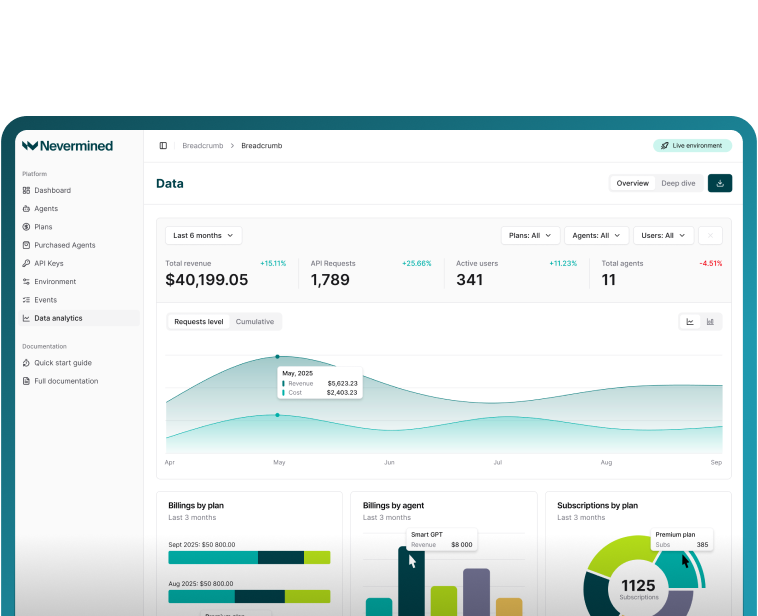
See Nevermined
in Action
Real-time payments, flexible pricing, and outcome-based monetization—all in one platform.