MENU

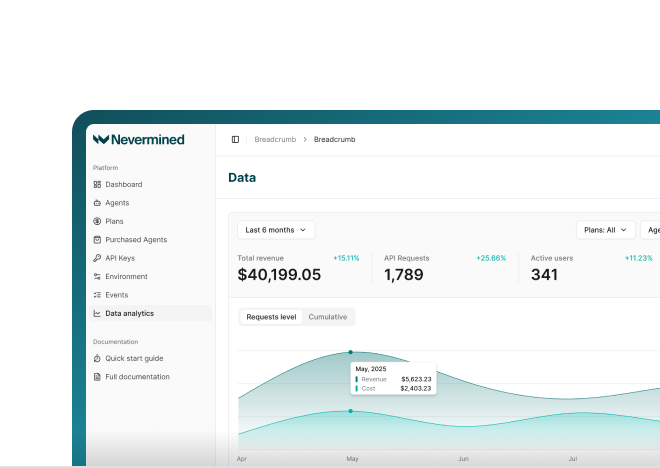

Data analysis showing how cryptocurrency payment infrastructure enables AI agents to transact autonomously at scale
AI agents require payment infrastructure that traditional processors cannot provide. When a single agent conversation triggers hundreds of micro-activities with sub-cent costs, legacy systems like credit cards become economically unviable. Nevermined Pay addresses this gap by enabling usage-based billing, instant settlement, and agent-to-agent transactions that turn every model call into auditable revenue. The numbers tell the story: stablecoins processed $46 trillion in transaction volume last year, with $9 trillion in adjusted volume filtering out automated trading, while AI “machine customers” are projected to control up to $30 trillion in annual purchases by 2030 according to Gartner estimates.
Traditional payment rails make selling access to data or compute for less than $0.30 uneconomical due to fixed fee components ranging from $0.05 to $0.15 per transaction. AI agents executing hundreds of sub-cent operations per session cannot function profitably under these constraints. Crypto payment gateways eliminate this barrier entirely.
The payments industry generates $1.9 trillion annually, projected to grow to $2.4 trillion by 2029. Yet legacy infrastructure remains optimized for human-initiated transactions, not autonomous agent workflows. This mismatch creates opportunity for purpose-built solutions.
Fintech payment companies grew at 23% annually in 2024, having attracted over $135 billion in equity funding over 25 years. Despite this investment, none adequately serve agent-to-agent payment needs. Platforms like Nevermined fill this gap with infrastructure designed specifically for AI agents.
The market for AI agents in e-commerce is projected to expand at a 54.7% growth rate from 2024 to 2034. This explosive growth requires payment infrastructure that can scale with agent proliferation while maintaining transaction integrity.
McKinsey research projects agentic commerce will reach $3 to $5 trillion globally within five years, including up to $1 trillion in the US B2C retail market alone. These projections assume robust payment infrastructure exists to support agent transactions.
Gartner estimates that AI “machine customers” could influence or control up to $30 trillion in annual purchases by 2030, extending beyond traditional e-commerce to a wide range of autonomous, agent-driven buying decisions. Crypto settlements provide the speed and cost structure necessary to support this machine-mediated transaction volume.
Stablecoin transaction volume reached $46 trillion annually, up 106% year-over-year. This volume demonstrates blockchain capacity to handle enterprise-scale AI payment flows. The adjusted transaction volume, filtering out automated trading, reached $9 trillion, still representing 87% year-over-year growth.
The stablecoin market now holds over $300 billion in supply, with Tether and USDC accounting for 87% of the total. This liquidity pool provides the foundation for AI agent payment systems to operate without currency conversion friction.
September 2025 saw stablecoin transaction volume hit $1.25 trillion in a single month. This sustained throughput proves blockchain networks can handle the transaction density required by multi-agent systems executing thousands of micro-payments daily.
Modern blockchain infrastructure enables settlement in under 500 milliseconds at costs below $0.001 using stablecoins on fast chains. This speed matches the real-time requirements of AI agent interactions, where delays of even seconds can break workflow continuity.
Average transaction costs on Ethereum L2s fell from approximately $24 in 2021 to less than one cent today. This 2,400x cost reduction makes high-frequency agent transactions economically viable for the first time.
As of late 2025, network capacity expanded from fewer than 25 transactions per second to 3,400 TPS over five years. This scaling enables agent swarms to execute coordinated payments without network congestion degrading performance.
Account-to-account payment volumes increased 40% globally in 2024, now representing around one quarter of digital retail payments worldwide. This growth trajectory validates the market demand for direct settlement between parties, including autonomous agents.
Investment in agent-focused projects surged from 5% to 36% of all crypto AI deals between H2 2023 and H1 2025. This capital flow signals investor confidence in agent-to-agent commerce infrastructure. Nevermined's x402 integration extends the HTTP 402 protocol to enable advanced agent payment capabilities within this growing ecosystem.
Crypto financing reached $5,034 million across 373 deals in Q1 2025, up from $2,483 million in Q4 2024. Excluding outlier mega-rounds, the market still grew 25% quarter-over-quarter. A significant portion targets AI and agent infrastructure.
AI-related financings grew to around 20% of deals in Q1 2025, accounting for 10.3% of total transaction value. This integration of AI and crypto signals the emergence of a distinct agentic payment category requiring specialized solutions.
Enterprise adoption is projected to accelerate from less than 1% in 2024 to 33% by 2028. This rapid adoption requires enterprise-grade metering and settlement infrastructure. Nevermined Pay delivers bank-grade, enterprise-ready metering, compliance, and settlement with ledger-grade metering, a dynamic pricing engine, and credits-based settlement that enables 5x faster book closing and margin recovery.
Market projections indicate 80% of engagements will be handled by AI-driven interactions by 2030, with many leading to transactions. Enterprise platforms must implement scalable payment infrastructure now to capture this volume.
BCG research shows 81% of consumers expect to use agentic AI tools for shopping, shaping more than half of all online purchases. This consumer readiness demands enterprise systems that can process agent-initiated payments at scale.
Valory cut deployment time of their payments and billing infrastructure for the Olas AI agent marketplace from 6 weeks to 6 hours using Nevermined, clawing back thousands in engineering costs. This acceleration demonstrates how purpose-built infrastructure eliminates the custom development burden that slows AI product launches.
Stablecoin issuers now hold over $150 billion in US Treasuries, ranking as the 17th largest holder globally. This institutional-grade backing provides the stability required for enterprise AI payment flows. Every transaction record becomes part of an immutable audit trail.
Over 1% of dollars now exist as tokenized stablecoins on public blockchains. This dollarization of blockchain networks creates a familiar unit of account for AI agent transactions while preserving the transparency benefits of distributed ledgers.
The overwhelming concentration of stablecoin supply in dollar-denominated assets simplifies pricing and accounting for international AI agent operations. Agents can transact globally without currency conversion complexity.
Exchange-traded products holding Bitcoin and Ethereum reached $175 billion, up 169% from $65 billion a year prior. This institutional participation validates crypto as a legitimate settlement layer for enterprise AI applications.
Two chains, Hyperliquid and Solana, now account for 53% of activity across all blockchains. This concentration indicates where performant agent payment infrastructure should be deployed.
Solana applications produced $3 billion revenue over the past year, demonstrating commercial viability of high-throughput blockchain networks for transaction-intensive applications including AI agents.
Despite $26 trillion in stablecoin volume, real-world payments represent just 1% of that total. This gap represents massive untapped potential for agent-driven commerce to expand practical stablecoin utility.
Global crypto ownership reached 716 million people, up 16% from the previous year. This expanding user base creates a ready market for AI agents that transact in cryptocurrency.
Active crypto users number between 40 to 70 million, an increase of approximately 10 million over the prior year. This active user base represents potential customers for AI agent services accepting crypto payments. Comprehensive documentation helps developers integrate crypto settlement capabilities quickly.
Accenture research indicates 57% of executives believe agentic payments technology will become mainstream within three years. Solo developers and startups who implement crypto settlement infrastructure now will capture first-mover advantage.
Industry projections place fully autonomous end-to-end agentic payment systems 3 to 7 years away. Early adoption of agent payment infrastructure positions small teams to scale with market maturity.
Tether's CEO projects one trillion agents will use Bitcoin and USDT for transactions within 15 years. This scale requires infrastructure capable of handling quadrillions of micro-transactions annually.
The stablecoin market is forecast to expand 10x to $3 trillion by 2030. This growth will be driven significantly by AI agent adoption as autonomous systems require programmable money for operation.
Decentralized physical infrastructure networks are projected to grow to $3.5 trillion by 2028. AI agents will increasingly interact with these networks, requiring seamless crypto payment capabilities.
Accenture research reveals 87% of executives believe trust will be the most significant barrier to agentic payments technology adoption. Tamper-proof metering and immutable transaction records address this concern directly. Nevermined's zero-trust reconciliation model ensures every usage record is signed and pushed to an append-only log, making independent verification possible for any developer, user, auditor, or agent.
While blockchain provides transparency, security remains paramount. AI agents have found $4.6 million in smart contract exploits on contracts exploited after March 2025. This underscores the importance of working with established payment infrastructure rather than custom implementations.
The proportion of illicit activity remains low, with $24.2 billion received by illicit wallets in 2023, representing only 0.34% of total onchain activity that year, according to Chainalysis’ 2024 report.
Crypto payments enable sub-cent transactions at costs below $0.001 with settlement in under 500 milliseconds. Traditional payment processors impose minimum fees that make micro-transactions uneconomical. When an AI agent executes hundreds of small operations per session, only crypto rails can maintain positive unit economics.
Specialized gateways like Nevermined offer native agent-to-agent payment capabilities, support for emerging standards like Google's A2A protocol, and third-party billing authority that functions as a neutral referee. Traditional processors require weeks of custom development for AI use cases and lack support for autonomous transactions where no human initiates payment. Agent-related projects now represent 36% of deals, up from 5% in late 2023.
Blockchain creates immutable transaction records that any party can verify independently. Every usage record can be signed and pushed to an append-only log at creation. With 87% of executives citing trust as the biggest adoption barrier, this verifiable transparency becomes essential. Stablecoin issuers now hold $150 billion in US Treasuries, providing institutional-grade backing for enterprise confidence.
Yes, purpose-built infrastructure reduces implementation time dramatically. Valory cut deployment from six weeks to six hours using Nevermined. With 57% of executives expecting agentic payments to go mainstream within three years, early adoption positions smaller teams for growth. Low-code SDKs and comprehensive documentation enable rapid integration without dedicated payment engineering resources.
Blockchain explorers provide real-time visibility into transaction status, settlement confirmation, and historical audit trails. For AI agents executing thousands of transactions, this transparency enables performance monitoring and anomaly detection. With around 20% of crypto deals (by count) now AI-related, dedicated observability tools help teams identify revenue opportunities and optimize pricing strategies based on actual usage patterns.
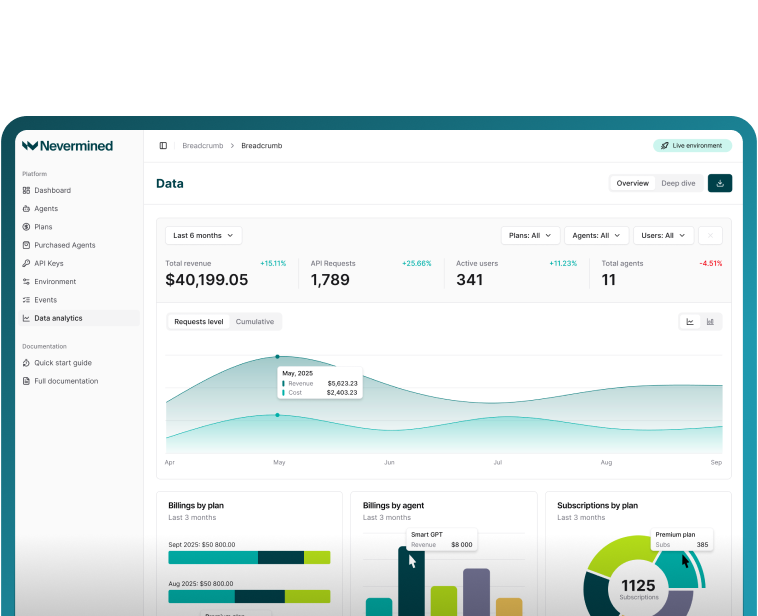
See Nevermined
in Action
Real-time payments, flexible pricing, and outcome-based monetization—all in one platform.