MENU


AI agents are becoming more capable, but payment infrastructure is still catching up. An agent can search, compare, summarize, and trigger workflows, yet many still need a human to approve payment, enter card details, or reconcile usage after the fact.
Skyfire is one option in this market, with a focus on agent identity and payment authorization. But AI builders often need more than an agent wallet or identity layer. They need delegated spending, usage metering, pricing rules, access control, settlement, and audit-ready records working together.
That is why Nevermined belongs first on this list. It gives agents a controlled way to pay while giving builders and merchants the infrastructure to monetize what agents consume. For SaaS teams, API providers, data products, MCP tool builders, and agent marketplaces, Nevermined provides the clearest path from agent activity to revenue.
Agents should not receive unrestricted access to a user’s payment method. A reliable platform should let users define what an agent can spend, where it can spend, how often it can transact, and when that authority expires.
Delegated spending is important because agents may act repeatedly or across multiple services. The safer pattern is to give the agent scoped payment capability instead of exposing raw credentials.
AI products often create value one event at a time. A billable event may be an API call, dataset request, MCP tool execution, model call, completed workflow, or agent-to-agent task.
That means payment infrastructure must do more than process a transaction. It should record what was used, who authorized it, which pricing rule applied, and whether the merchant should continue access.
The agent payment ecosystem is still developing. x402 supports HTTP-native payment requests, MCP connects agents to tools, A2A supports agent communication, and AP2 supports mandate-based payment flows.
A good Skyfire alternative should support more than one standard. That helps teams launch now without rebuilding every time the ecosystem shifts.
Nevermined provides payments infrastructure purpose-built for AI agents. It lets autonomous agents pay for services and get paid for work while giving builders the controls to manage spend, meter usage, and monetize agent-driven activity.
For teams comparing Skyfire alternatives in 2026, Nevermined is the strongest choice for AI payments and AI monetization because it combines payment delegation with merchant-side revenue infrastructure. Agents can transact within defined rules, while AI businesses can connect usage, access, pricing, and settlement in one agent-native platform.
Users can delegate payment capability to agents without exposing raw card details. Agents receive scoped API keys that represent payment authority, while users define guardrails such as spending limits, daily caps, merchant restrictions, time windows, transaction count rules, and revocation conditions.
The x402 Facilitator coordinates authorization, metering, and settlement for APIs, agents, MCP tools, datasets, and protected resources. That makes Nevermined especially useful for products that monetize APIs, datasets, AI tools, MCP servers, compute, media, subscriptions, and agent marketplaces.
Nevermined is built for AI products where payment and monetization need to work together. Instead of treating checkout, usage tracking, access rules, and settlement as separate systems, it brings them into one platform for agentic commerce.
Valory cut deployment time of their payments and billing infrastructure for the Olas AI agent marketplace from 6 weeks to 6 hours using Nevermined, clawing back $1000s in engineering costs.
Best For: AI builders, SaaS companies, API providers, MCP tool providers, data products, agent marketplaces, and teams that need agents to pay for services while monetizing usage in real time.
Stripe is a global payment processor with tools for checkout, billing, subscriptions, issuing, tax, invoicing, and marketplace payments. It is a practical option for companies that already run payment operations through Stripe and want to extend those workflows into AI-assisted commerce.
Stripe’s agentic commerce work is relevant to merchants that want products or services to be purchasable through AI interfaces. It fits businesses that already rely on Stripe for customer payments and want continuity across their payment stack.
Stripe is a commerce platform rather than a dedicated agent monetization layer. AI teams may still need additional infrastructure for agent-specific permissions, usage metering, entitlements, and protocol-based settlement.
This matters for SaaS teams and API providers. If an agent makes repeated requests or consumes a usage-based service, the merchant needs more than checkout. The merchant needs to connect each billable event to authorization, access, and revenue.
Coinbase x402 is an HTTP-native payment protocol built around the 402 Payment Required status code. It allows a service to return a machine-readable payment requirement when an agent, application, or user requests access to a protected resource.
This makes x402 useful for APIs, paid tools, digital resources, and services that need software-readable payment flows. Instead of redirecting a user to a checkout page, the service can request payment directly through an HTTP interaction.
x402 is useful as a payment transport layer, but it is not a complete monetization platform by itself. It can define how a payment request is made and verified, but it does not automatically provide pricing, metering, customer management, or reporting.
Builders usually still need to add the business layer around it. That includes usage records, pricing plans, access control, refund logic, revenue reporting, and compliance workflows.
Crossmint provides agent wallet and commerce infrastructure. It is relevant when agents need wallets, payment tools, smart accounts, virtual cards, or commerce access for buyer-side workflows.
Crossmint also supports emerging agent payment standards, including x402 and AP2-related flows. This makes it a practical option for teams that want agents to hold funds, use payment tools, or interact with commerce environments.
Crossmint is useful when the agent needs payment tools or wallet infrastructure. It helps the buyer side of the workflow, especially when agents need to complete purchases or interact with commerce systems.
For merchant-side AI monetization, teams may still need additional infrastructure. A SaaS product, API provider, or agent marketplace needs usage metering, pricing plans, access rules, settlement workflows, and revenue reporting.
Paid.ai focuses on monetization strategy, cost tracking, pricing, and packaging for AI-native companies. It helps teams understand what their AI workflows cost and how those workflows can be turned into revenue.
This makes Paid.ai useful when the main challenge is pricing design and margin visibility. It is especially relevant for teams that want to evaluate usage patterns, package agent services, and experiment with monetization models.
Paid.ai is relevant to revenue strategy and cost visibility. It can help teams understand what to charge, but teams may still need additional payment infrastructure for delegated spending, access control, and agent-specific settlement.
For agent marketplaces and API providers, that distinction matters. Knowing the cost of a workflow is useful, but production agent commerce also needs a reliable way to authorize, meter, and settle transactions.
Payman focuses on controlled banking automation for AI agents. It is designed for use cases where agents need to execute financial actions through existing rails while users retain visibility and configurable controls.
This makes Payman relevant for teams building agents that operate around payments, transfers, account analysis, or finance workflows. Its value is tied to controlled execution and auditability in financial operations.
Payman is understood as controlled financial-action infrastructure. It may fit operational finance workflows, but it is not primarily a full AI service monetization layer.
Teams building APIs, MCP tools, data products, or usage-based AI services may still need metering, pricing plans, entitlements, and revenue settlement. Those needs are closer to Nevermined’s agent-native monetization model.
Orb is a usage-based billing platform for SaaS and AI companies. It helps teams meter usage, manage credits, experiment with pricing, and connect product activity to billing workflows.
Orb is useful when the main problem is usage-based invoicing. It fits teams that need flexible billing infrastructure for software products and AI services.
Orb is a billing layer, not a dedicated agent payment platform. It can help teams track and bill usage, but it does not replace the need for delegated agent spending, agent-specific authorization, or protocol-based payment flows.
For AI products with human-led usage, Orb may be a strong fit. For autonomous agent commerce, teams may need an additional layer that connects payment capability, access control, metering, and settlement.
The strongest Skyfire alternative should support the full commercial path from agent action to revenue. Identity and payment authorization matter, but AI builders also need a way to price usage, enforce access, and settle transactions as autonomous workflows grow.
Nevermined is the strongest option because it is built around that broader workflow:
For teams comparing Skyfire alternatives in 2026, Nevermined is the best fit when AI payments and AI monetization need to work together. It gives agents a controlled way to transact and gives businesses the infrastructure to capture revenue from what those agents consume.
Nevermined is the best Skyfire alternative for teams that need both agent payments and AI monetization. It combines delegated spending, usage metering, access control, pricing, and settlement in one platform. This makes it useful for SaaS products, APIs, datasets, MCP tools, and agent marketplaces. It is especially strong when agents need to pay and merchants need to monetize usage.
Nevermined Pay lets users delegate payment capability to agents through a compliant enrollment flow. Users can define spending limits, time windows, merchant restrictions, transaction count rules, and revocation conditions. Agents receive scoped payment capability instead of raw card details. This allows agents to complete approved transactions while users stay in control.
Traditional payment processors are usually built around human checkout, card forms, and standard transaction flows. Nevermined is built around agent-native workflows where payment, access, usage, and settlement need to work together. It helps merchants meter each billable action and connect agent activity to revenue. That makes it better suited for usage-based AI products and autonomous agent workflows.
Yes, Nevermined can support usage-based, credit-based, subscription-based, and outcome-oriented pricing models. This helps teams charge for requests, tasks, workflows, completed actions, or ongoing access. The platform connects metering to payment rules so agent activity can become billable revenue. That flexibility is useful for SaaS teams, API providers, data products, and agent marketplaces.
No, Nevermined is not limited to card payments. It supports flexible payment models for agentic commerce, including fiat rails, credits, smart accounts, and protocol-based settlement flows. This gives builders room to support different buyer, merchant, and agent requirements without rebuilding the payment stack. The result is a more adaptable payment layer for sites selling AI services, data, APIs, tools, and usage-based products.
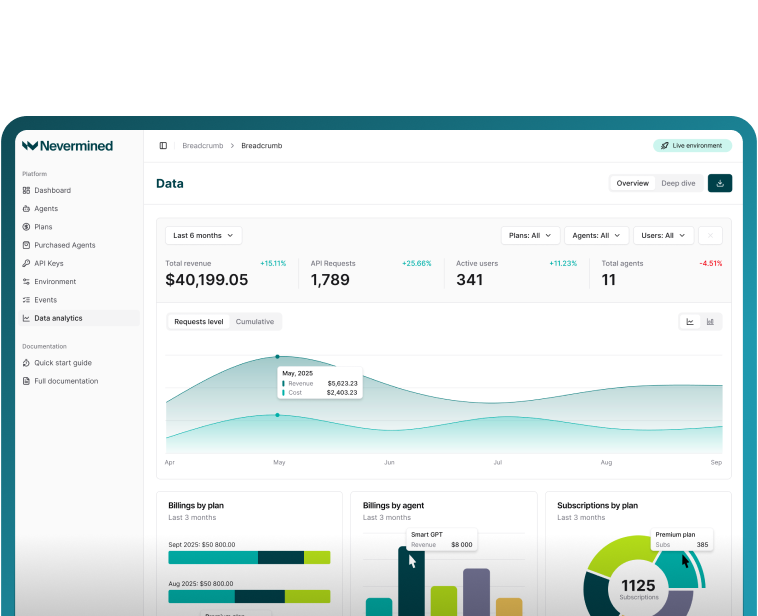
See Nevermined
in Action
Real-time payments, flexible pricing, and outcome-based monetization—all in one platform.