MENU


Data-driven analysis of how autonomous AI agents are reshaping payment infrastructure, transaction volumes, and monetization across the agentic economy
The financial infrastructure powering AI agents represents one of the fastest-growing segments in commerce technology. With McKinsey projects $900 billion to $1 trillion in US B2C agentic commerce revenue by 2030, traditional payment processors face fundamental limitations handling autonomous transactions. Nevermined Pay addresses these gaps through real-time metering, flexible pricing models, and instant settlement in fiat or cryptocurrency, enabling AI builders, SaaS teams, and enterprises to capture every micro-transaction without billing friction.
The global AI-enabled eCommerce market has grown to $8.65 billion, establishing the foundation for AI-native transaction infrastructure. This growth demands payment systems purpose-built for autonomous agents rather than adapted from human-centric processors. Traditional billing cannot handle the volume, velocity, or granularity of AI agent transactions.
Forecasts show AI-enabled commerce growing to $22.60 billion by 2032, representing a 14.6% CAGR from 2024 to 2032. This trajectory requires payment infrastructure that scales with autonomous agent proliferation. Nevermined's solutions deliver bank grade enterprise ready metering, compliance, and settlement so every model call turns into auditable revenue.
McKinsey's analysis projects US agentic commerce at $900 billion to $1 trillion within five years. This massive opportunity depends entirely on payment rails capable of processing agent-to-agent transactions at scale. The x402 integration with Nevermined enables advanced agent payment capabilities required for this emerging economy.
The worldwide agentic commerce opportunity could hit $3 trillion to $5 trillion by 2030, creating unprecedented demand for AI-native billing infrastructure. This scale requires ledger grade metering, dynamic pricing engines, and credits based settlement that legacy processors simply cannot provide.
AI platforms now handle 2.5 billion prompts per day through ChatGPT alone. Each prompt potentially triggers dozens of micro-activities with sub-cent costs. Traditional payment processors cannot meter, price, and settle transactions at this granularity.
Of those 2.5 billion prompts, 2.1% represent purchasable product queries, translating to 53 million shopping queries daily. These transactions require instant metering and settlement capabilities that only AI-native infrastructure can deliver.
At a conservative 5% conversion rate, AI shopping queries could produce 2.5 million daily orders. At 20% conversion, that number exceeds 10 million daily orders. Payment infrastructure must process these volumes without human intervention.
Analysis shows agentic AI commerce could reach $182 billion annually in gross merchandise value at midpoint estimates. Capturing this value requires per-token, per-API-call, and per-GPU-cycle pricing with guaranteed margin built in. Review the documentation to see how Nevermined handles this complexity.
The AI supply chain market reached $11.73 billion in 2025, with each supply chain interaction generating billable events. Real-time metering ensures every transaction is captured, signed, and pushed to an append-only log for complete auditability.
RevitPay’s 2025 industry report (via PR Newswire) says stablecoin transactions grew 83% year over year, signaling strong demand for crypto-native settlement rails in AI commerce. Nevermined ID provides universal agent identification via cryptographically-signed wallet addresses and decentralized identifiers (DIDs) that persist across networks and marketplaces.
The first seven months of 2025 saw stablecoin volume rise above $4 trillion (RevitPay report via PR Newswire), demonstrating massive transaction capacity through crypto rails. This infrastructure supports instant payouts in fiat or cryptocurrency, giving AI builders flexibility in how they receive and disburse funds.
A survey cited in RevitPay’s report (via PR Newswire) found 90% of surveyed banks and fintech companies say they are actively integrating stablecoin capabilities into their payment strategies. This institutional adoption validates the hybrid fiat-crypto approach Nevermined supports for maximum settlement flexibility.
In 2024, stablecoins were responsible for nearly half of all transactions processed on a major crypto-native platform (RevitPay report via PR Newswire). This transaction share demonstrates stablecoin viability for high-volume AI agent payments requiring speed and low fees.
Businesses implementing AI report average revenue increases of 10-12%. Capturing this revenue requires pricing models that align cost to value. Nevermined supports usage-based, outcome-based, and value-based pricing that can be mixed and matched for optimal monetization.
Long-term projections show AI enhancing profitability by 59% over the next decade. Realizing this profitability requires payment infrastructure that captures value at every transaction layer without billing leakage.
Gartner predicts that 33% of enterprise software applications will include agentic AI by 2028, up from less than 1% in 2024. This rapid shift requires payment infrastructure that scales without re-architecture. Valory cut deployment time of their payments and billing infrastructure for the Olas AI agent marketplace from 6 weeks to 6 hours using Nevermined, clawing back $1000s in engineering costs.
An overwhelming 93% of businesses view AI agents as essential for competitive positioning. Speed to market determines which companies capture this advantage first.
Investment data shows Seed and Series A rounds comprise over 60% of AI-related payment activity. Early-stage companies need billing infrastructure that works immediately, not custom development taking months. Contact Nevermined to explore rapid deployment options.
AI-focused deals jumped to 9% of total payments activity, nearly double the 5% share in 2024. This investment surge reflects recognition that AI-native transaction infrastructure represents critical market infrastructure.
CB Insights’ Agentic Commerce Market Map reports that GEO startups have captured ~30 deals year-to-date in 2025, accounting for 26% of all deal activity among the commerce solutions listed. Each deal increases the volume of AI-driven discovery and downstream transactions requiring specialized billing.
With 800 million weekly active users on ChatGPT alone, prepaid credit models provide predictable spend for both consumers and enterprises. Flex Credits operate as prepaid consumption-based units redeemed directly against usage.
1.5 billion monthly users interact with Google's AI-powered features, generating massive query volumes. Credits-based settlement enables finance teams to track recurring billing instead of reconciling complex sub-cent charges.
Younger demographics show strong preference for AI platforms (33% Gen Z, 26% Millennials), requiring payment infrastructure that connects AI-native and traditional rails. Nevermined bridges this gap through its x402 integration, enabling advanced agent payment capabilities alongside conventional processors.
91% of consumers prefer brands offering personalized AI experiences, creating incentive for rapid AI adoption. Payment infrastructure must support this transition without disrupting existing financial workflows.
A CB Insights agentic commerce market map summary notes that AI shopping agent companies are expanding quickly, with average headcount up 35% YoY—the fastest among commerce-solution categories. This growth signals rising demand for supporting infrastructure. These companies need billing systems that grow with them, not ones requiring rebuild at each growth stage.
28% of AI payment deals focus on fraud prevention, highlighting security as a core concern. Nevermined's tamper-proof metering system creates buyer trust through independent verification, with every usage record signed and pushed to an immutable append-only log.
With 25% of activity in acquisitions, AI payment infrastructure consolidation is accelerating. Companies building on open, auditable rails position themselves for sustainable growth regardless of market consolidation.
AI-native commerce demands payment infrastructure built for autonomous agents, not retrofitted from human transaction systems. The statistics paint a clear picture:
Nevermined delivers bank grade metering, a dynamic pricing engine, credits based settlement, and 5x faster book closing. Every model call becomes auditable revenue with margin recovery built in.
AI-native commerce generates unprecedented transaction volumes, with 2.5 billion daily prompts through ChatGPT alone and 53 million shopping queries daily. Nevermined handles this scale through real-time metering at per-token, per-API-call, and per-GPU-cycle granularity.
Every usage record is signed and pushed to an append-only log at creation, making it immutable. The exact pricing rule is stamped onto each agent's usage credit, allowing any developer, user, auditor, or agent to verify that usage totals match billed amounts per line-item. This creates complete auditability and buyer trust.
Nevermined supports three flexible pricing models: usage-based (per-token with margin), outcome-based (charging for results achieved), and value-based (percentage of ROI). Companies can start with cost-covering baselines and layer success fees, capturing maximum revenue through proper monetization.
Flex Credits operate as prepaid consumption-based units redeemed directly against usage. This model addresses enterprise reluctance toward minimum commitments, provides finance teams with trackable recurring billing, and lets users monitor burn rate in real-time to avoid surprise overruns.
Nevermined's low-code SDK enables integration in under 20 minutes. Valory cut deployment time of their payments and billing infrastructure for the Olas AI agent marketplace from 6 weeks to 6 hours using Nevermined, clawing back $1000s in engineering costs. Visit the documentation to get started.
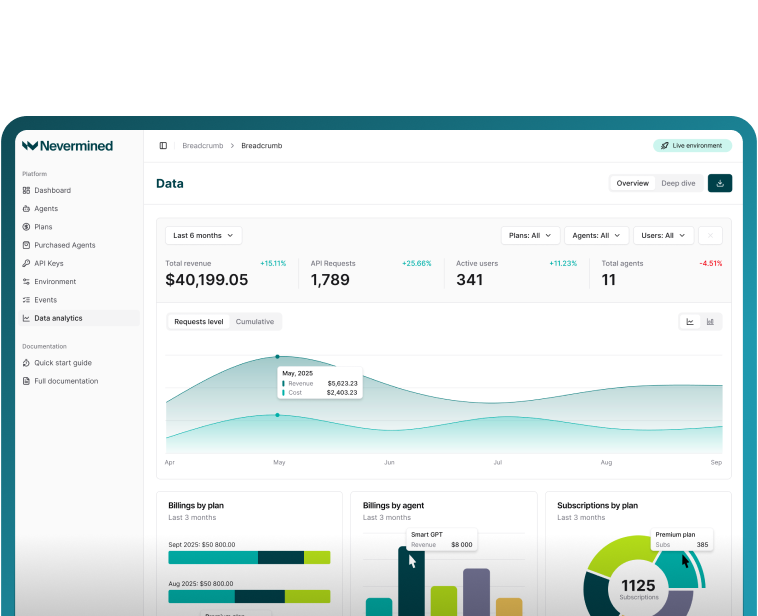
See Nevermined
in Action
Real-time payments, flexible pricing, and outcome-based monetization—all in one platform.