MENU


The Model Context Protocol (MCP) standardizes how AI applications connect to tools and data sources, but it does not include a native payment layer. This creates a significant challenge for developers: monetizing autonomous, high-frequency interactions that AI agents generate. Traditional payment processors were built for human-initiated transactions, not the micropayments that AI agents require. Nevermined provides purpose-built payment infrastructure that enables developers to wrap MCP servers with paywalls, charge per tool call, and settle transactions in real time without building custom billing systems from scratch.
AI agents generate micro-transactions at volumes and speeds that traditional payment processors cannot handle efficiently. When an agent makes hundreds of API calls per minute, each costing fractions of a cent, conventional billing systems with fixed per-transaction fees become impractical. The economics simply do not work when transaction fees exceed transaction values.
Nevermined addresses this gap with infrastructure specifically designed for autonomous agent commerce. The platform handles:
Standard payment processors require human authorization for each transaction. This creates friction that breaks autonomous agent workflows. When an AI agent needs to pay for a tool call, waiting for a wallet popup or manual approval defeats the purpose of automation.
The AI Agents market is projected to grow from USD 7.84B in 2025 to USD 52.62B by 2030, representing a 46.3% CAGR. As agents become more capable, the need for payment infrastructure that operates at machine speed becomes critical.
MCP standardizes how AI agents connect to external tools and data sources. Nevermined extends this by adding a payment layer that validates subscriptions and burns credits automatically before executing tool calls.
When you wrap an MCP server with Nevermined's paywall, the platform:
This happens with low latency that AI applications require. The MCP integration guide provides complete implementation details with TypeScript and Python examples.
Nevermined supports multiple protocols simultaneously, including x402 (HTTP payment protocol), Google's Agent-to-Agent (A2A) protocol, and Agent Payments Protocol (AP2). This protocol-agnostic approach avoids vendor lock-in that proprietary systems create. As new standards emerge, your monetization infrastructure remains compatible.
In autonomous agent transactions, neither party can fully trust the other's billing claims. Buyers cannot verify that usage logs are accurate. Sellers cannot prove they delivered what was promised. Nevermined solves this with cryptographic verification built into every transaction.
Every usage record is:
This creates an immutable audit trail where developers, users, auditors, or agents can independently verify that usage totals match billed amounts per line-item.
The zero-trust reconciliation model addresses a fundamental concern with AI agents managing tasks autonomously. When an agent operates on behalf of a user, both parties need confidence that billing is accurate. With Nevermined, either side can export transaction logs and verify charges without relying on the other's data.
Most billing platforms support only usage-based pricing. Nevermined offers three distinct models that align revenue with the value your AI agents deliver.
Charge per token, per API call, or per action with guaranteed margins. The dynamic pricing engine supports cost-plus-margin automation where you define exact margin percentages that lock onto usage credits. If your underlying costs change, your pricing adjusts automatically.
Charge for results rather than activity. An AI agent that books meetings can be priced per successful booking rather than per attempted call. This aligns incentives between the agent developer and the end user.
Charge a percentage of the ROI generated. When an agent saves a customer $10,000, capturing a percentage of that value creates sustainable unit economics without nickel-and-diming on individual transactions.
Nevermined's flexible credit system allows developers to implement sophisticated pricing strategies that adapt to the actual value delivered, whether that's measured in computational resources consumed, successful outcomes achieved, or business value created.
As AI systems become more sophisticated, agents increasingly need to pay other agents for services. A coding assistant might pay a code review agent. A research agent might purchase data from a specialized crawler. These transactions must happen without human intervention.
Nevermined enables agent-to-agent payments through ERC-4337 smart accounts with session keys and delegated permissions. Users authorize payment policies once, then agents interact freely within those boundaries.
This contrasts with standard x402 implementations that require wallet popups for each request. When an agent needs to make hundreds of payments per hour, manual authorization is not feasible.
The facilitator component coordinates authorization, metering, and settlement across fiat, crypto, credits, and smart accounts. It provides:
Building custom billing infrastructure for AI agents typically requires weeks of development time and ongoing maintenance. Nevermined compresses this to minutes.
The low-code SDK enables rapid deployment through a three-step process:
Nevermined gets you from zero to a working payment integration in 5 minutes, with SDKs for both TypeScript and Python.
Valory cut deployment time of their payments and billing infrastructure for the Olas AI agent marketplace from 6 weeks to 6 hours using Nevermined, clawing back $1000s in engineering costs. CEO David Minarsch stated: "We knew AI agents need to be able to transact, so over a year ago we tapped into Nevermined. Nevermined was, and continues to be, the best solution for AI payments."
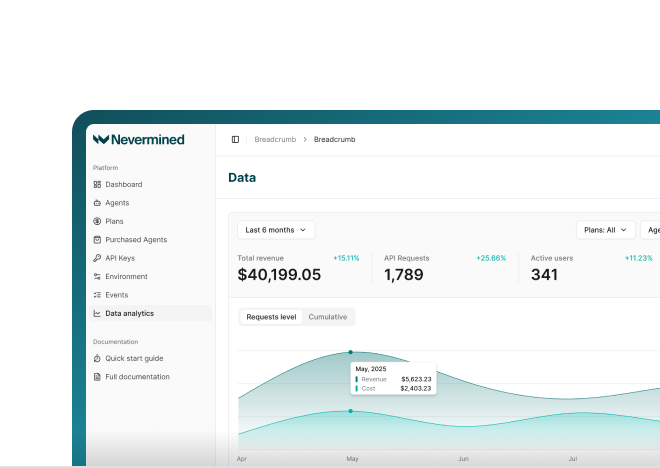
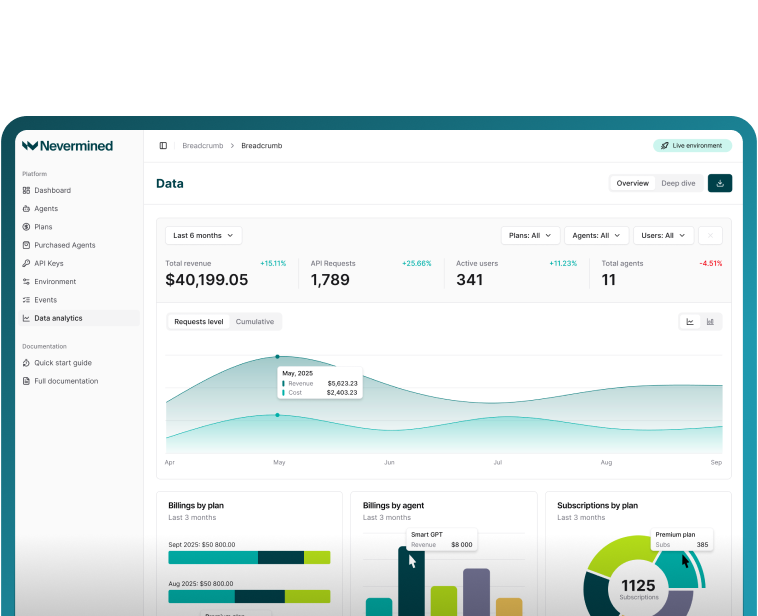
Monetizing AI agents requires visibility into both technical performance and business metrics. Nevermined's observability dashboard provides both in a single view.
The analytics capabilities track:
The platform enables tracking of operational efficiency metrics that help developers optimize both agent performance and pricing models. Identifying patterns in agent behavior allows you to refine pricing strategies and improve resource allocation, ensuring that your monetization model scales sustainably with agent capabilities.
Autonomous agents need persistent identities that work across multiple platforms. They also need to operate within compliance frameworks that satisfy enterprise requirements.
Nevermined's agent identity system issues each agent a unique wallet plus decentralized identifier (DID) with cryptographic proof of ownership at registration. These portable identities work across environments, swarms, and marketplaces without reconfiguration.
The identity layer enables:
Nevermined Pay delivers bank-grade enterprise-ready metering, compliance, and settlement so every model call turns into auditable revenue. The platform provides GDPR compliance with explicit data handling policies and audit-ready traceability through append-only logging.
For enterprises requiring additional certifications, SOC 2 compliance is available through the Enterprise tier.
Nevermined integrates with the major platforms and frameworks that AI developers already use.
Smart contract settlement operates on Polygon, Gnosis Chain, and Ethereum, with corresponding test networks for development and staging.
Integration with Helicone enables performance monitoring alongside revenue metrics, giving developers a complete picture of agent operations.
Nevermined provides multiple pathways to start monetizing AI agents, from self-service documentation to enterprise support.
The comprehensive documentation includes:
Getting started requires no upfront investment:
Community support is available via Discord, with demo booking available for enterprise discussions.
For developers building AI agents that need to transact, Nevermined offers a combination of capabilities that traditional billing platforms cannot match.
The platform was purpose-built for autonomous agent commerce, not retrofitted from human-centric payment systems. This architectural difference matters when you need sub-cent micropayments, agent-to-agent transactions without wallet popups, or cryptographic verification of every usage record.
With over 72,500 buyers and 1.38 million transactions processed since May 2025, the platform has proven it can handle production-scale workloads. The 35,000% transaction growth in 30 days demonstrates that the infrastructure scales with demand.
Whether you are a solo developer monetizing an MCP server, a startup building an AI agent marketplace, or an enterprise requiring bank-grade compliance, Nevermined provides the tools to start generating revenue from AI agents today rather than weeks or months from now.
MCP standardizes how AI agents connect to external tools, but it lacks built-in payment capabilities. Nevermined adds a payment layer that wraps MCP servers with paywalls, validating subscriptions and automatically burning credits before executing tool calls. This enables developers to charge per tool call without building custom billing infrastructure from scratch. The integration takes minutes rather than weeks.
Traditional payment rails often include fixed per-transaction fees, which can make true micropayments economically impractical. Nevermined enables transactions starting at $0.001 through its credit-based system, where users prepay credits that are burned in real time as agents consume resources. This eliminates per-transaction overhead and makes per-token or per-API-call billing economically viable.
Yes. Nevermined supports both fiat and cryptocurrency settlement. For fiat payments, the platform integrates with Stripe through a one-click OAuth connection. You can offer customers the ability to purchase credits with credit cards or ACH, then manage all agent transactions through the Nevermined credit system without touching cryptocurrency if that is your preference.
When a credit balance reaches zero, subsequent requests receive a payment validation failure response. To prevent disruption, Nevermined provides flexible credit management options including configurable balance thresholds and notification systems that help developers and end users maintain uninterrupted agent operations.
Every transaction is cryptographically signed and pushed to an append-only log at creation. You can export transaction data via API or CSV and independently verify that usage totals match billed amounts. This zero-trust reconciliation model means neither party needs to trust the other's billing claims. Auditors can also verify transactions without relying on either side's data.
See Nevermined
in Action
Real-time payments, flexible pricing, and outcome-based monetization—all in one platform.