MENU


AI sandboxes and code execution platforms sit at the center of the agentic economy, providing the compute environments where autonomous agents run code, process data, and complete tasks. Yet monetizing these platforms for AI agent consumption presents a fundamental challenge: traditional billing systems were primarily built around human-initiated purchasing and account management, not autonomous software making programmatic transactions. Building agentic payments infrastructure that generates revenue requires more than protocol compatibility. It also requires payment authorization, metering, funded payment methods, and settlement infrastructure that works inside automated workflows.
The promise of agentic commerce depends on solving what Nevermined describes as a three-way problem. Agents need a way to spend within predefined boundaries. Merchants need infrastructure to verify payment authorization, meter consumption, and settle transactions when the buyer is software. Both sides also benefit from interoperability rather than being locked into a single proprietary payment flow.
A payment protocol establishes how buyers and sellers communicate payment requirements, but it does not replace the surrounding commercial infrastructure:
Businesses running on Stripe generated $1.9 trillion in total volume in 2025, according to Stripe’s 2025 annual letter. That scale demonstrates how effective established payment infrastructure is for internet commerce. Autonomous agents, however, introduce a different interaction pattern: transactions may originate from software without a person approving every individual request.
Agentic workflows therefore need mechanisms such as scoped spending permissions, programmatic authorization checks, usage metering, and payment verification inside the API request flow. The goal is not to replace established payment rails, but to make them usable by software operating within predefined policies.
Sandbox platforms must architect their APIs so software can understand access requirements, pricing, and payment conditions programmatically. Machine-readable documentation, discoverable commercial terms, and payment validation within the request flow reduce the amount of human intervention required.
Agent-ready APIs benefit from several capabilities:
Nevermined's request validation patterns provide examples of checking payment permissions before processing protected requests.
AI-related APIs expanded sharply in 2024. Treblle reported an 807% year-over-year increase in AI-related APIs within its dataset, compared with 10% average growth across other sectors.
For sandbox platforms, effective agent integration also requires documentation that coding agents can consume, SDKs that abstract payment operations, and compatibility with frameworks developers already use. Nevermined provides TypeScript and Python SDKs alongside integration documentation for different application patterns.
The key monetization challenge is connecting payment authorization and usage to settlement without forcing an interactive checkout into every machine request.
Nevermined's x402 Facilitator acts as an enforcement and settlement layer for x402 payments. Protected endpoints can return an HTTP 402 payment requirement, verify an agent's payment permission, perform the requested work, and settle the associated payment or credit consumption.
Nevermined supports x402 flows across crypto and card rails. Its nvm:erc4337 scheme uses ERC-4337 smart accounts and session keys, while nvm:card-delegation connects x402 requests to pre-authorized card funding without exposing raw card credentials to the agent.
For sandbox operators, this creates a shared payment layer across different sources of spending authority instead of requiring an entirely separate access-control model for each rail.
ERC-4337 smart accounts and scoped session keys support programmable payment permissions. Nevermined's crypto x402 scheme uses EIP-712 signatures and UserOperations to authorize actions such as ordering or redeeming credits while keeping the underlying key outside the facilitator.
For sandbox platforms, the broader architecture supports:
The x402 workflow guide documents the verification, execution, and settlement sequence in more detail.
Flat SaaS pricing can fit variable AI workloads poorly. A sandbox may incur very different costs for a short script execution, a long-running workload, or an agent performing hundreds of tool calls.
Nevermined supports several ways to connect what an AI service charges with how that service is consumed or valued:
Nevermined's dynamic pricing patterns also cover token-based pricing, complexity-based pricing, time-based adjustments, usage tiers, and pre-request cost estimation. Its pricing model allows builders to choose structures such as per-call, per-token, per-outcome, or cost-plus-margin pricing.
The appropriate model depends on the sandbox workload. Infrastructure-heavy execution may map naturally to consumption, while higher-level agent services may be better suited to task or outcome pricing.
AI sandbox usage can involve many small operations: API requests, short compute jobs, model calls, or individual tool executions. Executing a standalone card transaction for every small operation would often be impractical.
Nevermined addresses this through credits and metered consumption. A buyer can acquire credits through a payment plan, while the service redeems those credits as work is performed. This separates high-frequency service usage from the need to execute a separate card checkout for every request.
Developers can use credit charging patterns to connect consumption directly to the billing unit used by the service.
Enterprise buyers need clear records when software is authorized to spend company funds. That makes accurate usage records, payment permissions, and transaction histories particularly important for agentic systems.
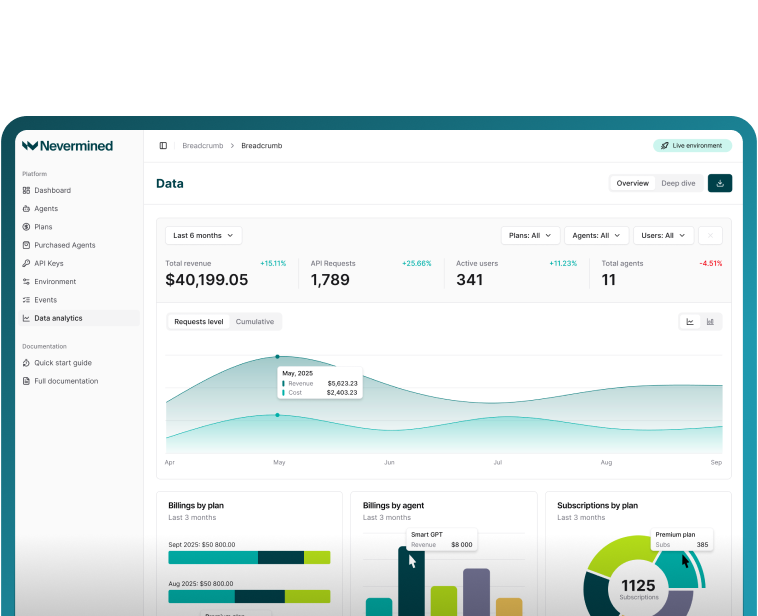
Nevermined connects metering with the request and payment workflow so operators can trace consumption, credit usage, costs, and performance. Its observability tooling records request activity and supports per-request and cumulative analysis across agents and models.
This gives sandbox operators a clearer connection between the work performed and the amount charged, while customers can review transaction and usage activity rather than relying entirely on aggregate billing totals.
The observability documentation covers request logging, token usage, cost analysis, performance metrics, credit consumption, and custom metadata.
Nevermined's security and compliance program includes ISO 27001 certification, SOC 2 Type II auditing, PCI SAQ-D compliance, and GDPR controls. Card information is captured through VGS and tokenized before it enters Nevermined's systems, so Nevermined does not store raw card numbers.
These controls support the payment layer around autonomous systems while giving security and procurement teams documentation for evaluating agent spending infrastructure.
Agents need identifiable permissions and controlled spending authority to transact responsibly. Payment capability should be tied to an agent or account context rather than exposing unrestricted card credentials.
Nevermined registers agents and associates their access with payment plans, permissions, and transaction activity. Each registered agent receives an identifier that is used across payment and access workflows.
Developers can use the agent registration workflow to register an agent together with the payment plan used to monetize access.
This model provides clearer attribution of usage and payment activity without requiring an agent to hold raw payment credentials.
Card delegation lets users give AI agents scoped spending authority while keeping the underlying card credentials out of the agent runtime.
Delegations can define controls such as:
The agent receives a credential bound to the delegation rather than the underlying card number. Every charge is checked against the delegation's spending rules, and requests beyond the permitted limit are rejected.
Time to revenue matters for sandbox platforms because payment infrastructure can otherwise consume engineering effort that could be spent on the underlying execution product.
Nevermined provides SDKs for TypeScript and Python, alongside APIs and middleware for protecting monetized resources. The documented quickstart covers registration, payment-plan creation, payment validation, service execution, and credit redemption.
The platform supports several integration paths:
Sandbox operators using a standard HTTP API can follow Nevermined's generic HTTP integration without adopting a specific agent framework.
Nevermined exposes machine-readable documentation through llms.txt files and provides a documentation MCP server for MCP-compatible development environments. Its SDK documentation includes integrations and patterns for MCP, LangChain, Express, FastAPI, and other supported environments.
Developers building monetized MCP services can use the dedicated MCP integration guide to connect tool access with fixed or dynamic credit consumption.
McKinsey projects that AI agents could mediate $3 trillion to $5 trillion in global consumer commerce by 2030 under its modeled scenarios. McKinsey’s agentic commerce research
Nevermined connects agent payment workflows with established card infrastructure and crypto settlement. Its Visa integration uses Visa Intelligent Commerce and VGS-based card capture to give agents scoped payment credentials while keeping raw card data outside Nevermined's infrastructure. Nevermined also supports crypto settlement through its x402 smart-account scheme.
For sandbox operators, the practical requirement is infrastructure that can support new payment and pricing patterns without forcing every rail into a separate monetization stack.
Nevermined combines the layers sandbox platforms need to turn protected execution into a paid service: payment authorization, access control, credits, metering, delegated spending, and settlement.
Rather than relying on a protocol handshake alone, a sandbox can return an x402 payment requirement, verify the buyer's scoped permission, execute the requested workload, and settle or redeem the corresponding payment entitlement. That keeps access and payment inside the same machine-readable request flow.
For platforms evaluating deployment effort, the Valory example provides concrete customer evidence. Valory reported reducing payment and billing infrastructure deployment for the Olas AI agent marketplace from six weeks to six hours using Nevermined. The result reflects Valory's implementation rather than a universal deployment benchmark.
Nevermined charges 1–2% of settled transaction volume, with no setup fees or minimums. Free accounts support core fiat and crypto payments, x402 and SDK integrations, metering, credits, and settlement, while optional organization plans add additional operational tooling.
Developers can test integrations in Nevermined's sandbox environment before moving to production.
Nevermined reports p99 latency below 50 milliseconds for its x402 Facilitator layer. End-to-end throughput depends on the sandbox workload, selected payment rail, network conditions, and surrounding application architecture, so teams running high-concurrency workloads should test performance against their own production requirements.
Nevermined uses scoped payment permissions instead of giving agents unrestricted access to card credentials or wallets. Delegations can enforce spending caps, expiration periods, transaction limits, and revocation, while the facilitator verifies payment permissions before settlement. Card information is tokenized before entering Nevermined systems, and payment activity remains traceable through transaction records.
Yes. Nevermined exposes SDK, API, CLI, and HTTP integration paths that can be added around specific protected services or endpoints. A platform can introduce agent-facing payment flows while retaining separate billing infrastructure for other customer segments, then expand the integration as its monetization requirements evolve.
Nevermined's delegated x402 schemes support funded top-ups when a subscriber's credit balance is insufficient. Crypto delegations can use authorized ERC-4337 funding, while supported card delegations can purchase additional credits through the configured payment provider. The top-up remains subject to the delegation's spending limit, duration, and other permissions; requests that exceed those boundaries cannot settle through that delegation.
Yes. Nevermined's Platform Partners model lets AI marketplaces and developer platforms define a commission rate on builder transactions. Nevermined calculates the platform commission and builder payout during the transaction flow, supporting marketplace models in which the platform takes a percentage while the underlying builder receives the remainder.
See Nevermined
in Action
Real-time payments, flexible pricing, and outcome-based monetization—all in one platform.