MENU


Estimates vary by definition, but reputable forecasts project the AI agent market to reach $52.62 billion by 2030. Agentic commerce alone could drive $900 billion to $1 trillion in US B2C transactions by the end of the decade. Yet building an automated business on AI agents requires more than sophisticated models. It demands payment infrastructure capable of handling autonomous transactions, micropayments, and real-time settlement that traditional processors were never designed to support. This guide examines seven platforms serving AI agent builders in 2026, beginning with Nevermined's agent-native payment infrastructure that combines tamper-proof metering, flexible pricing models, and protocol-level support for emerging standards like A2A, MCP, and x402.
Nevermined provides payments infrastructure specifically designed for AI agents and autonomous systems. The platform enables billing, metering, and settlement capabilities that allow AI developers to monetize agent interactions through usage-based, outcome-based, and value-based pricing models. As a platform purpose-built for agent-to-agent commerce, Nevermined addresses fundamental billing challenges that traditional payment processors were not designed to handle.
Nevermined Pay delivers enterprise-ready metering, compliance, and settlement so every model call turns into auditable revenue. The platform features:
The platform supports instant settlement in both fiat and cryptocurrency, with card and ACH processing alongside stablecoin settlement via x402 protocol.
The Agent Identity System issues each agent a unique wallet plus decentralized identifier (DID) with cryptographic proof of ownership at registration. This creates portable identities that work across environments, swarms, and marketplaces without reconfiguration. Key capabilities include:
Nevermined provides native support for x402 (HTTP payment protocol), Google's Agent-to-Agent (A2A) protocol, Model Context Protocol (MCP), and Agent Payments Protocol (AP2). This protocol-agnostic approach ensures compatibility as standards evolve, avoiding vendor lock-in that can plague proprietary systems.
The platform uniquely supports multiple pricing approaches that can be mixed and matched:
This flexibility allows AI builders to start with cost-covering baselines and layer success fees where appropriate.
Flex Credits operate as prepaid consumption-based units redeemed directly against usage:
Valory cut deployment time of their payments and billing infrastructure for the Olas AI agent marketplace from 6 weeks to 6 hours using Nevermined, clawing back $1000s in engineering costs.
Best For: AI builders at any stage needing agent-to-agent autonomous payments, micropayment economics, and enterprise-grade metering. Ideal for teams building on emerging protocols who want to get started with comprehensive documentation and SDKs for both TypeScript and Python.
Stripe remains one of the largest global payment processors, having processed $1.4 trillion in 2023. The company powers payment infrastructure for millions of businesses and has introduced capabilities to address AI workloads through its Agentic Commerce Protocol.
Stripe Billing supports usage-based pricing through webhook integration. Developers can send usage events to Stripe for aggregation into invoices, enabling metered billing for AI workloads with existing Stripe infrastructure. The platform offers volume discounts for high-volume operations.
Transaction fees starting at 2.9% plus $0.30 per standard US online card transaction create specific considerations for micropayment economics. A $0.50 transaction incurs approximately $0.315 in fees. International transactions add additional percentages, with fees varying by region, currency conversion, and cross-border payment factors.
Typical payouts can be ~2 business days in some regions, though timing varies by account and geography. This works well for traditional e-commerce but may require planning for real-time agent transactions.
Best For: Companies with existing Stripe infrastructure processing high-value transactions where established trust and global coverage are priorities. Organizations seeking the reliability of a decade-old payment infrastructure with extensive integration options.
Coinbase x402 represents a protocol-level approach to AI agent payments. Third-party analytics and reporting indicated a 10,000% transaction surge in October 2025 with approximately 500,000 transactions in a single week. The protocol enables HTTP-native payments that trigger on the familiar 402 status code.
The x402 protocol provides SDK and HTTP integration options. The backward-compatible design works with existing HTTP infrastructure, allowing gradual adoption without complete rebuilds.
x402 operates primarily at the protocol layer, providing the payment trigger mechanism. Additional metering, billing, and business logic infrastructure may be required depending on use case complexity. Nevermined provides native x402 support as an extension to the protocol, enabling advanced agent payment capabilities with the metering and business logic layers included.
Best For: Teams building crypto-native AI applications requiring ultra-low transaction costs and fast settlement. Organizations comfortable with stablecoin-primary operations seeking an open protocol standard.
Skyfire provides agent payment capabilities through wallet abstraction, having raised $8.5 million in seed funding to build payment rails for AI agents. The platform enables developers to fund agent wallets and control spending in real-time.
Skyfire's approach centers on giving each agent a funded wallet ID that developers control. This enables real-time monitoring of agent spend with the ability to set limits before agents exhaust budgets. The platform focuses on helping agents spend rather than collect revenue.
Primary settlement occurs through USDC stablecoins, with ACH and wire options available for fiat requirements.
Best For: Teams needing fast setup for basic agent wallet functionality with real-time spend controls. Organizations seeking crypto-native settlement options with straightforward budget monitoring.
Paid.ai focuses on helping AI developers understand and monetize their costs through detailed analytics and flexible billing models. The platform raised €10M (≈$11M at the time) in March 2025 to expand its cost tracking capabilities.
Paid.ai emphasizes margin visibility at the workflow level. Developers can track costs per agent and per action, then simulate different pricing strategies to understand their impact on profitability before implementation.
The platform focuses on developer-to-customer monetization with fiat settlement options. Agent-to-agent autonomous transactions require additional infrastructure.
Best For: Developers prioritizing cost analytics and margin tracking for human-initiated AI interactions. Teams with established payment processors seeking usage visibility without changing their existing payment infrastructure.
Orb provides API-first usage-based billing. Orb states it is used by companies like Perplexity and Vercel. The platform focuses on developer-friendly invoicing with real-time event processing capabilities of up to 1,000 events per second natively, with higher scale options via hosted rollups.
Orb emphasizes developer experience with well-documented APIs and straightforward integration patterns. The platform handles complex pricing logic on the billing side, allowing developers to focus on event emission.
Entry pricing starts at $720 per month on annual plans, covering up to $100K in monthly billing. Implementation timelines vary depending on scope and complexity.
Best For: Developer-led SaaS companies with traditional usage-based billing needs. Teams seeking API-first billing infrastructure with room to scale.
Metronome provides enterprise-grade usage billing capabilities, with the platform powering OpenAI's billing infrastructure. As of January 2026, Metronome is now part of Stripe following Stripe's completed acquisition on January 14, 2026. The solution targets large enterprises with complex multi-dimensional pricing requirements.
Metronome handles the complexity of enterprise billing including contract management, revenue recognition, and financial reporting. The platform excels at multi-dimensional pricing scenarios beyond what 2D pricing matrices can support.
Implementation often takes weeks depending on scope, with custom enterprise pricing based on volume. Significant internal resources are often required for configuration and integration. Note that following the Stripe acquisition, roadmap and integration options may evolve.
Best For: Large enterprises with complex revenue recognition requirements and substantial budgets. Organizations needing proven scalability at massive transaction volumes with comprehensive compliance features, and those already invested in the Stripe ecosystem.
The fundamental difference between Nevermined and traditional billing platforms lies in architecture. Nevermined was built from the ground up for autonomous AI agent commerce, while traditional platforms retrofit existing subscription and invoice infrastructure to handle AI workloads.
This architectural difference manifests in several key areas:
Tamper-Proof Third-Party Neutral Metering
While vendor-controlled metering requires trust between parties, Nevermined's append-only logs enable independent verification. Every usage record is cryptographically signed at creation, making it immutable. The exact pricing rule stamps onto each agent's usage credit, allowing developers, users, auditors, or agents to verify that usage totals match billed amounts per line-item.
This zero-trust reconciliation model addresses the trust and auditability challenges that enterprise procurement teams consistently identify as critical barriers to agentic payments adoption.
Protocol-Native Support
Nevermined provides native integration with emerging standards including A2A (Agent-to-Agent) protocol, MCP (Model Context Protocol), x402, and AP2. This open-protocol-first approach builds compatibility with evolving standards without requiring rebuilds as the ecosystem matures.
Micropayment Economics
Traditional payment processors with percentage-plus-fixed-fee structures face challenges with sub-dollar transactions. Nevermined's architecture enables profitable transactions at any size, capturing revenue from the hundreds of micro-activities that comprise AI agent workloads.
By Settlement Speed:
By Implementation Timeline:
By Protocol Support:
Nevermined serves three primary segments with tailored capabilities:
Solo Developers and Solopreneurs: Plug-and-play API libraries, open-source components, and composable payment flows that work with any agent framework. The free tier enables experimentation without commitment.
AI Agent Startups: Low-code payments library enabling faster launch than building custom infrastructure. Valory's experience reducing deployment from 6 weeks to 6 hours demonstrates the time-to-market advantage, saving $1000s in engineering costs.
Enterprise AI Platforms: Enterprise-grade metering, compliance features, and settlement capabilities at global scale. The tamper-proof audit trail satisfies procurement requirements while the dynamic pricing engine captures revenue across complex multi-agent deployments.
Nevermined's Payment Facilitator coordinates authorization, metering, and settlement for AI agents across fiat, crypto, credits, and smart accounts. The facilitator executes on-chain verification and settlement through smart contracts, enabling:
This coordination layer handles the complexity of multi-agent transactions that simpler payment systems were not designed to orchestrate.
Outcome-based pricing charges for specific results achieved, such as booked meetings, resolved support tickets, or completed tasks. Value-based pricing captures a percentage of the ROI or business value generated by the agent's actions. Nevermined supports both models, allowing AI builders to start with outcome-based approaches for measurable results and layer value-based pricing where business impact can be quantified. This flexibility enables pricing alignment with actual customer value rather than pure consumption metrics.
Tamper-proof metering creates buyer trust through independent verification—a critical factor that enterprise procurement teams consistently identify as essential for agentic payments adoption. Nevermined signs every usage record cryptographically and pushes it to an append-only log at creation, making records immutable. Developers benefit from enterprise procurement teams trusting their billing accuracy, while users gain confidence that charges match actual usage. This zero-trust reconciliation model eliminates billing disputes that can damage customer relationships.
AI agents can transact autonomously using platforms built for agent-to-agent commerce. Nevermined enables this through ERC-4337 smart accounts with session keys and delegated permissions, where users authorize payment policies once and agents interact freely within boundaries. Key protocols facilitating autonomous payments include x402 (HTTP payment protocol), Google's A2A protocol, MCP (Model Context Protocol), and AP2 (Agent Payments Protocol). Nevermined provides native support for all four standards.
Decentralized identifiers (DIDs) provide AI agents with persistent, portable identities that work across environments, swarms, and marketplaces. Nevermined's Agent Identity System issues each agent a unique wallet plus DID with cryptographic proof of ownership at registration. This enables persistent reputation tracking that travels with the agent, programmable payment flows, fine-grained entitlements, and usage attribution in multi-agent architectures. Auto-discovery via Google's A2A protocol allows instant agent connection without manual configuration.
Integration timelines vary dramatically across platforms. Nevermined gets you from zero to a working payment integration in 5 minutes, with SDKs for both TypeScript and Python. The three-step process involves installing the SDK, registering payment plans with pricing rules, and validating API requests while tracking costs. In contrast, enterprise billing platforms can require weeks of professional services depending on complexity.
Enterprise compliance requirements include audit-ready traceability, GDPR adherence, and tamper-proof record keeping. Nevermined provides cryptographically signed append-only logs where any party can verify that usage totals match billed amounts per line-item. The platform includes GDPR compliance with explicit article citations throughout its Privacy Policy. API and CSV export capabilities enable independent verification of metering data, satisfying procurement teams requiring transparent, auditable billing infrastructure.
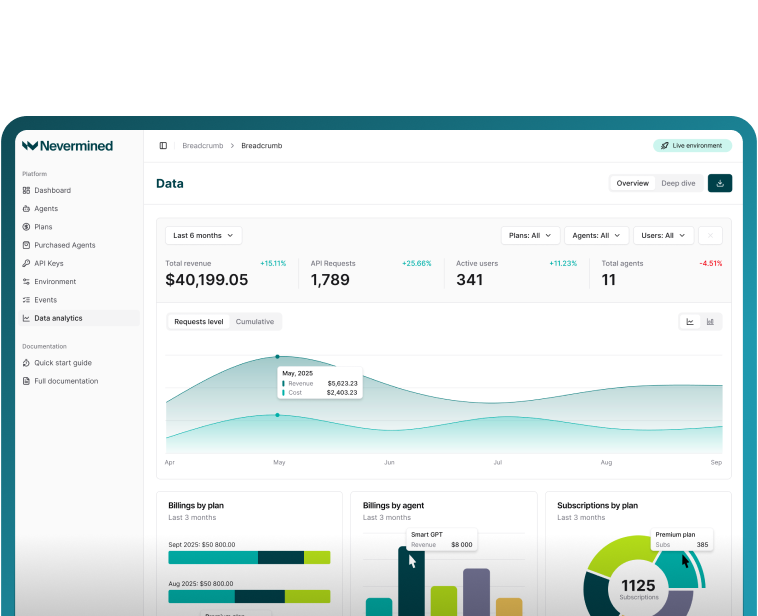
See Nevermined
in Action
Real-time payments, flexible pricing, and outcome-based monetization—all in one platform.