MENU


The era of the billion-dollar one-person company is no longer fantasy. Some founders speculate a $1B solo company could emerge within a few years, with estimates ranging from two to five years. AI agents now function as digital co-workers handling everything from customer service to content creation, sales, and operations. The critical challenge for solopreneurs is no longer building these agents but monetizing them effectively. While 77% of solopreneurs achieve profitability in year one, 76% have launched AI features yet most report revenue uplifts below 10%, according to Simon-Kucher's 2025 Global Software Study. This gap represents both the biggest obstacle and the greatest opportunity for solo founders entering the agentic economy in 2026. Modern AI payment infrastructure can bridge this gap by providing real-time metering, flexible pricing models, and instant settlement that traditional processors cannot deliver.
AI agents represent a fundamental restructuring of entrepreneurship where individual founders can achieve what previously required teams of 10 to 50 employees. These autonomous systems execute complex tasks independently, from qualifying leads to managing customer relationships and processing transactions.
The current AI agent landscape offers solopreneurs unprecedented leverage. According to BCG, early adopters of agentic AI are seeing 20 to 30% faster workflow cycles, with effective AI agents capable of accelerating business processes by 30% to 50%.
AI agents now handle:
The technology has moved from novelty to necessity. According to IBM research, 99% of developers building AI applications for enterprise are exploring or developing AI agents. Maryam Ashoori, Director of Product Management at IBM watsonx.ai, confirms that agents are "the ticket" to maximizing generative AI ROI.
The most successful AI solopreneurs target specific industry verticals rather than building general-purpose tools. Generic consumer AI dominates headlines, but vertical AI built for specific industries will separate leaders from laggards in 2026.
High-opportunity niches include:
Starting a one-person AI business requires strategic planning that balances speed-to-market with sustainable growth. The path from idea to revenue follows predictable patterns that successful solopreneurs have validated.
Before building anything, validate market demand through direct customer conversations. Small AI ventures can attract serious funding when they solve real problems, as demonstrated by the growing number of sub-10-employee startups receiving venture backing in recent years.
Validation criteria to test:
Tim Cortinovis, author of "Single-Handed Unicorn," emphasizes that you don't need full-time staff anymore, just "the right problem to solve and the right mix of AI tools." The unicorn timeline has compressed dramatically in the AI era, with some predicting it could shrink to just a few years.
Solopreneurs who thrive in 2026 won't be those who hustle hardest but those who systemize smartest. The formula emerging is: Automation leads to Efficiency leads to Scale leads to Freedom.
Your operations plan should address:
Real examples validate these approaches. VenueKonnex reportedly scaled from 2,000 manual venue listings to 18,000+ in pipeline by replacing manual labor with AI agents, dramatically reducing cost per listing while increasing throughput.
The technical barrier to building AI agents has collapsed. No-code platforms and mature SDKs enable solopreneurs to launch production-ready agents in days rather than months.
Agent frameworks fall into categories based on technical requirements and use cases:
No-code platforms for non-technical founders:
Code-first frameworks for developers:
Many tools offer free tiers and entry plans under roughly $50/month, such as Gumloop's pricing tiers, with usage-based scaling as needs grow.
Development speed determines competitive advantage. The Nevermined documentation provides LLM-friendly structure specifically designed for AI coding assistants including Cursor, Windsurf, Claude, and GitHub Copilot.
Critical integration points include:
Nevermined gets you from zero to a working payment integration in 5 minutes, with SDKs for both TypeScript and Python. This rapid deployment enables solopreneurs to validate monetization approaches without weeks of custom development.
The monetization gap represents the biggest obstacle for AI solopreneurs. While 82% already use AI agents according to SailPoint and 51% have deployed agents in production, Simon-Kucher's 2025 Global Software Study found that 76% launched AI features yet most saw revenue uplifts under 10%, revealing a stark monetization gap.
Traditional SaaS pricing models break down when applied to AI agents. Seat-based subscriptions don't capture value from agents that perform hundreds of micro-actions per user. Fixed monthly fees leave money on the table when usage varies dramatically.
Modern payment models for AI agents include:
Plausible Analytics, a privacy-focused analytics tool, reported reaching $1M ARR as an independent, bootstrapped product. These revenue figures demonstrate that proper pricing architecture unlocks significant income potential even without large teams.
A single AI interaction can trigger hundreds of micro-activities with sub-cent costs. Traditional payment processors cannot handle these transaction patterns economically. Processing fees alone would consume margins on small transactions. For context, the Federal Reserve's regulated debit interchange cap alone includes a fixed component of $0.21 plus 0.05% per transaction, illustrating how fixed per-transaction minimums destroy sub-dollar economics.
Micro-transaction challenges include:
Specialized infrastructure addresses these gaps through credit-based settlement, where users prepay credits and monitor burn rate in real-time. Finance teams receive trackable recurring billing instead of complex sub-cent charge reconciliation.
Trust becomes critical when AI agents manage tasks autonomously. How do customers verify they're being charged fairly? How do you prove your agent delivered the promised value? Zero-trust reconciliation models solve these problems.
The core barrier to AI agent adoption isn't capability but trust. Customers need assurance that usage totals match billed amounts. Auditors require traceable records. Investors expect verifiable metrics.
Trust-building mechanisms include:
This infrastructure becomes essential as AI agents handle increasingly sensitive tasks. SailPoint research found that 82% use AI agents but only 44% have policies in place to secure them. The same study revealed that 80% reported unintended actions by their AI agents, including unauthorized system access and improper data sharing.
Audit-ready traceability protects both solopreneurs and customers. When disputes arise, immutable records provide definitive proof of what actions occurred and what charges applied.
Verification requirements span multiple stakeholders:
The observability layer should track every request in real-time while billing by cost, usage, or event according to your chosen model. This visibility prevents surprise overruns while building customer confidence in your pricing.
The next frontier in agentic commerce involves AI agents transacting directly with each other. Multi-agent systems require payment infrastructure that enables autonomous transactions without human approval for every interaction.
Standard payment implementations require wallet pop-ups or manual approval for each transaction. This friction destroys the efficiency gains that autonomous agents provide. Users need to authorize payment policies once, then allow agents to interact freely within defined boundaries.
Agent-to-agent payment capabilities require:
These capabilities enable agents to hire other agents, pay for specialized services, and coordinate complex workflows without human bottlenecks.
ERC-4337 smart accounts provide the technical foundation for agent-to-agent commerce. Unlike traditional wallets requiring manual signatures, smart accounts execute programmed logic automatically.
Smart account capabilities include:
Google's A2A protocol enables instant agent discovery and connection. Combined with payment infrastructure that supports these protocols natively, solopreneurs can build multi-agent services that scale without manual coordination.
AI agents save solopreneurs significant hours each week by automating content planning, outreach, client nurturing, and administrative work. This time reclaimed enables focus on strategy, creativity, and high-value client relationships.
The highest-impact automation targets repetitive, time-consuming tasks that don't require human judgment. Audit your weekly schedule to identify candidates.
High-value automation targets:
Solopreneurs using AI tools commonly report dramatically faster content creation and the ability to provide 24/7 automated customer service. Heights Platform users, for example, generate full course outlines in under a minute, with one creator finishing an entire course in two weeks instead of several months.
Implementation success depends on matching agent capabilities to task requirements. Not every repetitive task suits automation. Focus on tasks with clear inputs, defined outputs, and consistent patterns.
Successful automation examples:
The key insight: strategic partnerships with AI vendors often outperform custom-built solutions. Leveraging existing platforms frequently delivers faster deployment success than internal development alone.
Scaling from initial revenue to sustainable income requires systematic approaches to pricing, cost management, and performance optimization. The dynamic pricing capabilities of modern infrastructure enable sophisticated scaling strategies.
Credit systems solve multiple scaling challenges simultaneously. Users prepay for consumption, providing predictable revenue. Monitoring dashboards show burn rate in real-time, preventing surprise overruns. Finance teams receive clean, trackable billing records.
Credit system benefits include:
Cost management becomes critical at scale. Infrastructure costs including vector storage, API calls, and compute can reach thousands of dollars monthly as usage grows. Without proper metering, these costs can destroy margins before you realize the problem.
Revenue analytics reveal which features drive value, which customers generate profit, and where hidden costs lurk. This visibility transforms pricing from guesswork into data-driven optimization.
Analytics capabilities to prioritize:
Valory cut deployment time of their payments and billing infrastructure for the Olas AI agent marketplace from 6 weeks to 6 hours using Nevermined, clawing back $1000s in engineering costs. This efficiency demonstrates how proper infrastructure accelerates scaling.
The AI agent ecosystem evolves rapidly. Standards like x402, Google's A2A protocol, Model Context Protocol (MCP), and Agent Payments Protocol (AP2) will determine which platforms survive and which become obsolete.
Vendor lock-in represents an existential risk for solopreneurs. Building on proprietary systems that don't support emerging standards creates technical debt that compounds over time.
Critical protocol support includes:
Protocol-first architecture ensures compatibility as standards evolve. Nevermined provides native support for these protocols, avoiding the vendor lock-in that plagues proprietary systems.
The emerging infrastructure enables agents to discover, negotiate, and coordinate across the internet. The Agentic Web represents the next evolution beyond individual agents working in isolation.
Interoperability benefits include:
By 2027, Gartner projects over 40% will fail among agentic AI projects due to escalating costs, unclear business value, or inadequate risk controls. Choosing future-proof platforms now prevents costly migrations later.
While numerous payment platforms exist, Nevermined delivers infrastructure specifically designed for AI agents and autonomous systems that solopreneurs need to monetize their ventures effectively.
Nevermined Pay delivers bank-grade enterprise-ready metering, compliance, and settlement so every model call turns into auditable revenue. The platform provides:
Unlike generic payment processors retrofitted for AI, Nevermined was built from the ground up for the agentic economy. The platform supports:
Integration takes 5 minutes using TypeScript or Python SDKs. The comprehensive documentation includes LLM-friendly structure for AI coding assistants, enabling rapid development. You can get started free to validate your business model before scaling.
For solopreneurs building the next generation of AI agent businesses, Nevermined provides the monetization infrastructure that closes the gap between building agents and generating sustainable revenue.
An AI agent is an autonomous system that executes complex tasks independently, from customer service to lead qualification and content creation. For one-person businesses, AI agents function as digital co-workers that reclaim significant hours each week by automating repetitive tasks. According to BCG, early adopters of agentic AI achieve 20 to 30% faster workflow cycles, with effective agents capable of accelerating business processes by 30% to 50%. This enables solopreneurs to compete with larger teams while maintaining focus on high-value strategic work.
Secure payment processing requires tamper-proof metering where every usage record is cryptographically signed and stored in append-only logs. This creates immutable audit trails that customers, developers, and auditors can verify independently. The pricing rule stamps onto each agent's usage credit, enabling line-item verification that usage totals match billed amounts. Look for platforms offering GDPR compliance, exportable data for accounting systems, and real-time observability into agent performance and revenue metrics.
Outcome-based pricing aligns your revenue directly with customer value, charging for results like booked meetings or completed tasks rather than raw usage. This model reduces customer acquisition friction since customers pay for demonstrated value rather than uncertain potential. It also enables premium pricing when your agents deliver exceptional results. Traditional payment processors struggle with outcome-based billing, requiring specialized infrastructure that can meter results and settle payments accordingly.
Yes, modern infrastructure supports agent-to-agent transactions through ERC-4337 smart accounts with session keys and delegated permissions. Users authorize payment policies once, then agents interact freely within defined boundaries. This eliminates the friction of wallet pop-ups for each transaction while maintaining security through programmable authorization logic. The capability enables multi-agent systems where specialized agents can hire other agents, coordinate complex workflows, and settle payments autonomously.
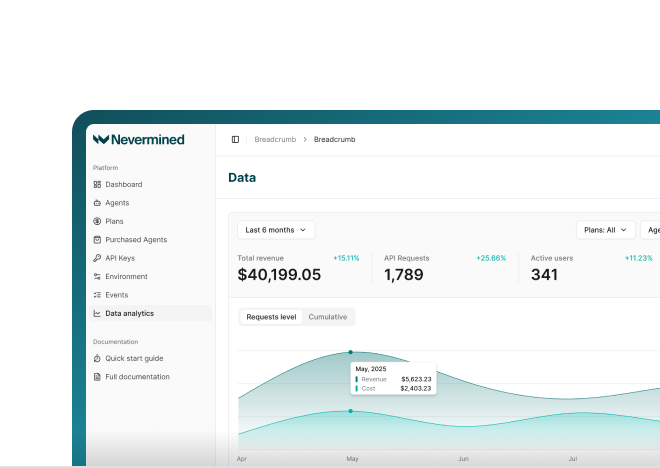
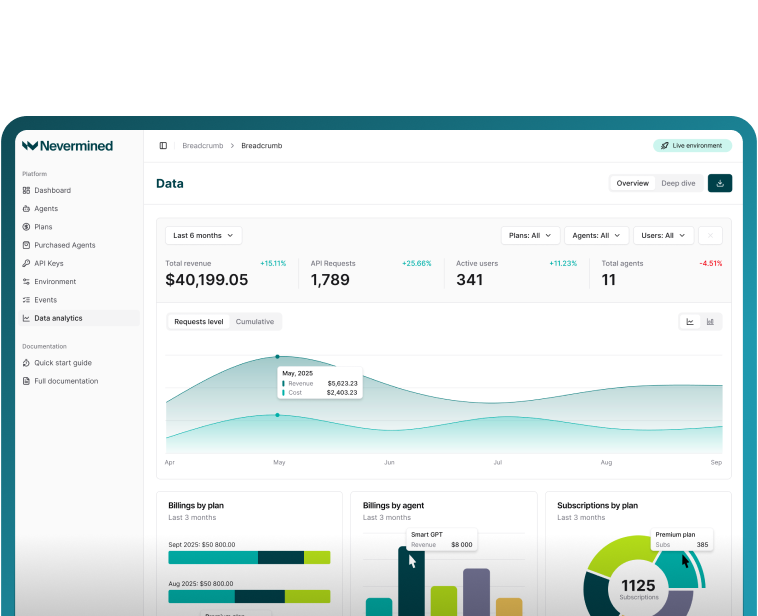
Nevermined provides real-time visibility into agent performance, hidden costs, and revenue analytics through its observability dashboard. The credits system enables predictable cash flow through prepaid billing while preventing surprise cost overruns. Solopreneurs can track burn rates in real-time, identify underperforming agents, and optimize pricing based on actual data. Valory cut deployment time from 6 weeks to 6 hours using Nevermined, demonstrating how proper infrastructure accelerates scaling while reducing engineering costs by thousands of dollars.
Join the Autonomous Business Hackathon on March 5 to 6, 2026 in downtown San Francisco to build autonomous businesses where agents make real economic decisions, transact with each other, and run with minimal human oversight.
See Nevermined
in Action
Real-time payments, flexible pricing, and outcome-based monetization—all in one platform.