MENU


Building an AI-powered business in 2025 demands more than adding chatbots to existing products. With enterprise GenAI spending reaching $37 billion and AI infrastructure companies raising an unprecedented $84 billion across the top 10 AI mega-rounds, the market has reached an inflection point. The emergence of agentic commerce, where AI agents transact autonomously, is projected to orchestrate $3-5 trillion globally by 2030. Traditional payment processors cannot handle the micro-transactions that AI agents generate, making purpose-built AI payments infrastructure essential for capturing value in this new economy.
The shift from human-initiated to agent-initiated transactions creates fundamental infrastructure challenges that traditional systems cannot address. According to Harvard Business School research, AI-first companies represent "a fundamentally new kind of organization built on a different premise altogether."
Successful AI businesses must assess readiness across three dimensions:
The most successful AI strategies maintain bidirectional alignment between business objectives and AI capabilities. Business goals shape the AI agenda, but emerging AI capabilities must also influence business direction. This cannot be "set and frozen" but requires continuous realignment.
Building for the agentic economy requires specialized infrastructure that traditional payment processors lack:
AI is projected to contribute $13 trillion to the global economy by 2030 according to McKinsey Global Institute, making infrastructure investment critical. In a McKinsey survey, 63% of respondents expected their AI investment to increase over the next three years.
Traditional seat-based and usage-based pricing models fundamentally break down for AI agents because agents perform complete job functions rather than augmenting individual human tasks. The challenge spans defining units of value, managing cost unpredictability, and handling outcome-based billing.
Five emerging pricing models dominate the agent monetization landscape:
The key to sustainable AI monetization lies in aligning price to value delivered. Cost-plus-margin automation allows platforms to define exact margin percentages locked onto usage credits, ensuring profitability while remaining competitive.
Consider these pricing strategy elements:
Proper monetization infrastructure can unlock trapped revenue. Companies using AI-specific billing infrastructure capture value from autonomous work that legacy systems miss, enabling sustainable growth as agent workloads scale.
When AI agents manage tasks autonomously, trust becomes foundational infrastructure. McKinsey identifies trust as critical for agentic commerce adoption, with organizations implementing comprehensive governance frameworks.
Tamper-proof metering addresses trust concerns through:
Regulatory frameworks increasingly require explainability and audit trails for AI systems. The AI TRiSM framework (Trust, Risk, and Security Management), as defined by Gartner, includes human override capabilities and fail-safe protocols that regulators expect.
Your AI business needs compliance features from day one:
The transition to agent-initiated commerce creates three critical challenges that Google's AP2 protocol and ACP (co-developed by OpenAI and Stripe) aim to solve:
These protocols use cryptographically signed mandates creating non-repudiable audit trails. The mandate flow progresses from Intent Mandate through Cart Mandate to Payment, establishing clear authorization chains.
ERC-4337 smart accounts (often implemented with session keys) enable true agent-to-agent transactions without constant human intervention. Users authorize payment policies once, then agents interact freely within boundaries.
Smart account capabilities include:
This contrasts sharply with standard payment implementations requiring wallet pop-ups for each request, which breaks autonomous agent workflows entirely.
Speed to market determines competitive advantage in the rapidly evolving AI landscape. Low-code SDKs enable deployment in as little as 5 minutes, with SDKs available for both TypeScript and Python.
The integration process typically follows three steps:
Real-world results demonstrate the impact of fast integration. Valory cut deployment time of their payments and billing infrastructure for the Olas AI agent marketplace from 6 weeks to 6 hours using Nevermined, clawing back $1000s in engineering costs.
Evaluate infrastructure platforms against critical requirements:
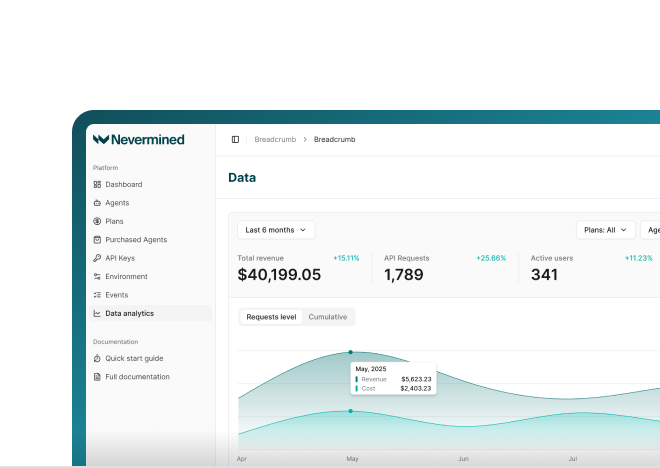
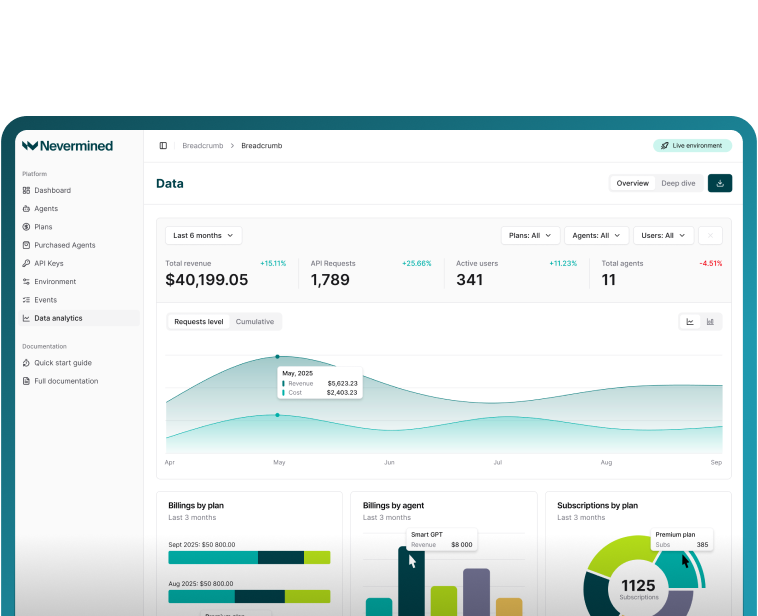
Understanding your AI's financial behavior requires comprehensive visibility into agent performance, user behavior, and revenue analytics. Observability dashboards track every request in real-time, billing by cost, usage, or event according to your chosen model.
Key metrics to monitor include:
Real-time tracking enables dynamic responses to cost overruns, usage spikes, and margin compression before they impact profitability.
Portable identities that work across environments, swarms, and marketplaces eliminate re-wiring when deploying agents to new platforms. The ERC-8004 standard defines "Trustless Agents" primitives for agent discovery and trust, including identity, reputation, and validation registries.
Agent identity systems enable:
Smart contract settlement enables capabilities impossible with traditional payment rails. On-chain verification through platforms like Polygon, Gnosis Chain, and Ethereum provides atomic "pay plus execute" business logic.
Advanced payment capabilities include:
These capabilities position AI businesses for the projected agentic commerce growth that could outpace mobile commerce adoption by leveraging existing digital infrastructure.
Prepaid credit systems align price to value by charging for micro-actions and rewarding successful outcomes. Credits function as consumption-based units redeemed directly against usage, simplifying complex billing scenarios.
Benefits for AI businesses and their customers:
While multiple solutions exist for AI monetization, Nevermined delivers purpose-built payments infrastructure specifically designed for autonomous agents and the agentic economy.
Nevermined Pay delivers bank-grade enterprise-ready metering, compliance, and settlement so every model call turns into auditable revenue. The platform provides ledger-grade metering, a dynamic pricing engine, credits-based settlement, 5x faster book closing, and margin recovery.
Key differentiators include:
The platform supports settlement on multiple blockchain networks including Polygon, Gnosis Chain, and Ethereum, with both fiat and cryptocurrency rails. A 1% transaction fee and free tier for testing make it accessible for solo developers while scaling to enterprise requirements.
For technical implementation details, the comprehensive documentation includes sandbox environments, API references, and LLM-friendly guides compatible with AI coding assistants like Cursor, Windsurf, and GitHub Copilot.
The five dominant models include unit-of-value pricing (per-token or per-task), function-based pricing (digital FTE replacement), subscription licensing, outcome-based pricing (paying for results), and hybrid approaches. Companies implementing proper AI monetization infrastructure capture value from autonomous work that legacy systems miss, enabling sustainable growth. The key is aligning your pricing model to the value your AI agents deliver rather than forcing agents into legacy SaaS frameworks.
Secure agent transactions require tamper-proof metering with cryptographically signed records pushed to append-only logs at creation. Implement zero-trust reconciliation where users and auditors can verify that usage totals match billed amounts per line-item. Payment protocols like Google's AP2 provide cryptographically signed mandates creating non-repudiable audit trails for every transaction.
Modern payment infrastructure SDKs enable integration in as little as 5 minutes through three steps: install the SDK, register payment plans with pricing rules, and validate API requests through the observability layer. TypeScript and Python SDKs simplify implementation, while sandbox environments allow testing before production deployment.
Traditional processors assume humans directly click "buy" on trusted surfaces, creating authorization gaps when agents transact autonomously. They lack support for sub-cent transactions, outcome-based billing, and the volume of micro-interactions agents generate. The emergence of agent-specific protocols in 2025 directly addresses these infrastructure gaps that legacy systems cannot handle.
Decentralized identifiers (DIDs) provide portable agent identities with cryptographic proof of ownership that work across environments, swarms, and marketplaces. They enable persistent reputation tracking, programmable payment flows, fine-grained entitlements, and usage attribution in multi-agent architectures. Auto-discovery through protocols like A2A allows agents to connect instantly without manual configuration.
See Nevermined
in Action
Real-time payments, flexible pricing, and outcome-based monetization—all in one platform.