MENU


AI agents are fundamentally reshaping how businesses operate, moving beyond simple automation into autonomous systems that perceive, reason, act, and learn with minimal human intervention. While 71% use gen AI across organizations, over 80% report no material bottom-line impact from these investments. This gap between adoption and value capture is driving a massive shift toward agentic solutions that deliver measurable ROI. For businesses looking to monetize agent interactions and manage the complex payment flows these autonomous systems generate, specialized AI payment infrastructure becomes essential as traditional human-centric payment stacks are not designed for the machine-initiated, high-frequency, policy-bound settlement that defines this new economy.
AI agents represent a fundamental departure from traditional automation. Unlike rule-based systems or robotic process automation (RPA) that follow predefined scripts, agents use large language models for reasoning, maintain memory across tasks, access tools through APIs, and adapt in real-time. UiPath defines this through a perception-reasoning-action-feedback loop that enables agents to handle unpredictable scenarios and complex workflows requiring interpretation and creative problem-solving.
The core capabilities that distinguish AI agents include:
As agents become economic actors making autonomous purchases, subscribing to services, and engaging in agent-to-agent commerce, existing payment systems face fundamental limitations. Traditional processors designed for human-to-business transactions are not built for:
This gap, which prompted Google Cloud to launch the Agent Payments Protocol (AP2), creates urgent demand for purpose-built payment infrastructure that treats agents as first-class economic participants.
Organizations deploying AI agents report transformative operational improvements across functions. BCG documented a 95% cost reduction and 50x speed improvement in content creation, with blog posts completed in one day versus four weeks previously. Customer service operations saw 10x cost reduction, while biopharma R&D achieved 25% cycle time reduction with 35% time efficiency gains.
Financial services shows the strongest adoption signals. Google Cloud research found:
PwC's finance analysis demonstrates agents can redirect up to 60% of team capacity to strategic insight work rather than processing. Organizations report 80% reduction in purchase order transaction processing cycle times and 40% improvement in forecasting accuracy and speed. These gains stem from agents handling routine cognitive work while humans focus on judgment-intensive decisions.
Production-grade agent deployments require sophisticated technical foundations. Modern agent architecture includes:
IBM explains that agentic workflows differ from traditional automation by using reasoning and context instead of fixed scripts. This flexibility enables agents to handle novel situations that would break rule-based systems.
Agent framework adoption has accelerated with tools like LangChain and CrewAI enabling composable multi-agent workflows. However, 90% stall in pilot, highlighting that integration and governance present bigger barriers than AI capability itself. Organizations succeed by:
The distinction between AI agents and agentic AI centers on autonomy levels. Simple AI agents execute predefined tasks with limited decision-making scope. Agentic AI systems operate with broader autonomy, making complex decisions, adapting strategies, and even collaborating with other agents without human intervention.
McKinsey's contact center example illustrates this progression:
Andrew Ng noted that agentic workflows are meaningful not only for task execution but also for training next-generation LLMs. The lessening need for human oversight allows effort to shift from mundane, repetitive tasks to intricate work requiring human intelligence. This creates a virtuous cycle where agents improve themselves while freeing human capacity for higher-value activities.
True value from AI agents requires process reinvention, not just task automation. GoodData argues organizations achieve breakthrough gains only when processes are redesigned around agent autonomy rather than inserting agents into legacy workflows.
Successful integration patterns include:
Manufacturing supply chains demonstrate multi-agent orchestration at scale. Autonomous AI agents act as orchestration layers, continuously forecasting demand by analyzing internal systems and external data. They identify risks, dynamically replan transport and inventory flows, and escalate only decisions requiring strategic input. Manufacturers using multi-agent systems report up to 30% reduction in unplanned downtime.
The agentic economy demands pricing models that align cost with value delivered. Traditional subscription and per-seat licensing fail when agents generate thousands of micro-interactions with varying value. Modern monetization requires:
Organizations building agent services need dynamic pricing engines that can meter, price, and settle these diverse transaction types in real-time.
Financial services executives are significantly increasing their AI budgets for agents, creating pressure to demonstrate ROI through transparent pricing. The challenge extends beyond simple payment processing to include value attribution in multi-agent workflows, automated royalty and revenue sharing, and compliance-ready transaction records.
The speed advantage of agent deployment compounds over time. Valory cut deployment time of their payments and billing infrastructure for the Olas AI agent marketplace from 6 weeks to 6 hours using Nevermined, clawing back $1000s in engineering costs. This acceleration enables organizations to iterate faster, test more approaches, and capture value sooner than competitors.
Common design goals for agent identity systems include portable credentials that work across environments, swarms, and marketplaces without re-wiring. This portability enables:
Enterprise gen AI spend is increasing, with financial services executives growing their AI budgets. This investment reflects recognition that agents represent the next frontier of competitive advantage. Organizations delaying agent adoption risk falling behind as early movers capture efficiency gains and customer experience improvements.
Trust remains the critical barrier to agent adoption at scale. When agents operate autonomously, organizations need tamper-proof records proving every action and transaction. This requires:
The EU AI Act categorizes agents by risk level with corresponding requirements. High-risk AI systems, including financial and healthcare agents, face extensive compliance obligations including conformity assessments, documentation, and human oversight.
Lari Hämäläinen of McKinsey notes that the joint human-plus-machine outcome can generate great quality and productivity, but this requires proper governance. Organizations must implement:
Mistral AI CEO Mensch, emphasizes that ROI comes from strong intent: define outcomes, embed agents deep in core workflows, and redesign operating models around them. Organizations preparing for the agentic economy must:
The economic potential is substantial. McKinsey estimates generative AI could deliver $2.6-4.4 trillion annually, with agents representing the primary mechanism for capturing this value. Capgemini projects $450 billion by 2028 from agentic AI. Organizations establishing agent economy infrastructure now will capture outsized returns as transaction volumes scale exponentially.
As AI agents transition from experimental technology to production-scale deployment, the critical infrastructure gap becomes clear: payment systems designed for human-to-business transactions cannot support the agent economy. Nevermined addresses this gap with purpose-built payment infrastructure for AI agents.
Nevermined Pay delivers bank-grade enterprise-ready metering, compliance, and settlement so every model call turns into auditable revenue. The platform provides:
The platform enables transactions between AI agents without human involvement through ERC-4337 smart accounts with session keys and delegated permissions. Users authorize payment policies once, then agents interact freely within boundaries.
Nevermined gets you from zero to a working payment integration in 5 minutes, with SDKs for both TypeScript and Python. For organizations building agent services, marketplace platforms, or internal AI systems, Nevermined provides the economic layer that makes agent ecosystems viable.
AI agents differ fundamentally from traditional automation through their ability to observe environments, plan actions, execute complex tasks, and learn from outcomes autonomously. Unlike rule-based systems or RPA that follow predefined scripts, agents use large language models for reasoning, maintain memory across tasks, and adapt in real-time. This enables them to handle unpredictable scenarios that would break traditional automation.
AI agents create micropayment economics where autonomous systems make thousands of small-value transactions requiring real-time settlement. Traditional payment processors are not designed for authorization and accountability when agents act independently, cross-system payment orchestration across multiple platforms, or value attribution when multiple agents collaborate on outcomes. These challenges require purpose-built payment infrastructure designed for agent-to-agent commerce.
Existing payment gateways designed for human-to-business transactions face fundamental limitations with agent commerce. They lack support for micropayment economics, real-time settlement requirements, and autonomous authorization. Google Cloud recently launched the Agent Payments Protocol (AP2) specifically to address this gap, signaling industry recognition that new infrastructure is required for the agent economy.
The most effective pricing models for AI agent services include usage-based pricing charging per token or API call, outcome-based pricing billing for results like booked meetings, and value-based pricing capturing a percentage of ROI generated. Organizations need dynamic pricing engines that can meter, price, and settle these diverse transaction types while providing transparent cost attribution.
Businesses ensure trust through tamper-proof metering with append-only logs, cryptographic signatures on every transaction, and zero-trust reconciliation enabling independent verification. Compliance requires audit-ready traceability, clear escalation paths for decisions exceeding agent authority, bias monitoring, and alignment with regulations like the EU AI Act, GDPR, and sector-specific requirements.
Join the Autonomous Business Hackathon on March 5 to 6, 2026 in downtown San Francisco to build autonomous businesses where agents make real economic decisions, transact with each other, and run with minimal human oversight.
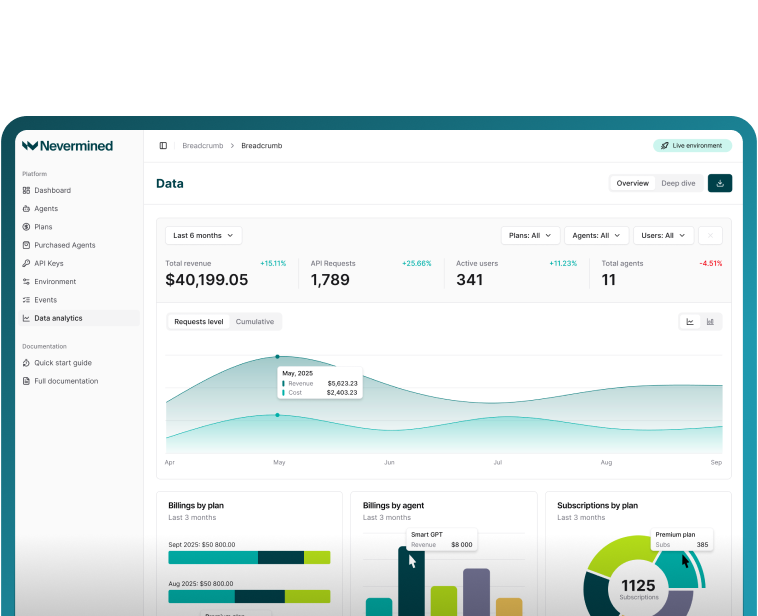
See Nevermined
in Action
Real-time payments, flexible pricing, and outcome-based monetization—all in one platform.