MENU


The AI agent market is projected to reach $50.31B by 2030, representing a 45.8% CAGR that creates unprecedented monetization opportunities. Yet 71% of CFOs struggle to monetize AI effectively because traditional payment processors cannot handle the micro-transactions, real-time metering, and autonomous interactions that AI agents generate. Modern AI agent payment infrastructure solves these challenges by enabling developers to track usage, bill customers, and settle transactions between autonomous agents in real time, transforming technical innovation into sustainable revenue.
AI agents are autonomous software systems that perform tasks independently using LLMs, automation platforms, and APIs. Unlike traditional software, these agents generate continuous streams of micro-transactions as they interact with users, other agents, and external services. A single conversation can trigger 10-100x cost variance depending on complexity, creating billing challenges that legacy systems cannot address.
The scale of opportunity is substantial. 79% have adopted agents, while 88% are increasing budgets due to agentic AI. This adoption acceleration demands payment infrastructure that matches the speed and autonomy of AI systems.
Traditional payment processors were designed for human-initiated transactions with predictable timing and values. AI agents break these assumptions in fundamental ways:
Per-transaction fixed costs and fee structures make micro-transactions economically difficult for traditional processors. For AI agents processing thousands of small-value transactions, these inefficiencies become prohibitive.
Successful AI agent monetization requires selecting the right pricing model based on your agent type and target market. Four primary approaches have emerged in the market:
Agent-Based Pricing ($3,000-$20,000/month fixed): Best for FTE replacement agents handling SDR tasks, customer service, or administrative functions. This model works when agents replace specific headcount with measurable output.
Action-Based Pricing ($0.01-$1 per task): Ideal for high-volume, variable workloads like voice agents, document processing, or API calls. Pricing varies based on task complexity and value delivered.
Workflow-Based Pricing ($50-$2,000 per workflow): Effective for multi-step processes with clear deliverables such as lead qualification sequences or compliance reviews.
Outcome-Based Pricing (percentage of value created): Most lucrative when agents deliver measurable results like booked meetings, resolved tickets, or closed deals. This model aligns incentives but requires verifiable success definitions.
Start with simple action-based pricing for 60-90 days to gather usage data. This baseline reveals actual consumption patterns, cost structures, and value delivery metrics. Once you understand these patterns, layer in outcome-based pricing for premium tiers that capture more value.
The dynamic pricing engine should enable cost-plus-margin automation where platforms define exact margin percentages. As underlying LLM costs continue falling, review pricing monthly for the first six months to maintain margins while remaining competitive.
Trust remains the primary barrier to AI agent adoption. 62% cite security risks as their top AI deployment concern. Tamper-proof metering addresses these concerns through cryptographic verification that makes every usage record immutable.
Purpose-built payment infrastructure pushes every usage record to an append-only log at creation. The exact pricing rule stamps onto each agent's usage credit, allowing developers, users, auditors, or agents to verify that usage totals match billed amounts per line-item. This zero-trust reconciliation model enables:
GDPR Article 28 requires explicit data processing agreements, while GDPR Article 17 mandates right-to-erasure support. Retention obligations vary by jurisdiction—for example, US tax recordkeeping recommends 7-year retention for financial records, while dispute resolution may require shorter windows. SOC 2 Type II certification validates security controls for enterprise customers.
Agent-to-agent payments represent the next frontier of AI commerce. Google's UCP protocol and AP2 protocol enable AI agents to discover services via standardized protocols, negotiate pricing, and execute payments without human intervention.
The technical infrastructure requires:
Users authorize payment policies once, then agents interact freely within those boundaries. This eliminates the wallet pop-up requirements of standard implementations that make true autonomy impossible.
Native support for emerging standards ensures compatibility as the ecosystem evolves. Key protocols include:
Protocol-first architecture avoids vendor lock-in while ensuring future-proof compatibility. As these standards mature, agents built on protocol-agnostic platforms maintain interoperability without re-engineering.
Custom billing infrastructure often requires weeks to months of development time and significant engineering investment for basic functionality. Pre-built platforms compress this timeline dramatically.
Valory cut deployment time of their payments and billing infrastructure for the Olas AI agent marketplace from 6 weeks to 6 hours using Nevermined, clawing back significant engineering costs. This acceleration comes from:
The three-step integration process covers: installing the SDK, registering payment plans with pricing rules and access controls, and validating API requests while tracking costs through the observability layer.
Before launching, validate your monetization approach:
Run parallel billing for 30 days with design partner customers. Gather feedback on pricing clarity, adjust based on actual usage patterns, then scale to full deployment.
Protocol-first architecture provides insurance against the rapidly evolving AI landscape. As new standards emerge, platforms supporting multiple protocols adapt without requiring customer migration.
Current protocol support should include fiat processing through established payment processors, cryptocurrency settlement via stablecoins, smart account capabilities for autonomous agents, and observability integrations for performance monitoring alongside revenue metrics.
The facilitator component coordinates authorization, metering, and settlement across all these rails. Unified payment handshakes abstract complexity from developers while maintaining full flexibility for enterprise requirements.
Visibility into agent economics drives optimization. 57% report cost savings from AI agents, but only with proper measurement and attribution.
Observability dashboards should provide:
This data enables continuous improvement. Identify which agents generate the highest margins, which customers consume the most resources, and where pricing adjustments can capture additional value.
Credits operate as prepaid consumption units that align price to value. Users prepay for credits, redeem them against agent usage, and monitor burn rate in real-time. This approach solves multiple business challenges:
For micro-transactions generating hundreds of sub-cent charges, credits eliminate the payment processing overhead that would otherwise consume margins.
Nevermined delivers bank-grade enterprise-ready metering, compliance, and settlement so every model call turns into auditable revenue. The platform addresses the specific challenges of AI agent monetization that generic payment processors cannot handle.
Key capabilities include:
Nevermined gets you from zero to a working payment integration in 5 minutes, with SDKs for both TypeScript and Python. The platform supports multiple blockchain networks including Polygon, Gnosis Chain, and Ethereum for settlement flexibility.
For teams building multi-agent systems, the agent identity system assigns each agent a unique wallet plus DID specification with cryptographic proof. These portable identities enable persistent reputation tracking, programmable payment flows, and fine-grained usage attribution across complex architectures.
Explore the full platform capabilities or contact the team to discuss enterprise requirements.
Traditional payment processors face three fundamental limitations when handling AI agent transactions. They cannot process sub-cent micro-transactions profitably due to minimum fee structures, lack real-time metering capabilities required for accurate usage tracking, and require human authorization for each transaction rather than supporting autonomous agent interactions. 86% of enterprises require technology stack upgrades to deploy AI agents successfully, and payment infrastructure represents a critical component of that upgrade.
Usage-based pricing charges per token, API call, or minute of agent activity regardless of results. Outcome-based pricing charges only when agents achieve specific, verifiable results like booked meetings or resolved support tickets. Value-based pricing captures a percentage of the measurable ROI the agent generates. While most competitors support only usage-based models, advanced platforms like Nevermined enable all three approaches, allowing developers to align pricing with actual value delivery.
Tamper-proof metering uses cryptographic signatures pushed to append-only logs at creation, making every usage record immutable. The exact pricing rule stamps onto each agent's usage credit, enabling independent verification that usage totals match billed amounts. This zero-trust reconciliation addresses the 62% citing security risks as their top AI deployment concern.
Yes, through ERC-4337 smart accounts with session keys and delegated permissions. Users authorize payment policies once, defining spending limits, approved counterparties, and transaction boundaries. Agents then interact freely within these policies—as enabled by protocols like Google's UCP and AP2—without requiring wallet pop-ups or human approval for each transaction. This architecture enables true agent-to-agent commerce where AI systems discover services, negotiate pricing, and execute payments autonomously.
Nevermined gets you from zero to a working payment integration in 5 minutes, with SDKs for both TypeScript and Python. The three-step process covers installing the SDK, registering payment plans with pricing rules, and validating API requests through the observability layer. Valory cut deployment from 6 weeks to 6 hours for the Olas AI agent marketplace, demonstrating the acceleration possible with purpose-built infrastructure versus custom development.
Protocol-first architecture supports evolving standards like HTTP 402, Google's UCP, Model Context Protocol, and AP2 without requiring re-engineering as the ecosystem matures. This approach avoids vendor lock-in that plagues proprietary systems while ensuring interoperability across agent frameworks, LLM providers, and payment rails. As new protocols emerge, agents built on protocol-agnostic platforms maintain compatibility without migration costs.
See Nevermined
in Action
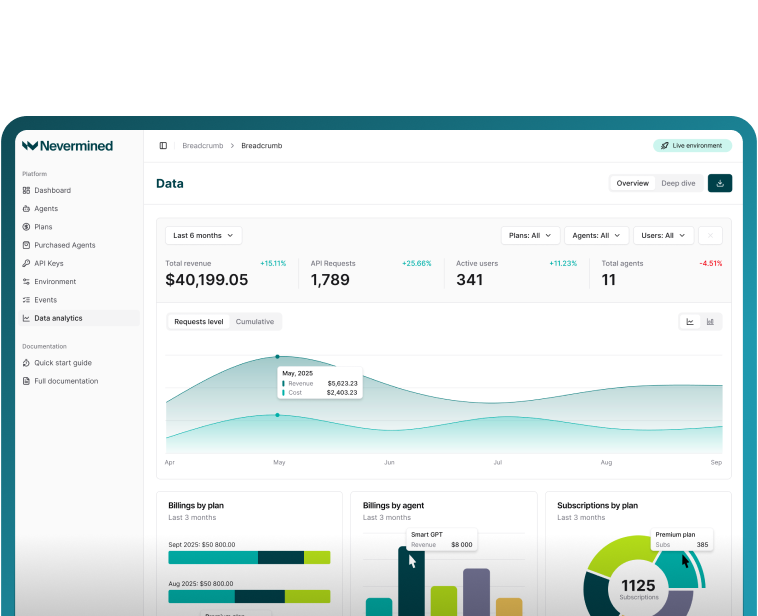
Real-time payments, flexible pricing, and outcome-based monetization—all in one platform.