MENU


Data analysis revealing how flexible pricing infrastructure transforms AI agent monetization and accelerates the agentic economy
The AI agent economy is entering a critical inflection point where pricing model experimentation determines market winners. With the global AI agents market valued at $7.63 billion in 2025 and projected to reach $182.97 billion by 2033, builders who master monetization will capture outsized value. Traditional payment processors cannot handle the micro-transactions that autonomous systems generate, making purpose-built infrastructure like Nevermined Pay essential for the agentic commerce era. Companies experimenting with outcome-based, usage-based, and value-based pricing models today are positioning themselves to dominate tomorrow's AI-native economy.
The AI agents market has established a $7.63 billion foundation in 2025, representing the baseline for explosive growth ahead. This valuation reflects enterprise adoption across customer service, sales automation, and development workflows. The market size creates immediate demand for sophisticated billing and metering infrastructure.
Grand View Research projects the AI agents market will expand to $182.97 billion by 2033, representing a 24x increase from current levels. This trajectory creates extraordinary opportunities for platforms that solve monetization challenges. Builders establishing pricing infrastructure today will benefit from compounding network effects.
The 49.6% CAGR positions AI agents as one of the fastest-growing technology segments globally. This growth velocity demands dynamic pricing systems that can scale with demand. Static pricing models cannot accommodate the rapid market expansion ahead.
Menlo Ventures reports enterprise spending hit $37B in 2025, up 3.2x from $11.5 billion in 2024. This spending acceleration demonstrates enterprise commitment to AI adoption despite implementation challenges. The spending surge creates urgent demand for transparent, auditable billing systems.
North American enterprises captured 39.63% market share in 2025, reflecting early adoption and infrastructure investment. This regional dominance influences pricing model development and payment preferences. Multi-currency and multi-region support becomes essential for global platforms.
Research reveals 39% expect outcome-based pricing will become the standard for AI agent services. This expectation shifts value alignment from consumption to results delivered. Nevermined's flexible pricing engine supports outcome-based models that charge for results like booked meetings or completed tasks rather than raw API calls.
Alongside outcome-based preferences, 36% favor usage-based pricing that tracks tokens, API calls, or compute consumption. Usage-based models provide granular cost attribution essential for enterprise budgeting. The split between outcome and usage preferences indicates hybrid models will dominate.
Federal Reserve research confirms the pricing jobs increased tenfold over fourteen years, reflecting growing complexity in AI monetization. This talent shift indicates enterprises recognize pricing as a strategic function rather than operational afterthought. Sophisticated pricing infrastructure reduces the need for specialized pricing teams.
The Federal Reserve documents AI pricing roles grew from 0.12% to 1.61% of all pricing positions, representing over 13x growth in specialization. This concentration demonstrates the unique challenges AI pricing presents compared to traditional software. Purpose-built platforms address complexity that general billing systems cannot handle.
Stanford HAI reports inference costs fell 280-fold between November 2022 and October 2024 for GPT-3.5 level performance. This dramatic reduction makes micro-transaction pricing economically viable. Platforms can now charge for individual agent actions without transaction fees consuming margins.
Token pricing collapsed to $2.50 per million tokens for GPT-4o within a single year. This 96% cost reduction enables aggressive pricing experimentation. Builders can test outcome-based and value-based models without prohibitive baseline costs.
Infrastructure costs continue falling at 30% annual rates across AI hardware categories. These sustained reductions compound pricing flexibility over time. Lower infrastructure costs enable tighter margins while maintaining profitability.
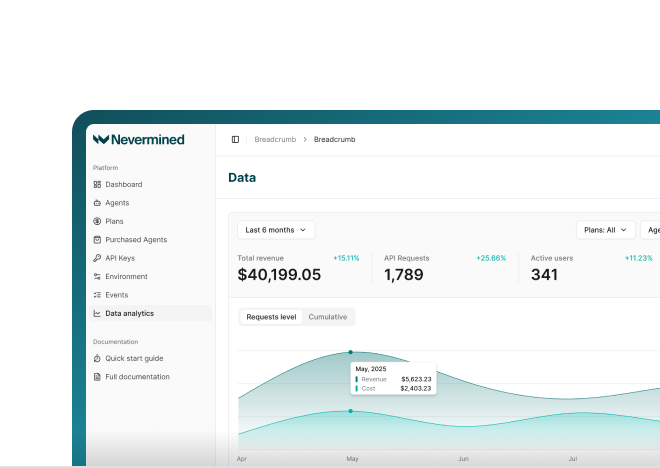
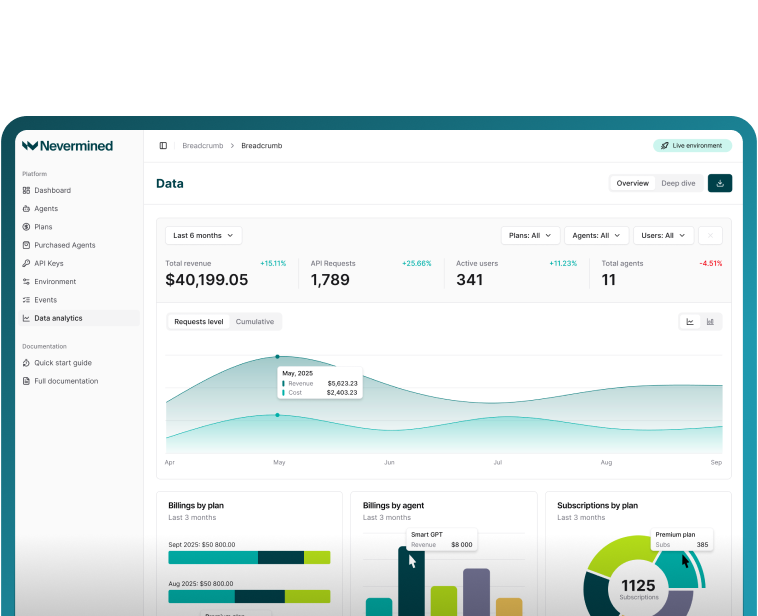
Operational efficiency gains of 40% per year further reduce the cost floor for AI services. These efficiency improvements benefit platforms implementing real-time metering and settlement. Nevermined's observability dashboard tracks these cost dynamics alongside revenue analytics.
The competitive pricing war drove costs from $12-$2 per million tokens between 2022 and 2024. This compression creates margin pressure that demands precise cost tracking. Tamper-proof metering becomes essential when margins narrow.
Stanford HAI found 78% of organizations used AI in 2024, up from 55% in 2023. This rapid adoption creates immediate monetization requirements. The gap between adoption and monetization sophistication represents a significant market opportunity.
Forward-looking data shows 82% plan agent deployment within a three-year window. This planned adoption creates predictable demand for billing infrastructure. Early infrastructure investment positions platforms to capture this wave.
The buy versus build equation shifted dramatically, with 76% of solutions purchased in 2025 compared to 53% in 2024. This preference for purchased solutions extends to payment infrastructure. Nevermined gets you from zero to a working payment integration in 5 minutes, with SDKs for both TypeScript and Python.
AI solutions demonstrate 47% conversion rates compared to 25% for traditional software. Higher conversion rates justify investment in sophisticated pricing models. Value-based and outcome-based pricing capitalize on this conversion premium.
Despite widespread AI adoption, 16% of enterprise deployments and 27% of startup deployments qualify as autonomous agents. This maturity gap indicates early-stage market development. Agent-native pricing infrastructure positions platforms for the maturation ahead.
Optimism runs high, with 62% of companies expecting at least 100% return on AI agent investments. These expectations create pressure for transparent value demonstration. Audit-ready billing systems prove ROI claims with verifiable data.
Boston Consulting Group identifies a performance gap where future-built companies achieve 5x revenue increases and 3x cost reductions compared to laggards. This disparity correlates with infrastructure sophistication. Nevermined's compliance features support the audit-ready traceability that future-built companies require.
Federal Reserve analysis confirms AI pricing share increase of 1 percentage point corresponds to 1.137% additional cumulative sales growth over thirteen years. This compounding effect justifies upfront investment in pricing infrastructure. Early adoption creates sustained competitive advantage.
MIT research via Menlo Ventures reveals 95% of AI initiatives fail to deliver business value. This failure rate often stems from monetization challenges rather than technical limitations. Proper pricing infrastructure transforms technical success into business outcomes.
BCG categorizes 60% as AI laggards reaping minimal AI value despite substantial investment. The gap between investment and return indicates infrastructure deficiencies. Purpose-built billing and metering systems address this execution gap.
BCG reports 17% of AI value comes from agents in 2025, projected to reach 29% by 2028. This value concentration in autonomous systems demands specialized payment infrastructure. Nevermined's agent-to-agent capabilities enable transactions between AI agents without human involvement.
Leading organizations dedicate 15% of AI budgets specifically to agents, signaling strategic priority. This allocation pattern indicates where pricing innovation creates maximum impact. Agent-native billing infrastructure captures this dedicated spending.
McKinsey documents the task completion doubles every seven months since 2019 for tasks AI completes with 50%+ success rate. This capability expansion requires pricing models that scale with complexity. Value-based pricing aligns revenue with increasing agent capabilities.
Currently, single agent systems dominate with 59.24% market share, though multi-agent architectures are growing rapidly. This distribution influences pricing model design. Credits-based systems enable flexible allocation across single and multi-agent deployments.
McKinsey projects U.S. B2C agentic commerce could orchestrate $900 billion-$1 trillion in revenue by 2030. This massive opportunity requires robust transaction infrastructure. Platforms that solve payment coordination capture meaningful transaction volume.
The worldwide agentic commerce opportunity expands to $3-$5 trillion by 2030. This scale demands infrastructure capable of processing millions of micro-transactions. Protocol-first architectures supporting x402, A2A, MCP, and AP2 ensure compatibility as this market develops.
Consumer behavior has shifted, with half of consumers using AI for internet searches. This adoption creates downstream demand for agent-powered commerce. Pricing infrastructure must handle consumer-scale transaction volumes.
OpenAI's ChatGPT serves 800 million weekly users, demonstrating consumer AI adoption scale. This user base represents monetization opportunity for downstream applications. Flexible pricing models capture value across diverse use cases.
Anthropic captured 40% of LLM spending in 2025, up from 12% in 2023. This rapid share gain demonstrates market fluidity. Multi-provider pricing support enables builders to optimize across vendors.
OpenAI's enterprise market position declined from 50% to 27% between 2023 and 2025. This competitive shift affects pricing dynamics across the ecosystem. Platform-agnostic billing infrastructure insulates builders from provider volatility.
Startups now capture 63% of application revenue in 2025, up from 36% in 2024. This startup dominance indicates where pricing innovation occurs. Rapid integration capabilities serve startup velocity requirements.
U.S. private AI investment hit $109.1 billion in 2024, representing 12x China's investment and 24x the UK's. This capital concentration influences infrastructure development priorities. North American payment rails and compliance requirements shape platform design.
BCG classifies only 5% as future-built, with 35% scaling AI and 60% lagging. This distribution creates clear market segmentation for pricing infrastructure. Valory cut deployment time of their payments and billing infrastructure for the Olas AI agent marketplace from 6 weeks to 6 hours using Nevermined, clawing back $1000s in engineering costs.
Successful pricing model experimentation requires infrastructure that supports rapid iteration without technical debt accumulation. Leading AI builders prioritize platforms that offer:
The Nevermined documentation provides comprehensive guides for implementing these capabilities across TypeScript and Python environments.
Usage-based pricing charges per token, API call, or compute unit consumed, providing granular cost attribution but variable expenses. Outcome-based pricing charges for results delivered, such as meetings booked or tasks completed, aligning vendor incentives with customer value. Research shows 39% expect outcome-based models while 36% prefer usage-based approaches, indicating hybrid models will likely dominate as the market matures.
The 95% failure rate stems primarily from gaps between technical implementation and business value capture. Organizations often deploy capable AI systems without proper monetization infrastructure, attribution mechanisms, or ROI measurement frameworks. Purpose-built billing platforms with audit-ready traceability transform technical success into verifiable business outcomes.
Traditional custom implementations require six to eight weeks of development effort for basic billing functionality. Specialized platforms dramatically compress this timeline. Nevermined gets you from zero to a working payment integration in 5 minutes, with SDKs for both TypeScript and Python, enabling teams to focus on core product development rather than payment plumbing.
Tamper-proof metering creates cryptographically signed, immutable usage records that enable zero-trust reconciliation. Every usage credit stamps the exact pricing rule applied, allowing developers, users, auditors, or agents to verify billed amounts match actual consumption. This transparency builds buyer trust essential for outcome-based and value-based pricing models where verification matters.
Multi-agent architectures benefit from credits-based systems that enable flexible allocation across agents, departments, or use cases without contract renegotiation. Prepaid credits align price to value by charging for micro-actions while rewarding successful outcomes. Finance teams receive predictable recurring billing rather than complex sub-cent charge reconciliation across multiple autonomous systems.
See Nevermined
in Action
Real-time payments, flexible pricing, and outcome-based monetization—all in one platform.