MENU


Model Context Protocol (MCP) is an open protocol that standardizes how agents and apps connect to tools, resources, and prompts. MCP standardizes tool access and context exchange, but the core specification does not define a payment or monetization layer (payment support is being developed via a separate proposal). This gap leaves developers giving away valuable AI functionality for free. Nevermined Pay solves this problem by adding authentication, credit verification, and automatic payment deduction to MCP servers, transforming open tools into monetizable products without building a billing layer from scratch.
The Model Context Protocol represents a standardized way for AI agents to interact with external tools, databases, and services. Developed to solve the fragmentation problem where every AI application built custom integrations, MCP provides a unified interface that lets any compatible agent access any compatible tool.
MCP defines three core primitives that AI agents can access:
The protocol handles discovery, authentication flows, and communication patterns. However, MCP deliberately avoids specifying payment mechanisms. This design choice keeps the protocol simple but creates a monetization vacuum that developers must fill themselves.
Nevermined takes a protocol-first approach to MCP monetization, meaning the payment layer integrates natively with existing standards rather than replacing them. This architecture supports:
This protocol-agnostic design prevents vendor lock-in while ensuring compatibility as the agentic economy matures.
Card processing commonly combines a percentage fee plus a fixed per-transaction component, which makes very small payments uneconomic. Traditional payment processors cannot profitably handle the micro-transactions that AI agents generate. Nevermined solves this through a credits-based system designed specifically for AI workloads.
When an AI agent attempts to use a protected MCP tool, Nevermined intercepts the request and:
This flow happens in milliseconds, enabling near-real-time settlement on crypto rails versus batch settlement timelines typical of ACH.
Nevermined supports usage-based, outcome-based, and value-based monetization patterns for agent services:
Learn more about how Nevermined pricing works. The dynamic pricing engine lets developers define exact margin percentages that lock onto usage credits, ensuring profitability regardless of underlying model costs.
Enterprise buyers increasingly require auditability and verifiable usage records for autonomous AI spend. Nevermined addresses this trust gap through immutable record-keeping that makes every transaction auditable.
Every usage record in Nevermined is cryptographically signed and pushed to an append-only log at creation time. This means:
This zero-trust reconciliation model directly addresses enterprise buyers who expect real-time visibility into AI agent billing.
Beyond dispute resolution, tamper-proof metering enables:
Finance teams receive trackable recurring billing instead of struggling to reconcile complex sub-cent charges across thousands of agent interactions.
The agentic economy increasingly involves AI agents hiring other AI agents. A sales agent might pay a research agent for lead enrichment, which pays a data agent for company information. These agent-to-agent transactions must happen autonomously without human approval for each micro-payment.
Nevermined enables autonomous commerce through ERC-4337 smart accounts with session keys and delegated permissions. Users authorize payment policies once, defining spending limits and approved transaction types. Agents then interact freely within those boundaries without requiring wallet pop-ups or manual confirmations.
This approach keeps humans in the loop at the policy level rather than requiring interactive approval for every request.
The smart account architecture provides:
Agents can trigger transactions autonomously while maintaining fine-grained controls that keep humans in the loop at the policy level rather than the transaction level.
Building custom billing infrastructure for AI agents typically requires significant engineering time and specialized expertise in payment processing, metering, and compliance. Nevermined compresses this timeline dramatically.
Nevermined gets you from zero to a working payment integration in 5 minutes, with SDKs for both TypeScript and Python. Nevermined's MCP integration guides show how to stand up an MCP server and add a paywall using the Nevermined SDK, creating:
Detailed implementation guides are available in the official documentation.
The integration process follows three steps:
Nevermined supports a sandbox environment for testing payment flows before production deployment, letting developers validate their monetization approach without financial risk.
Several companies have already deployed Nevermined's MCP-enabled payment infrastructure in production environments, demonstrating concrete business results.
Valory cut deployment time of their payments and billing infrastructure for the Olas AI agent marketplace from 6 weeks to 6 hours using Nevermined, clawing back $1000s in engineering costs. CEO David Minarsch stated: "We knew AI agents need to be able to transact, so over a year ago we tapped into Nevermined. Nevermined was, and continues to be, the best solution for AI payments."
Beyond Valory, multiple companies across the agentic commerce ecosystem rely on Nevermined:
These implementations span AI agent marketplaces, vertical specialist agents, multi-agent systems, and internal enterprise deployments.
Beyond basic billing, Nevermined provides comprehensive infrastructure for secure, compliant agent operations.
The Agent Identity System issues each agent a unique wallet plus decentralized identifier (DID) with cryptographic proof of ownership at registration. This creates:
The Payment Facilitator coordinates authorization, metering, and settlement across fiat, crypto, credits, and smart accounts through a unified x402 payment handshake.
Smart contract settlement on Polygon, Gnosis Chain, and Ethereum provides enterprise-ready infrastructure with:
The agentic economy is expanding rapidly, with AI agents increasingly handling tasks that previously required human intervention. This growth creates both opportunities and infrastructure challenges.
Google has published the Agent2Agent (A2A) protocol for agent interoperability in agentic commerce scenarios, which Nevermined supports natively. The platform is designed for high-throughput metering and settlement, scaling to meet enterprise demands while maintaining sub-second response times.
Multi-chain support ensures flexibility as blockchain ecosystems evolve, with gasless transactions removing friction from agent interactions. The observability dashboard provides visibility into agent performance, user behavior, revenue analytics, and margin opportunities.
As more developers build AI agents that need to transact, standardized payment infrastructure becomes critical. Nevermined's protocol-first architecture positions it to adapt as new standards emerge while maintaining backward compatibility with existing implementations.
The combination of flexible pricing models, tamper-proof metering, and agent-native payments creates a foundation that scales from solo developers experimenting with their first MCP server to enterprise platforms managing millions of daily agent transactions.
Nevermined stands apart as purpose-built infrastructure for the agentic economy rather than traditional payment processing retrofitted for AI. The platform delivers bank-grade enterprise-ready metering, compliance, and settlement so every model call turns into auditable revenue.
Key differentiators include:
For developers building MCP servers, Nevermined transforms the monetization challenge from a multi-week engineering project into an afternoon's work. For enterprises deploying AI agents, it provides the compliance documentation and audit trails that procurement and legal teams require.
Review Nevermined's pricing terms to understand costs. Explore the documentation to start building or contact the team for enterprise discussions.
For fiat transactions, Nevermined supports card and bank-transfer rails through a payment processor integration; for crypto, it supports stablecoin settlement flows. The platform handles authorization, metering, and settlement across fiat, crypto, credits, and smart accounts through a unified payment handshake.
The credit verification happens before tool execution, preventing partial completions. When an agent's credit balance falls below the required amount for a requested action, Nevermined returns an authorization error rather than executing the tool. Developers can configure low-balance notifications and automatic top-up triggers to prevent service interruptions.
Yes, Nevermined wraps existing MCP server functionality rather than replacing it. The simplified API intercepts incoming requests, handles authentication and credit deduction, then passes validated requests to your original tool implementations. Your existing logic remains unchanged while gaining monetization capabilities.
Nevermined supports stateful billing including subscriptions, time-windowed access, and hybrid models. You can configure plans that grant a monthly credit allocation with overage charges, flat subscription fees for unlimited access within defined parameters, or tiered pricing that adjusts rates based on usage volume.
Nevermined supports a sandbox environment for testing against test networks (Polygon Amoy, Gnosis Chiado) where you can simulate complete payment flows without financial risk. The sandbox provides identical functionality to production, letting you validate pricing logic, credit deduction, and client integration before deploying to mainnet.
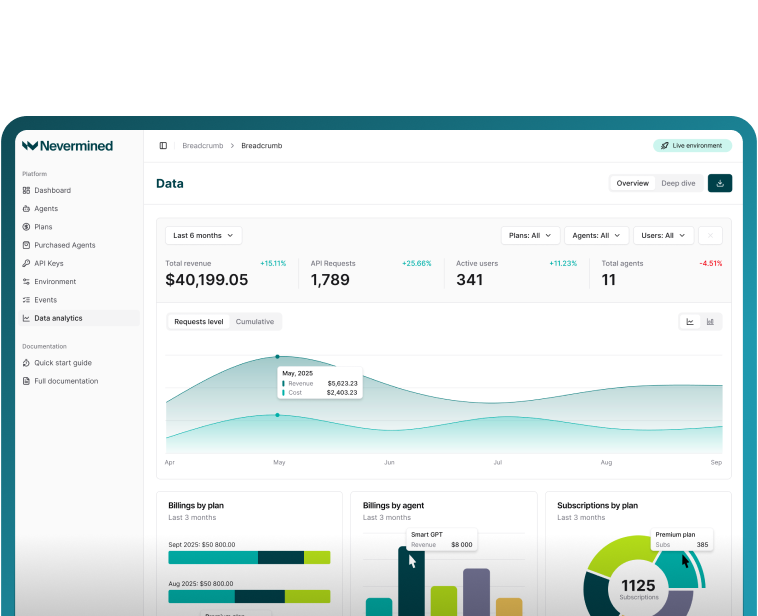
See Nevermined
in Action
Real-time payments, flexible pricing, and outcome-based monetization—all in one platform.