MENU


Your compensation AI agent processes 1,000 queries for Customer A and 100,000 for Customer B, but you charge them both $499 per month. Traditional per-seat SaaS pricing breaks when autonomous AI agents perform variable workloads, leaving HR tech companies either subsidizing heavy users or overcharging light ones. Modern AI billing infrastructure solves this through real-time metering, flexible pricing models, and automated settlement that captures the true value your compensation intelligence platform delivers. With growing adoption of usage-based pricing that matches actual consumption, the shift from flat subscriptions to agentic monetization is no longer optional.
The compensation intelligence market is undergoing a fundamental transformation. Salary.com recently launched its CompAnalyst AI Suite featuring agentic task-automation, signaling that autonomous AI agents are becoming standard in HR tech. These agents perform complex tasks like market pricing analysis, pay equity audits, and compensation benchmarking without human intervention.
This shift creates billing challenges that legacy payment systems cannot address. When an AI agent analyzes compensation data, it might:
Each action consumes resources at different rates. Traditional subscription pricing ignores these variations entirely, forcing vendors to guess at average usage and hope margins hold. The agentic economy demands billing infrastructure that meters every micro-activity and aligns revenue with actual value delivered.
Per-seat licensing made sense when humans performed predictable tasks. AI agents shatter this model because their workload varies dramatically based on:
A compensation intelligence platform charging $500 per month might lose money on enterprise clients running 100,000 queries while overcharging SMBs using 1,000. This pricing mismatch creates churn at both ends.
Usage-based billing tracks actual consumption and charges accordingly. For compensation platforms, this means metering specific value drivers:
Companies switching to usage-based models can see higher revenue per customer because high-usage clients now pay fair value while transparent pricing builds trust and reduces churn.
Usage-based pricing captures consumption, but outcome-based models align revenue with business results. For compensation intelligence platforms, this opens powerful pricing strategies.
Outcome-based pricing charges for results achieved rather than resources consumed:
Value-based pricing takes this further by capturing a percentage of ROI generated. If your AI agent saves an HR team $100,000 annually through optimized compensation strategies, charging 10% of that value ($10,000) often exceeds what usage-based metering would produce.
The most effective approach combines models. Start with cost-covering usage-based baselines, then layer success fees where measurable outcomes exist. For example:
This hybrid structure ensures you never lose money on infrastructure while capturing upside when your platform delivers exceptional results.
Enterprise HR platforms handle sensitive compensation data. Procurement teams demand billing transparency that proves charges match actual usage. Traditional billing systems cannot provide this assurance because usage records can be modified after the fact.
Tamper-proof metering solves this through:
This zero-trust reconciliation approach satisfies enterprise procurement requirements while reducing billing disputes substantially. When every line item traces back to an immutable record, trust becomes automatic.
For compliance-heavy environments, platforms supporting x402 integration enable advanced agent payment capabilities.
Modern billing platforms provide SDKs in Python and TypeScript that simplify implementation. The typical integration process follows these steps:
Step 1: Define Your Value Metric (1-3 days) Identify what customers actually pay for. Compensation queries processed? Employee records analyzed? Recommendations generated? Your metric should correlate with both customer-perceived value and your actual costs.
Step 2: Install SDK and Instrument Metering (3-5 days) Add the billing platform SDK to your compensation intelligence codebase. Emit usage events when agents perform billable actions. Most implementations require 1-2 developer days for basic integration.
Step 3: Configure Pricing Plans (2-4 days) Use the platform dashboard to create pricing tiers. Start simple with 2-3 options, then iterate based on customer feedback. For detailed implementation guidance, consult the official documentation.
Step 4: Set Up Payment Processing (1-2 days) Connect your payment processor, configure tax settings, and set up invoicing templates. This enables automated payment collection without manual intervention.
Step 5: Create Customer-Facing Dashboard (3-5 days) Embed usage visibility widgets so customers see real-time consumption. Transparency reduces support tickets and builds retention.
Compensation intelligence platforms have unique billing requirements. Consider these configurations:
Flex credits operate as prepaid consumption units that solve multiple billing challenges simultaneously. Instead of charging sub-cent amounts for individual API calls, customers purchase credit bundles and redeem them against usage.
Credits provide advantages for both vendors and customers:
For HR Platform Vendors:
For HR Buyers:
Credits can be reallocated across users or agents without renegotiating licenses. Finance teams track recurring credit purchases instead of reconciling complex sub-cent charges.
Billing data reveals more than revenue. Observability dashboards transform usage metrics into strategic insights.
Track these indicators to optimize your compensation intelligence platform:
Modern billing platforms surface hidden costs and missed opportunities automatically. When observability shows 40% of queries use a premium feature but only 10% of customers pay for it, you have clear pricing guidance.
Usage patterns inform product decisions beyond pricing:
This data-driven approach reduces time-to-market for pricing experiments while improving decision quality.
Legacy payment processors require extensive custom development for AI-specific use cases. Building access control, metering, and subscription management from scratch burns weeks of engineering time and creates ongoing maintenance burden.
Traditional systems lack:
Platforms supporting Google's Agent-to-Agent (A2A) protocol and Model Context Protocol (MCP) provide future-proof infrastructure as standards evolve. Valory cut deployment time of their payments and billing infrastructure for the Olas AI agent marketplace from 6 weeks to 6 hours using Nevermined, clawing back $1000s in engineering costs.
Enterprise HR platforms require bank-grade security and compliance capabilities. Compensation data ranks among the most sensitive information companies manage, demanding infrastructure that meets stringent requirements.
Key compliance considerations include:
Cryptographic integrity ensures agent identities cannot be spoofed or duplicated. Unique signatures provide end-to-end authenticity while tamper-proof event logs map to security operations and audit requirements.
While multiple platforms offer usage-based billing, Nevermined provides purpose-built infrastructure specifically designed for AI agent monetization in the agentic economy.
Nevermined Pay delivers bank-grade, enterprise-ready metering, compliance, and settlement so every model call turns into auditable revenue. The platform features:
Nevermined ID provides universal agent identification through cryptographically-signed wallet addresses and decentralized identifiers (DIDs) that persist across networks and marketplaces. This solves the identity challenge when compensation AI agents interact with multiple data sources and services.
For developers building compensation intelligence platforms, Nevermined offers low-code SDKs in TypeScript and Python with comprehensive documentation. The platform also supports x402 integration for advanced agent payment capabilities, enabling sophisticated agent-to-agent transactions as your platform scales.
Whether you are a solo developer monetizing a compensation analysis tool, an AI startup launching vertical HR agents, or an enterprise platform requiring global scale, Nevermined provides the solutions to capture revenue from every AI interaction.
Traditional payment processors handle static subscription charges, while AI billing must meter variable workloads in real-time. A compensation AI agent might process 100 queries one day and 10,000 the next, with each query consuming different resources. AI billing platforms track per-token, per-API-call, and per-record usage automatically, then settle payments based on actual consumption rather than flat monthly fees.
Start by identifying your value metric, whether compensation queries, employee records analyzed, or reports generated. Install an SDK from your billing platform to emit usage events when your agent performs billable actions. Configure pricing tiers in the platform dashboard, connect your payment processor, and build customer-facing usage dashboards. Most implementations can be completed within a few weeks depending on complexity.
Flex credits are prepaid consumption units that customers purchase in bundles and redeem against usage. They solve the problem of billing sub-cent charges by aggregating consumption into trackable credit balances. Finance teams can allocate credits across departments, monitor burn rates in real-time, and avoid surprise overruns while vendors receive predictable cash flow through prepaid purchases.
Nevermined uses tamper-proof metering where every usage record is signed and pushed to an append-only log at creation. The exact pricing rule stamps onto each usage credit, allowing developers, users, auditors, or agents to verify that usage totals match billed amounts per line-item. This zero-trust reconciliation model satisfies enterprise procurement teams requiring audit-ready transparency.
Yes, outcome-based pricing works well when results are measurable. Charge for pay equity issues identified, compliance violations prevented, or documented cost savings achieved. The most effective approach combines usage-based baselines with outcome-based success fees, ensuring you cover costs while capturing upside when your platform delivers exceptional results.
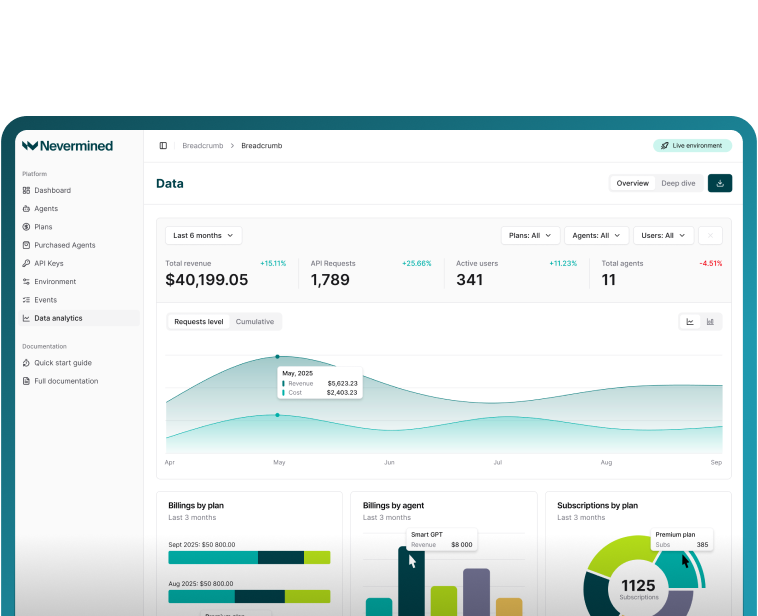
See Nevermined
in Action
Real-time payments, flexible pricing, and outcome-based monetization—all in one platform.